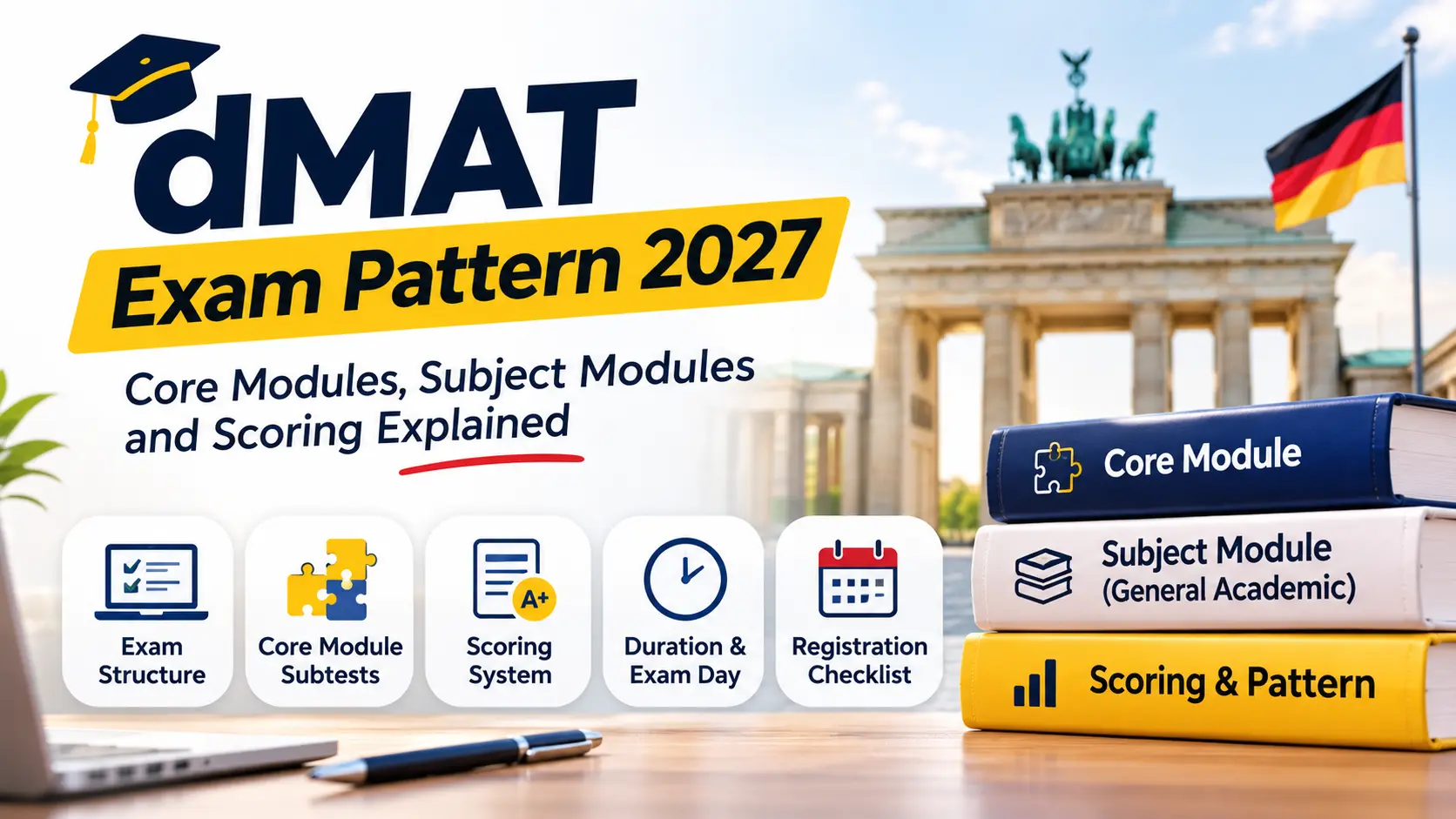
What This Free dMAT Mock Test Covers
The Digital Master Test (dMAT) is an academic aptitude examination for selected Indian students applying for Master's programmes in Germany. It assesses cognitive abilities and the application of analytical skills to academic problems.
For students preparing for the examination, practising different question formats is essential. A dMAT mock test or practice exercise can help you understand how questions are presented and how much time you need to solve them.
The examination consists of two main modules:
Core Module
General Academic Module (the subject module required for the Indian APS process)
What are the four sections covered in dMAT practice?
Section | What you practise | Published exam format |
Figure Sequences | Visual patterns and figure relationships | 20 questions, 25 minutes |
Mathematical Equations | Numerical relationships and equations | 20 questions, 25 minutes |
Latin Squares | Grid-based logical reasoning | 20 questions, 25 minutes |
General Academic Module | Academic reasoning using passages and information | Approximately 60 questions on average |
The General Academic Module question count can vary. The actual examination instructions and timings should always be checked through the official g.a.s.t. portal.
1. Figure Sequences
Figure Sequences tests your ability to identify visual patterns and understand how figures change.
You may see a sequence of shapes or figures that change according to specific rules involving:
Position
Rotation
Colour
Orientation
Repeating patterns
Your task is to identify the underlying rule and select the correct answer.
What to practise: Focus on identifying one change at a time. Once you understand the individual patterns, practise questions where multiple rules operate together.
2. Mathematical Equations
This section assesses numerical reasoning and your ability to solve mathematical relationships.
You may encounter equations where letters represent numbers and you need to determine their values using the given conditions.
What to practise:
Identifying numerical relationships.
Solving equations systematically.
Recognising shortcuts.
Checking whether your answer satisfies all conditions.
The objective is not simply to calculate quickly. You should understand the structure of the problem before attempting to solve it.
3. Latin Squares
Latin Squares questions assess logical reasoning through structured grids.
You need to complete a grid while following specific rules. For example, in a 5×5 Latin Square, each letter from A to E must appear exactly once in every row and column.
What to practise:
Identifying missing elements.
Checking row and column conditions.
Eliminating impossible options.
Applying logical deductions systematically.
This section rewards careful reasoning. Random guessing without checking the grid rules can waste valuable time.
4. General Academic Module
The General Academic Module focuses on applying reasoning skills to academic problems.
Questions may involve information from areas such as:
Mathematics
Natural sciences
Engineering
Business administration
Economics
Social sciences
Humanities
You are expected to understand the information provided and use it to answer questions. Memorising your undergraduate textbooks is not a substitute for practising this type of reasoning.
dMAT
What to practise: Read passages carefully, interpret the information and answer using the assumptions and evidence provided rather than relying on unrelated outside knowledge.
How to Take This dMAT Mock Test Like the Real Exam
A useful dMAT practice session should help you become familiar with the actual examination experience.
Simply solving questions without a time limit may improve your understanding, but it does not prepare you fully for the time pressure of the examination.
Step 1: Understand the examination conditions
Before beginning timed practice, understand the basic examination structure.
Exam condition | Details |
Examination mode | Computer-based |
Language | English |
Question format | Single-choice |
Core Module | Three timed subtests |
Subject Module | General Academic Module for the Indian APS route |
Total duration | Approximately 3.5 hours, including a break |
Calculator and notes | Not allowed |
The official test is conducted at designated test centres. Practising on a computer is therefore useful for becoming familiar with screen-based questions.
StudyArk+1
Step 2: Start with an untimed practice session
If you are attempting dMAT questions for the first time, do not immediately put yourself under strict time pressure.
Begin by understanding the question formats.
Attempt a Figure Sequences question.
Practise a Mathematical Equations problem.
Solve a Latin Squares question.
Try a General Academic Module question.
Read the explanations carefully and understand the logic behind each answer.
Step 3: Introduce time limits
Once you understand the question formats, begin timed practice.
The published Core Module pattern allows approximately 75 seconds per question.
Use this as a practice benchmark:
Section | Questions | Time | Average time per question |
Figure Sequences | 20 | 25 minutes | 75 seconds |
Mathematical Equations | 20 | 25 minutes | 75 seconds |
Latin Squares | 20 | 25 minutes | 75 seconds |
Do not rush through questions just to finish within the time limit. Your first objective should be to maintain accuracy while gradually improving speed.
Step 4: Practise without external help
To make your practice more realistic:
Avoid using a calculator.
Do not search for solutions while attempting a question.
Avoid switching between unrelated browser tabs.
Attempt the question independently.
Review the explanation only after submitting your answer.
These habits help you develop a more disciplined examination approach.
Step 5: Try StudyArk's free dMAT practice questions
You can practise representative dMAT-style questions directly on the StudyArk dMAT preparation page.
The practice section covers:
Latin Squares
Figure Sequences
Mathematical Equations
Subject Module questions
Each practice question includes an explanation to help you understand the reasoning.
Free practice
Try dMAT Sample Questions on StudyArk
Explore the question formats and practise before moving to timed exercises.
Start Practising Now
These are illustrative StudyArk practice questions, not official g.a.s.t. examination questions. Full-length mock tests and timed practice are listed as coming soon on the current page.
How to Review Your dMAT Mock Test Score and Improve Performance
Attempting questions is only one part of preparation. The next step is understanding your performance.
A practice session becomes useful when you can identify which question types are causing problems and why.
1. Review correct and incorrect answers
Do not review only the questions you answered incorrectly.
Even if your answer is correct, you may have reached it through an unnecessarily complicated method.
For every question, ask yourself:
Did I understand the underlying rule?
Did I take too long to reach the answer?
Was my answer based on logic or guesswork?
Could I have solved the question more efficiently?
This helps you improve both accuracy and speed.
2. Identify your weak sections
Maintain a simple performance tracker after every practice session.
Section | Accuracy | Time taken | Improvement needed |
Figure Sequences | Record result | Record time | Pattern recognition |
Mathematical Equations | Record result | Record time | Numerical reasoning |
Latin Squares | Record result | Record time | Grid deduction |
General Academic | Record result | Record time | Passage interpretation |
Do not compare your practice performance with unofficial score targets found online. A few sample questions cannot produce an official dMAT score or percentile.
3. Understand the reason behind every mistake
Most practice mistakes fall into four categories:
Conceptual mistakes: You did not understand the underlying pattern or rule.
Calculation mistakes: You understood the question but made an error while solving it.
Time-management mistakes: You spent too long on one question.
Reading mistakes: You missed an important condition or misunderstood the question.
Identifying the reason helps you decide what to practise next.
4. Maintain an error log
An error log is a simple record of questions that you found difficult.
Date | Section | Mistake | What to improve |
Day 1 | Figure Sequences | Missed rotation pattern | Practise visual changes |
Day 2 | Equations | Incorrect numerical relationship | Review solving steps |
Day 3 | Latin Squares | Missed a column condition | Practise grid deduction |
Day 4 | General Academic | Misinterpreted passage | Improve information analysis |
Review this log every few days. Reattempting difficult question types helps you determine whether you have actually improved.
dMAT mock test strategy for each section
Figure Sequences
Look for changes in position, direction and orientation.
Identify whether one or multiple rules are operating.
Avoid spending too long on one visual pattern.
Mathematical Equations
Start by identifying the simplest relationship.
Use the given conditions systematically.
Check your solution against all the equations.
Latin Squares
Check the missing elements in both rows and columns.
Eliminate options that violate the grid rules.
Use existing letters to narrow down possibilities.
General Academic Module
Read the passage before selecting an answer.
Separate the information provided from your own assumptions.
Pay attention to tables, data and supporting statements.
Select the option that is supported by the given information.
The best strategy is to practise the section where you lose the most time or make the most mistakes, while continuing to revise your stronger sections.
dMAT Mock Test Preparation Plan Before the 2027 Exam
A structured practice plan helps you move from understanding individual questions to becoming comfortable with the complete examination.
The following is a suggested four-week plan. It is not an official g.a.s.t. schedule, and you can adjust it according to your examination date and current preparation level.
Week 1: Understand the question formats
Goal: Become familiar with all four sections.
Day 1: Explore the official dMAT preparation materials.
Day 2: Practise Figure Sequences.
Day 3: Practise Mathematical Equations.
Day 4: Practise Latin Squares.
Day 5: Attempt General Academic Module sample questions.
Day 6: Review explanations and identify weak areas.
Day 7: Revise the difficult question types.
Week 2: Improve accuracy
Goal: Understand the reasoning behind each question.
Practise different question variations.
Focus on accuracy before speed.
Maintain an error log.
Review incorrect answers.
Reattempt questions you previously found difficult.
Week 3: Introduce timed practice
Goal: Improve your speed and consistency.
Practise each Core Module section with a 25-minute timer.
Work on the General Academic Module regularly.
Track your time per question.
Review mistakes after each session.
Practise switching between different question types.
Week 4: Prepare for examination conditions
Goal: Become comfortable with the digital examination format.
Revise the official preparation material.
Attempt longer practice sessions.
Review your weakest sections.
Watch the official digital test demonstration videos.
Check your examination instructions and registration details.
How many mock tests should you take before the dMAT exam?
There is no officially prescribed number of mock tests.
Rather than attempting several practice tests without reviewing them, focus on the quality of each session.
A useful approach is to:
Start with individual sample questions.
Practise each section separately.
Introduce timed section-wise exercises.
Attempt full-length mock tests when suitable tests are available.
Review your mistakes and repeat weak areas.
The goal is not to collect a high number of completed tests. It is to become more accurate, confident and consistent.
Are there official dMAT mock tests and previous-year papers?
It is important to distinguish official preparation materials from third-party mock tests.
g.a.s.t. provides official preparation materials, sample questions and a demonstration version of the digital test through its website and participant portal. The official FAQ confirms that sample questions are intended to illustrate possible topics and question types; their difficulty may differ from the actual examination.
dMAT
StudyArk also provides its own illustrative practice questions for the Core Module and Subject Module. These are designed to help students become familiar with the question styles, but they are not official dMAT questions.
StudyArk
Use both resources for different purposes:
Official g.a.s.t. materials: Understand the official instructions, sample tasks and digital interface.
StudyArk practice questions: Build familiarity with the question formats and review your reasoning.
Official resources:
When should you take your first dMAT mock test?
Do not wait until the final week before attempting practice questions.
Start with a diagnostic session as soon as you understand the basic examination structure.
This helps you identify:
Which section is easiest for you.
Which question types take the most time.
Whether you understand the Core Module rules.
How comfortably you interpret General Academic passages.
You can then plan your preparation around actual weaknesses instead of spending equal time on every section.
Prepare with StudyArk
Understanding the dMAT format is a starting point. Consistent practice and reviewing your mistakes are what help you become more comfortable with the examination.
StudyArk offers dMAT preparation resources, illustrative sample questions and guidance for students preparing for Germany's Master's admission process.