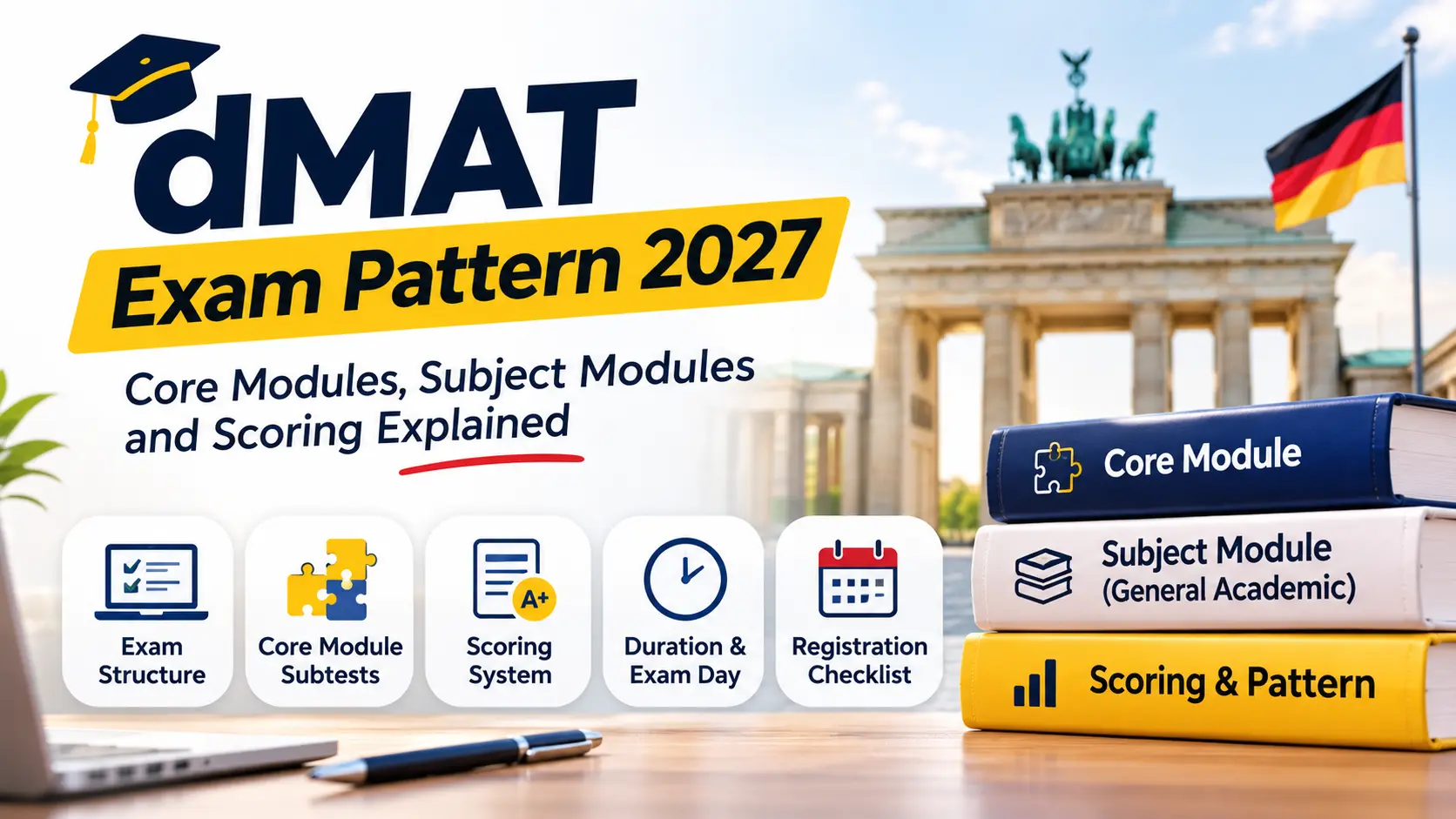
60-Second Summary
- Two main modules: The dMAT consists of a Core Module and a subject module. Indian students taking it for the APS process must take the General Academic Module.
- Three Core Module subtests: The Core Module assesses cognitive and analytical abilities through different question formats, including figure sequences, mathematical equations and Latin squares.
- Scoring system: Each module receives a separate score on a scale of 0–200. The certificate also includes a percentile rank.
- Exam duration: The test takes approximately 3.5 hours, including a break. All questions follow a single-choice answer format.
- dMAT Exam Pattern: Core Modules and Subject Modules
- Core Module
- Subject Module
- dMAT Exam Core Module Subtests: What Each One Actually Tests
- 1. Figure Sequences
- 2. Mathematical Equations
- 3. Latin Squares
- dMAT Exam Scoring System and Marking Scheme: How the Exam Pattern Is Marked
- dMAT score: 0–200 scale
- What is the dMAT percentile rank?
- Is there negative marking in dMAT?
- dMAT vs GRE and GMAT: How the exam formats differ
- dMAT Exam Day: Duration, Timings, Preparation Plan and Registration Checklist
- How long is the dMAT exam?
- What should you bring on dMAT exam day?
- Which dMAT exam preparation plan should you follow?
- dMAT exam registration and documents checklist
- Prepare for dMAT with StudyArk
dMAT Exam Pattern: Core Modules and Subject Modules
The Digital Master Test (dMAT) is a standardised academic aptitude test developed to assess the skills required for postgraduate-level studies. For Indian students applying to selected Master's programmes in Germany, it has been introduced as an additional requirement in the APS documentation and verification process.
The dMAT exam pattern is divided into two main parts:
Core Module
Subject Module
Both modules assess different abilities. While the Core Module focuses on general cognitive and analytical skills, the subject module evaluates how effectively candidates can apply those skills to academic problems.
Core Module
The Core Module evaluates general study aptitude. It focuses on cognitive abilities such as identifying patterns, logical reasoning and solving analytical problems.
It consists of three subtests:
Figure Sequences
Mathematical Equations
Latin Squares
These tasks assess how candidates interpret information, identify relationships and solve problems.
Subject Module
The subject module evaluates the ability to apply analytical and cognitive skills to academic problems.
For Indian students taking dMAT as part of the APS verification process, the required subject module is the General Academic Module.
This module assesses academic problem-solving and application skills rather than simply testing how much information a candidate has memorised.
The dMAT also offers other subject-specific modules for selected university programmes. These include:
Subject module | Application |
General Academic | Required for the Indian APS process |
Chemistry | Specific university programmes |
Physics | Specific university programmes |
Computer Science | Specific university programmes |
Electrical Engineering | Specific university programmes |
Mechanical Engineering | Specific university programmes |
Data Science | Specific university programmes |
The availability and requirements of these modules depend on the participating university and programme. Indian students taking dMAT for APS should not assume they need to select an additional subject-specific module.
dMAT Exam Core Module Subtests: What Each One Actually Tests
The Core Module is designed to assess general cognitive and analytical abilities. Rather than testing knowledge from one particular academic subject, it focuses on how candidates process information and approach unfamiliar problems.
The three subtests use different question formats.
1. Figure Sequences
Figure Sequences questions assess your ability to identify patterns and relationships between visual elements.
You may be presented with a sequence of figures that changes according to a particular rule. Your task is to identify the pattern and select the figure that correctly completes the sequence.
This type of question tests:
Visual reasoning
Pattern recognition
Logical thinking
Ability to identify changes in a sequence
Preparation tip: Practise identifying changes in shape, position, direction, rotation and arrangement. Focus on understanding the rule behind a sequence rather than guessing the next figure.
2. Mathematical Equations
Mathematical Equations questions assess your ability to understand numerical relationships and solve mathematical problems.
The focus is on identifying the relationship between numbers and applying logical steps to reach the correct answer.
You should practise:
Understanding numerical relationships
Identifying mathematical patterns
Solving equations logically
Working accurately under time constraints
Preparation tip: Practise different types of numerical reasoning problems. Build accuracy first and gradually improve your solving speed.
3. Latin Squares
Latin Squares questions test logical reasoning and the ability to identify patterns within structured grids.
Candidates need to understand the arrangement of symbols or elements and determine the correct option according to the underlying rules.
These questions assess:
Logical deduction
Pattern identification
Structured problem-solving
Attention to detail
Preparation tip: Practise grid-based reasoning exercises and focus on understanding how the elements are arranged. Avoid relying on trial and error.
The official dMAT preparation resources provide sample tasks and explanatory videos for these question formats. Practising with the official material is particularly useful because it helps candidates become familiar with how questions appear on screen.
dMAT Exam Scoring System and Marking Scheme: How the Exam Pattern Is Marked
Understanding the dMAT scoring system is just as important as understanding its modules. Candidates receive results for both the Core Module and the subject module.
The official dMAT certificate reports two types of results:
dMAT score
Percentile rank
dMAT score: 0–200 scale
The dMAT score is calculated by converting the number of correct answers into a standardised score between 0 and 200.
The average score is 100.
A separate score is reported for the Core Module and the subject module. The overall result is calculated by adding the two module scores.
Scoring element | Details |
Core Module score | 0–200 |
Subject Module score | 0–200 |
Average score | 100 |
Overall score | Sum of both module scores |
The standardised scoring system allows results to be compared across test modules, question groups, test centres and test dates.
What is the dMAT percentile rank?
The percentile rank indicates how your result compares with those of other test participants.
For example, a percentile rank of 70 means that 70% of participants received a lower or equal result, while 30% achieved a higher result.
This helps universities understand a candidate's relative performance compared with other test takers.
Universities may use dMAT results differently during their selection process. Therefore, students should check the specific admission requirements of their chosen university instead of assuming that one particular score guarantees admission.
Is there negative marking in dMAT?
The official information describes the question format and scoring system, but candidates should consult the latest official instructions for any detailed rules about unanswered questions or incorrect answers.
Do not assume that an unanswered question and an incorrect answer are treated identically without checking the applicable test instructions.
dMAT vs GRE and GMAT: How the exam formats differ
Students preparing for international Master's programmes may already be familiar with examinations such as the GRE and GMAT.
However, dMAT has a different purpose and should not be treated as a replacement for either examination.
Factor | dMAT | GRE | GMAT |
Primary purpose | Academic aptitude assessment for specified programmes and APS requirements | Graduate admissions assessment | Graduate business school admissions |
Main focus | Cognitive and academic problem-solving skills | Verbal reasoning, quantitative reasoning and analytical writing | Quantitative reasoning, verbal reasoning and data insights |
Structure | Core Module and subject module | Verbal, Quantitative and Analytical Writing sections | Quantitative, Verbal and Data Insights sections |
Use | Selected German university programmes and Indian APS process | Graduate programmes across different disciplines | Primarily business and management programmes |
The three examinations serve different purposes. Whether you need to take one or more of them depends on the requirements of your target university and programme.
dMAT Exam Day: Duration, Timings, Preparation Plan and Registration Checklist
Knowing the exam pattern is only one part of preparation. Candidates should also understand the examination duration, digital test format, preparation resources and registration requirements.
How long is the dMAT exam?
The official examination duration is approximately 3.5 hours, including a break between the examination modules.
The examination is conducted digitally at test centres appointed by g.a.s.t. All questions follow a single-choice answer format.
The exact operational instructions, including reporting time and test-day arrangements, should be checked through the official candidate portal before the examination.
What should you bring on dMAT exam day?
Candidates should follow the instructions provided by g.a.s.t. for their selected test centre.
For registration, the official dMAT information specifies a valid passport as the required identification document. Other identification documents are not accepted for this purpose.
Before leaving for the examination, check your confirmation and test-centre instructions for any additional requirements.
Which dMAT exam preparation plan should you follow?
Your preparation should cover both modules rather than focusing only on the Core Module.
A practical preparation approach can be divided into four stages:
Stage 1: Understand the exam format
Learn the structure of the Core Module.
Understand the purpose of the General Academic Module.
Review the official sample questions.
Become familiar with the digital test interface.
Stage 2: Practise Core Module questions
Solve Figure Sequences questions.
Practise Mathematical Equations.
Work on Latin Squares problems.
Identify your weaker question types.
Stage 3: Prepare for the General Academic Module
Practise academic problem-solving questions.
Improve your ability to interpret information.
Work on applying concepts rather than memorising facts.
Practise questions from different academic areas.
Stage 4: Attempt timed practice sessions
Practise questions under time constraints.
Review incorrect answers.
Identify recurring mistakes.
Work on accuracy and consistency.
The official dMAT website provides preparation materials, sample tasks, solutions and demonstration videos. Candidates should use these resources to understand the question formats and the digital examination environment.
dMAT exam registration and documents checklist
Registration and test-centre booking are managed by g.a.s.t. Candidates should complete the registration process through the official portal and carefully check the information before making payment.
Use this checklist before registering:
Confirm whether your undergraduate degree falls under the affected categories for the Indian APS process.
Check the applicable test date and registration availability.
Keep a valid passport ready.
Select your preferred test centre.
Review the registration and payment instructions.
Save your registration confirmation and candidate details.
Check the latest examination instructions before test day.
The official information currently lists the upcoming dmat exam dates 2027
Test session | Examination date |
January 2027 | 16 January 2027 |
March 2027 | 13 March 2027 |
Registration is open through the official g.a.s.t. portal. Check the portal for current availability and registration deadlines.
Official registration: Register for dMAT through g.a.s.t.
Prepare for dMAT with StudyArk
Understanding the dMAT exam pattern is the first step towards preparing effectively. However, students also need a structured preparation approach, regular practice and a clear understanding of the different question types.
StudyArk helps students prepare for the dMAT with focused preparation resources and guidance.
Explore our dMAT preparation course to understand how you can approach your preparation.
Not sure where to start?
Get a free personalised strategy session with a StudyArk mentor.
Book Free ConsultationFrequently Asked Questions
What is the dMAT exam pattern for Indian students?
The dMAT consists of two modules: the Core Module and a subject module. For the Indian APS process, candidates must take the General Academic Module as their subject module. The Core Module contains three subtests that assess general cognitive and analytical abilities.
How many modules are there in the dMAT exam?
The dMAT has two main modules: the Core Module and the subject module. For Indian students taking the examination for APS verification, the subject module is the General Academic Module.
What are the three Core Module subtests in dMAT?
The three Core Module subtests are Figure Sequences, Mathematical Equations and Latin Squares. They assess visual reasoning, numerical relationships and logical problem-solving abilities.
How many questions are there in the dMAT exam?
The General Academic Module contains approximately 60 individual questions. The actual number may be higher or lower. Candidates should refer to the latest official examination information for updates.
What is the total duration of the dMAT examination?
The dMAT examination takes approximately 3.5 hours, including a break between the two modules.
This article was reviewed by StudyArk's expert review panel, comprising experienced professionals and subject-matter experts.
Panel of Reviewers
Manish Sahoo
Masters Student at University of Tokyo · University of Tokyo
Shailendra Nama
Director at Alvarez & Marsal · Oxford