60-Second Summary
- A new requirement for selected students: dMAT is an additional academic aptitude test introduced in 2026 for specific groups of Indian students applying for Master's programmes in Germany.
- Understand the examination structure: The test consists of a Core Module and a General Academic Module, assessing cognitive abilities and the application of academic knowledge.
- Not every student needs to take it: The requirement applies to selected undergraduate degree backgrounds, including Engineering, Commerce, Economics and Business/Management.
- Preparation matters: Understand the examination format, practise the official sample questions and plan your preparation around the upcoming January and March 2027 sessions.
- What Is dMAT Germany and Why Has It Been Introduced?
- What Is dMAT Germany?
- Why Has dMAT Been Introduced?
- 2. Understanding the dMAT Exam Structure
- Core Module: Testing General Cognitive Abilities
- General Academic Module: Applying Academic Knowledge
- dMAT Exam Format and Scoring
- 3. Who Needs to Take the dMAT Germany Exam? Is It Mandatory?
- Which Students Are Required to Take dMAT?
- Who Does Not Need to Take dMAT?
- Does dMAT Replace the APS Certificate?
- 4. Important dMAT Dates to Remember and How to Prepare
- Important dMAT Examination Dates
- How Should Students Prepare for the dMAT Germany Exam?
- How StudyArk Can Help You Prepare for dMAT
What Is dMAT Germany and Why Has It Been Introduced?
If you are planning to pursue a Master's in Germany, there is a new requirement you cannot afford to overlook: the Digital Master Test (dMAT).
Introduced in 2026, dMAT is a standardised academic aptitude test designed for selected Indian students applying for postgraduate programmes in Germany. It has been introduced as an additional component of the Academic Evaluation Centre (APS) documentation and verification process.
The examination is administered by g.a.s.t. (Gesellschaft für Akademische Studienvorbereitung und Testentwicklung), while APS India continues to handle academic document verification.
What Is dMAT Germany?
dMAT stands for Digital Master Test. It is an online examination conducted at authorised test centres to assess whether applicants possess the cognitive, analytical and academic application skills relevant to Master's-level studies.
Unlike examinations that primarily focus on memorising facts, dMAT places emphasis on understanding information, analysing problems, identifying patterns and applying knowledge to unfamiliar situations.
The examination has been introduced for selected groups of Indian students whose undergraduate qualifications fall within the academic disciplines specified by APS India.
It is important to understand that dMAT is an additional requirement in the APS process. It does not replace the APS certificate, university admission requirements or formal recognition of your previous degree.
Why Has dMAT Been Introduced?
The introduction of dMAT adds a standardised academic aptitude assessment to the existing APS documentation process for selected applicants.
The examination aims to assess academic abilities that are relevant to successful Master's-level study, rather than relying exclusively on previous academic records.
For students, this means that academic documents and the additional examination result become separate elements of the relevant APS assessment.
However, dMAT should not be confused with a university-specific entrance examination. It is introduced as part of the APS process for affected applicant groups, rather than being a universal entrance test for every German university.
What students should understand: A dMAT certificate does not guarantee university admission. German universities continue to apply their own academic eligibility, subject prerequisites and admission criteria.
2. Understanding the dMAT Exam Structure
Understanding the examination structure is one of the most important steps before beginning preparation.
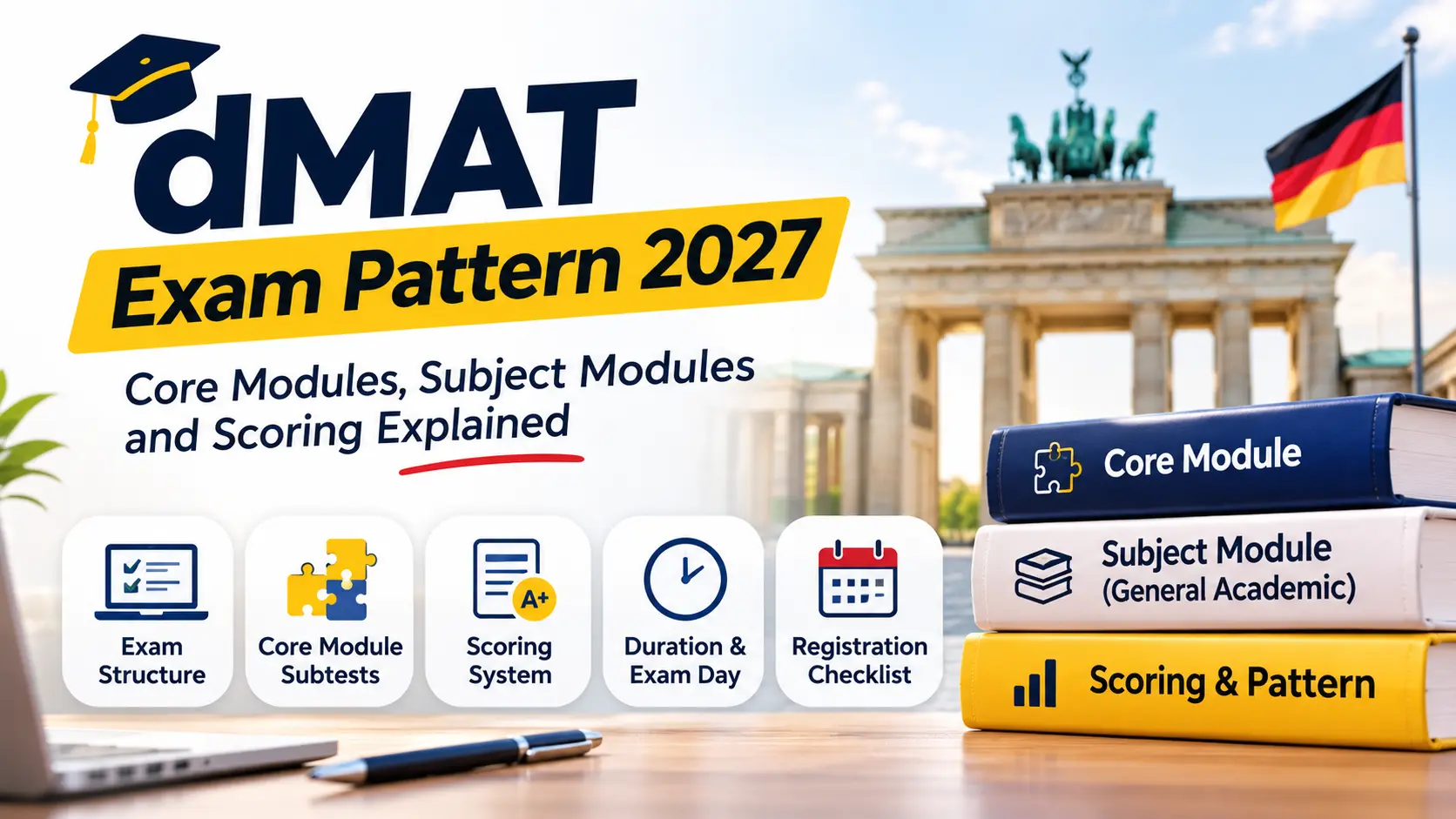
For the APS process in India, dMAT consists of two compulsory modules for applicants who fall under the requirement:
Core Module
General Academic Module
The examination is conducted digitally at authorised examination centres and takes approximately three and a half hours, including a break between the modules.
Core Module: Testing General Cognitive Abilities
The Core Module evaluates general cognitive and analytical abilities that are relevant to higher education.
It consists of three subtests designed to assess different aspects of academic aptitude.
These tasks focus on skills such as:
Recognising patterns and relationships.
Understanding numerical and logical information.
Analysing problems systematically.
Identifying relationships between different pieces of information.
Applying logical reasoning to unfamiliar situations.
The objective is to understand how effectively a candidate processes information and approaches different types of problems.
Candidates should become familiar with the question formats rather than relying only on memorisation or repetitive practice.
General Academic Module: Applying Academic Knowledge
The General Academic Module assesses how candidates apply cognitive and analytical skills to general academic problems.
It contains approximately 60 individual questions, although the actual number may vary.
Questions are presented around typical problem situations followed by related questions. Candidates are expected to interpret the information, understand the underlying problem and select the most appropriate answer.
The examination may involve topics drawn from areas such as:
Mathematics.
Computer Science.
Natural Sciences.
Engineering.
Business Administration.
Economics.
Social Sciences and Humanities.
The emphasis is on applying knowledge and transferring understanding to new situations rather than simply recalling memorised facts.
For the current Indian APS procedure, the General Academic Module is the required subject module.
dMAT Exam Format and Scoring
Here is a quick overview of the examination format.
Examination Component | Details |
Examination mode | Digital, at authorised test centres |
Core Module | Three subtests |
Subject Module | General Academic Module |
Question format | Single-choice questions |
General Academic Module | Approximately 60 questions |
Examination language | English |
Total duration | Approximately 3.5 hours, including a break |
Maximum score | 200 overall |
Certificate issued by | g.a.s.t. |
The dMAT certificate reports separate scores for the Core Module and the subject module, along with an overall result.
The overall dMAT score is calculated on a scale from 0 to 200, with a mean score of 100. The certificate also includes a percentile rank, indicating how the candidate performed relative to other test participants.
Candidates should understand that the score is an academic aptitude result. It should not be interpreted as an automatic university admission decision or an APS approval guarantee.
For detailed information about the examination format, candidates can refer to the official dMAT examination structure.
3. Who Needs to Take the dMAT Germany Exam? Is It Mandatory?
One of the biggest questions among Indian students planning to study in Germany is whether dMAT is compulsory.
The answer depends on your previous undergraduate qualification and the type of programme you intend to pursue.
According to the updated APS India guidelines published on 29 October 2026, the dMAT requirement applies to selected Indian applicants planning to pursue Master's programmes in Germany.
Which Students Are Required to Take dMAT?
The current requirement covers Indian Master's applicants whose undergraduate degrees belong to the following academic disciplines:
1. Engineering and Technology
All B.Tech and B.Eng degrees are included, regardless of the specific engineering specialisation.
2. Commerce and Economics
Undergraduate degrees in the following areas are covered:
Commerce.
Accounting.
Finance.
Economics.
3. Business and Management
Undergraduate degrees in:
Business Administration.
Management Studies.
For applicants in these categories, dMAT is a required component of the APS documentation process for Master's applications relating to Summer Semester 2027 onwards, subject to the applicable transitional exemptions.
Who Does Not Need to Take dMAT?
Not every Indian student applying to Germany is required to take the examination.
Under the current APS India procedure, the following categories are not required to take dMAT:
Students applying for Bachelor's programmes in Germany.
PhD applicants.
Applicants whose undergraduate qualifications do not fall within the affected academic disciplines.
Applicants participating in officially confirmed exchange, double-degree or university partnership programmes that qualify for exemption.
Certain transitional exemptions also apply.
For example, applicants who completed their APS procedure and already received their APS certificate do not need to take dMAT retrospectively for that completed procedure.
Applicants who completed APS online registration or shipped their APS documents before 29 June 2026 may also fall under the transitional exemption rules.
Because eligibility depends on the exact application circumstances, students should verify their individual situation through the official APS India dMAT guidelines.
Does dMAT Replace the APS Certificate?
No. This is an important distinction.
The dMAT certificate is an additional document that becomes part of the APS documentation for affected applicants.
APS India continues to verify the authenticity and formal plausibility of academic documents. The dMAT result is checked separately and reflected in the APS certificate.
Applicants may submit their other required APS documents before receiving their dMAT certificate, where the applicable procedure permits it. However, APS India can issue the final APS certificate only after receiving and checking the required dMAT result.
Additionally, dMAT does not replace anabin recognition or UGC recognition requirements.
Even if a student achieves a strong dMAT result, their previous institution and qualification must still satisfy the applicable recognition requirements.
4. Important dMAT Dates to Remember and How to Prepare
Since dMAT was introduced in 2026, students should understand both the first examination cycle and the upcoming examination opportunities.
The first dMAT examination for Indian applicants took place on 26 September 2026. Results were published on 12 October 2026.
For students preparing for the next examination sessions, the January and March 2027 dates have now been confirmed.
Important dMAT Examination Dates
Important Events | Dates |
First dMAT registration opened | 29 June 2026 |
First examination date | 26 September 2026 |
First examination results | 12 October 2026 |
January 2027 examination | 16 January 2027 |
January registration deadline | 4 January 2027 |
March 2027 examination | 13 March 2027 |
March registration deadline | 1 March 2027 |
Registration for the January and March 2027 examination sessions is open through the official g.a.s.t. portal.
For complete registration instructions and direct booking links, read our guide to dMAT exam dates 2027
Candidates should check the official registration portal for the latest seat availability, deadlines and examination instructions.
How Should Students Prepare for the dMAT Germany Exam?
Preparing for dMAT requires more than memorising academic concepts. Students should focus on understanding the question formats, improving their analytical approach and practising how to apply information to unfamiliar problems.
Here are some practical preparation recommendations.
1. Understand Both Examination Modules
Begin by understanding the Core Module and General Academic Module separately.
Identify the different question types and the abilities each module evaluates. This will help you organise your preparation rather than approaching the entire examination as one general aptitude test.
2. Practise Official Sample Questions
Use the preparation resources provided on the official dMAT website.
The available sample questions, solutions and demonstration materials can help you understand how questions appear on screen and how to approach them.
Do not depend entirely on unofficial question banks or preparation material that may not match the actual examination format.
3. Improve Analytical and Logical Reasoning
The examination assesses your ability to recognise patterns, interpret information and solve problems.
Practise reasoning questions regularly. Focus on understanding why an answer is correct instead of memorising the answer itself.
4. Strengthen Academic Application Skills
For the General Academic Module, practise interpreting academic problems and applying relevant knowledge.
You may encounter situations involving mathematics, business, economics, sciences or other academic areas. The focus should be on understanding the information provided and applying it logically.
5. Practise Under Timed Conditions
Time management is important in any examination.
Once you become familiar with the question types, practise completing questions within a structured time limit. This can help you improve accuracy and avoid spending too much time on individual problems.
6. Get Familiar with the Digital Examination Interface
Since dMAT is conducted digitally, understanding the examination interface is also important.
Use the official demonstration materials to familiarise yourself with navigation, question presentation and answer selection before examination day.
How StudyArk Can Help You Prepare for dMAT
Understanding the dMAT requirement is the first step. Preparing systematically for the examination is equally important.
StudyArk offers dedicated dMAT preparation support for students planning to pursue Master's programmes in Germany.
Through structured preparation, practice resources and guidance, students can work towards understanding the examination format and developing the analytical skills needed for the test.
Explore our dMAT Preparation Course to learn more about the available preparation support and plan your preparation for the upcoming examination sessions.
Not sure where to start?
Get a free personalised strategy session with a StudyArk mentor.
Book Free ConsultationFrequently Asked Questions
What is the dMAT exam in Germany?
dMAT stands for Digital Master Test. It is a standardised academic aptitude examination introduced in 2026 as an additional component of the APS documentation process for selected Indian students applying for Master's programmes in Germany.
Is dMAT mandatory for all Indian students?
No. The examination is mandatory for selected Indian Master's applicants whose undergraduate qualifications fall within the affected fields specified by APS India. Bachelor's applicants and PhD applicants are among the groups not required to take it.
Is dMAT conducted online or offline?
The dMAT is a digital examination conducted at authorised test centres. Candidates must register online and select an available examination centre.
This article was reviewed by StudyArk's expert review panel, comprising experienced professionals and subject-matter experts.
Panel of Reviewers
Manish Sahoo
Masters Student at University of Tokyo · University of Tokyo
Shailendra Nama
Director at Alvarez & Marsal · Oxford