Understanding What TARA Preparation Requires
TARA preparation is different from preparing for a traditional subject-based entrance examination. It does not test how much information you can memorise from a particular academic subject. Instead, it assesses how effectively you can analyse information, solve unfamiliar problems and communicate your ideas.
For students applying to selected undergraduate courses at universities such as Oxford and UCL, these skills can form an important part of the admissions assessment.
Why TARA Requires a Different Preparation Approach
Many school examinations reward students for remembering concepts, applying familiar formulas and following established methods. TARA places greater emphasis on how candidates think when they encounter unfamiliar information.
For example, in Critical Thinking, you may be given an argument and asked to identify an assumption that supports its conclusion. In Problem Solving, you may need to select relevant information and work through a situation without being told which method to use.
The Writing Task introduces another requirement: presenting a clear and reasoned argument within a limited time.
Therefore, effective TARA preparation should focus on three abilities:
Analytical thinking: Understanding arguments, assumptions and conclusions.
Problem-solving ability: Identifying relevant information and applying logical methods.
Written communication: Organising ideas and explaining a position clearly.
Simply completing hundreds of general aptitude questions may not be enough. Your practice should reflect the official TARA question types and examination format.
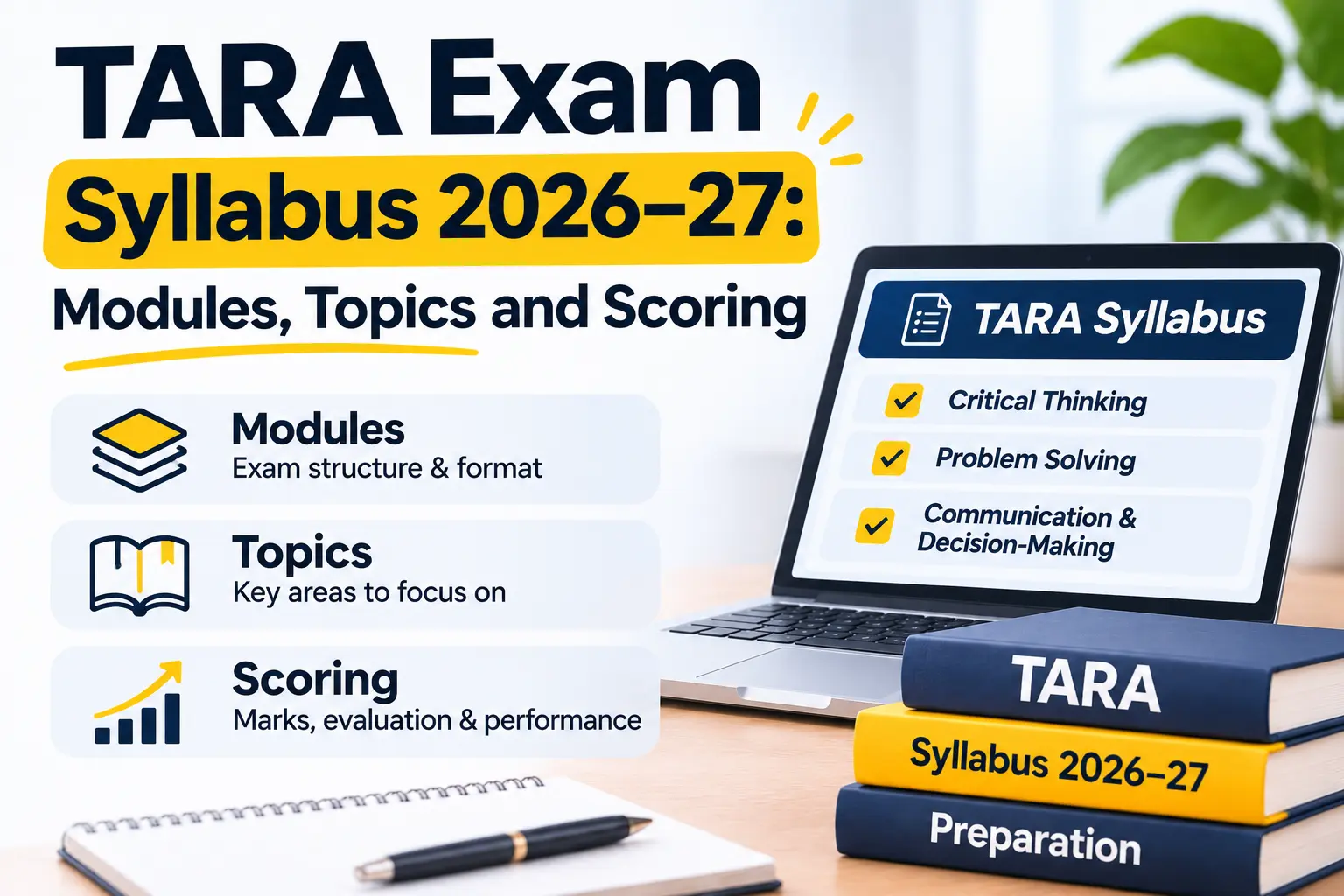
Understand full TARA exam syllabus for 2026-27.
Understanding the Three Modules Before Starting
Before creating a study timetable, understand what each module assesses.
Module | What it assesses | Preparation priority |
Critical Thinking | Analysing arguments and evaluating evidence | Argument analysis and logical reasoning |
Problem Solving | Solving unfamiliar problems using information and basic mathematics | Accuracy, information selection and structured problem-solving |
Writing Task | Developing and communicating a reasoned argument | Essay planning, clarity and logical structure |
For the complete module-wise syllabus and official question categories, refer to our guide to the TARA exam syllabus.
Identifying Your Current Preparation Level
Do not begin your preparation by assuming that every module requires the same amount of work.
Your first task should be to understand your current strengths and weaknesses.
Attempt a small set of official specimen questions from each module. This will help you identify which question types are comfortable and which require additional practice.
Use a simple assessment table:
Module | What to check | Preparation decision |
Critical Thinking | Can you identify conclusions and assumptions? | Revise argument analysis if needed |
Problem Solving | Can you select relevant information and solve unfamiliar problems? | Practise structured problem-solving |
Writing Task | Can you develop a clear argument within 40 minutes? | Improve essay planning and structure |
You can also record your initial performance in a preparation tracker.
For example, if you understand Critical Thinking questions but struggle to finish them within the time limit, your priority should be speed and question selection rather than revising every concept again.
The purpose of this initial assessment is to create a preparation plan based on actual needs.
How to Prepare for TARA Critical Thinking and Problem Solving
The two multiple-choice modules require different approaches. Critical Thinking focuses on understanding arguments, while Problem Solving involves working through unfamiliar situations using relevant information and logical steps.
Practise them separately before combining them into full timed sessions.
How to Prepare for TARA Critical Thinking
The Critical Thinking module contains seven official question types. Understanding these categories will help you recognise what each question requires.
For the complete descriptions of all seven categories, examples and syllabus coverage, see our TARA exam syllabus guide.
Identify the Main Conclusion
These questions test your ability to identify the central claim an argument is trying to establish.
A passage may contain several statements, examples and supporting reasons. Your task is to distinguish the main conclusion from the evidence used to support it.
To improve:
Read the complete argument before selecting an answer.
Identify what the author is ultimately trying to establish.
Separate supporting statements from the central claim.
Look for conclusion indicators such as "therefore", "thus" or "consequently", while remembering that conclusions may also appear without these words.
Check whether the selected statement summarises the overall argument rather than just one part of it.
Practice tip: After reading an argument, summarise the author's main point in one sentence. Then compare it with the answer options.
Practise Drawing Conclusions
These questions provide information and ask you to identify a conclusion supported by the available evidence.
To improve:
Read the complete passage before selecting an answer.
Identify the facts provided.
Separate what is explicitly stated from what can reasonably be inferred.
Avoid choosing an answer that introduces unsupported information.
Compare the answer choices carefully.
A useful exercise is to read a short argument and write down one conclusion that follows from the information. Then check whether your conclusion requires an assumption that the passage does not support.
Learn to Identify Assumptions
An assumption is an unstated condition on which an argument depends.
To practise this question type, focus on the relationship between the reasons and the conclusion.
Ask yourself:
What must be true for this argument to work?
Is the conclusion dependent on an unstated condition?
Would the argument still work if that condition were false?
Do not confuse an assumption with a supporting example. An example may make an argument more convincing, but an assumption is something the reasoning depends on.
Evaluate Additional Evidence
These questions ask how new information affects an existing argument.
The additional evidence may strengthen the conclusion, weaken it or have little effect.
For example, an argument may claim that introducing a new teaching method improves examination performance. Evidence that students using the method performed better may support the argument. However, information showing that those students already had stronger academic results before the method was introduced could weaken the conclusion.
Practise identifying the connection between the new information and the original claim.
Identify Errors in Reasoning
Some arguments contain logical weaknesses even when their conclusions sound convincing.
Common problems include:
Assuming that two events happening together means one caused the other.
Generalising from a small number of examples.
Ignoring alternative explanations.
Making a conclusion that goes beyond the evidence.
When reviewing an argument, identify the exact step where the reasoning becomes unreliable.
Practise Matching Arguments
Matching Arguments questions require you to identify another argument with a similar logical structure.
The subject of the two arguments may be different, but their reasoning pattern should be comparable.
Practise identifying:
The premises.
The conclusion.
The relationship between the premises and conclusion.
Any conditions used to reach the final claim.
Focus on the structure of the argument rather than the topic being discussed.
Understand How to Apply Principles
These questions provide a general principle and ask you to apply it to a specific situation.
Read the principle carefully and identify every condition it contains. Then check whether the example satisfies all those conditions.
Do not select an answer simply because it appears similar to the principle. It must follow the rule correctly.
How to Prepare for TARA Problem Solving
The Problem Solving module contains three official question types. Preparation should focus on selecting information, understanding procedures and recognising relationships.
Practise Relevant Selection Questions
Relevant Selection questions assess whether you can identify the information needed to solve a problem.
You may be given a passage, numerical information or several conditions. Not every detail will necessarily be useful.
To improve:
Read the question before working through every detail.
Identify what information is required.
Separate relevant information from distractions.
Check whether the answer satisfies all the conditions.
This approach can help reduce unnecessary calculations.
Practise Finding Procedures
Finding Procedures questions assess your ability to understand and follow a sequence of steps to reach a solution.
You may be given a set of instructions, conditions or rules and asked to determine the correct procedure or outcome.
To improve:
Read all the instructions before starting.
Identify the starting information and the required outcome.
Follow each condition in the correct order.
Check how one step affects the next.
Verify that the final result satisfies all the given requirements.
Practice tip: Work through procedural questions step by step instead of trying to calculate the final answer immediately. This helps prevent errors when several conditions are involved.
Work on Identifying Similarities
Identifying Similarity questions test your ability to recognise relationships between different sets of information or representations.
Practise comparing:
Numerical patterns.
Shapes and diagrams.
Relationships between quantities.
Similar structures presented in different formats.
Instead of looking only at surface-level similarities, identify the underlying relationship.
Improve Numerical Reasoning
The Problem Solving module may involve basic mathematical calculations and numerical relationships.
Revise skills such as:
Fractions and decimals.
Percentages.
Ratios and proportions.
Averages.
Basic arithmetic.
Measurements and units.
Reading numerical tables and graphs.
The objective is to use these skills accurately while solving unfamiliar problems.
Develop Logical Reasoning Skills
Logical reasoning helps you organise information and determine which steps are necessary to reach a conclusion.
Practise:
Breaking a problem into smaller steps.
Identifying conditions and restrictions.
Checking whether a conclusion follows from the information.
Comparing possible solutions.
Recognising patterns and relationships.
Do not immediately start calculating when you encounter a problem. First understand what it is asking.
Practise Data Interpretation
Some problems require you to interpret information presented in tables, charts, diagrams or numerical descriptions.
Develop the habit of checking:
What each value represents.
Whether the figures use the same units.
What comparisons are required.
Whether the question asks for an exact value, difference, ratio or percentage.
A common source of mistakes is selecting the correct information but interpreting it incorrectly.
Improve Accuracy Under Time Pressure
Both multiple-choice modules contain 22 questions and have a 40-minute time limit.
This gives an average of approximately 1 minute and 49 seconds per question. However, this is a planning reference, not an official question-by-question time allocation.
Some questions may take less time, while unfamiliar problems may require more.
Practise the following approach:
Read the question carefully.
Identify the information required.
Attempt a suitable method.
Check whether the answer satisfies the conditions.
Avoid spending too long on a single difficult question.
There is no negative marking for incorrect answers, so attempt every question within the available time.
How to Prepare for the TARA Writing Task and Build a Four-Week Study Plan
The Writing Task requires a different preparation method from the multiple-choice modules. You must understand a statement, select one prompt and develop a structured argument within 40 minutes.
A successful preparation routine should combine writing practice with regular Critical Thinking and Problem Solving sessions.
How to Prepare for the TARA Writing Task
Understand the Three-Prompt Format
The Writing Task presents three essay-style prompts. You must select and answer only one.
Read all three options before making your selection.
Choose the prompt that allows you to develop a clear position and support it with relevant reasoning.
Do not choose a topic simply because you have heard about it before. The important question is whether you can address the specific statement and develop a convincing argument.
Learn to Build a Clear Argument
A strong essay should have a clear central position.
Before writing, ask yourself:
What exactly is the question asking?
What position do I want to defend?
What are my strongest supporting arguments?
What might someone argue against my position?
How can I reach a logical conclusion?
Your response should address the statement rather than move into unrelated background information.
Structure Your Essay Effectively
A practical essay structure can help you organise your ideas within the time limit.
Essay section | Purpose |
Introduction | Explain the issue and establish your position |
Main argument | Present your strongest reasoning |
Supporting explanation | Develop the argument with relevant examples |
Alternative perspective | Consider a different viewpoint |
Conclusion | Bring the reasoning together and answer the prompt |
You do not need to follow this structure mechanically. The important thing is to communicate your reasoning in a clear and logical order.
Practise Writing Within the 750-Word Limit
The Writing Task has a maximum word limit of 750 words and lasts 40 minutes.
Practise writing complete responses under the same conditions.
A possible time allocation is:
5 minutes: Read and select a prompt.
5 minutes: Plan the argument.
25 minutes: Write the response.
5 minutes: Review and improve clarity.
This is a suggested practice structure, not an official UAT-UK timing rule.
You do not need to reach 750 words. Focus on answering the question with relevant points and avoiding unnecessary repetition.
Improve Clarity and Logical Flow
A good essay is not necessarily the one with the most complicated vocabulary.
Focus on:
Writing direct sentences.
Explaining one main idea per paragraph.
Connecting arguments logically.
Supporting claims with relevant examples.
Avoiding repetition.
Making your final position clear.
After writing an essay, review whether a reader can understand your argument without needing additional explanation.
A Four-Week TARA Preparation Plan
A four-week preparation plan can help you organise your revision and practice. It is a suggested schedule for candidates who already have a basic understanding of the skills assessed.
If you are starting with little familiarity, allow more time.
Week | Main focus | Suggested activities |
Week 1 | Understand the exam and build fundamentals | Read the specification, explore question types and attempt diagnostic questions |
Week 2 | Critical Thinking and Problem Solving | Practise each question category and review mistakes |
Week 3 | Writing and timed practice | Write essays, practise timed multiple-choice modules and analyse performance |
Week 4 | Mock tests, revision and final preparation | Complete full practice sessions, review weaknesses and refine time management |
Week 1 – Understand the Exam and Build Fundamentals
The first week should focus on understanding what TARA assesses.
Suggested activities:
Read the official TARA specification.
Understand all three modules.
Review the official Question Guide.
Attempt a small number of specimen questions.
Write one initial essay under timed conditions.
Identify your strongest and weakest areas.
Do not rush into completing multiple full practice tests. First understand the format and question styles.
Week 2 – Practise Critical Thinking and Problem Solving
Dedicate the second week to the two multiple-choice modules.
For Critical Thinking, practise identifying the main conclusion, drawing conclusions, recognising assumptions, evaluating additional evidence, detecting reasoning errors, matching arguments and applying principles.
For Problem Solving, practise Relevant Selection, Finding Procedures and Identifying Similarity.
Suggested activities:
Complete short practice sessions for individual question types.
Work on unfamiliar questions.
Practise basic numerical calculations without a calculator.
Review incorrect answers.
Record recurring mistakes.
Repeat questions after understanding the correct reasoning.
Week 3 – Focus on Writing and Timed Practice
The third week should combine Writing Task practice with timed multiple-choice sessions.
Suggested activities:
Write essays using different prompts.
Practise planning an argument quickly.
Complete one 40-minute Writing Task session.
Attempt 22 Critical Thinking questions within 40 minutes.
Attempt 22 Problem Solving questions within 40 minutes.
Review accuracy and time management.
Pay particular attention to whether your essays answer the actual question and whether your multiple-choice approach is efficient.
Week 4 – Mock Tests, Revision and Final Preparation
Use the final week to consolidate your preparation.
Suggested activities:
Complete official practice tests.
Practise the three modules in the correct order.
Review your error log.
Revisit difficult question types.
Complete another timed Writing Task.
Familiarise yourself with the Pearson test player.
Review test-day instructions.
Avoid introducing too many new resources during the final days. Focus on strengthening the skills you have already practised.
How to Create a Daily TARA Study Schedule
A daily schedule should give attention to all three modules without making preparation unnecessarily complicated.
Here is an example of a three-hour daily routine:
Activity | Suggested time |
Critical Thinking practice | 45 minutes |
Problem Solving practice | 45 minutes |
Writing Task or essay development | 40 minutes |
Reviewing mistakes and solutions | 30 minutes |
Concept revision and planning | 20 minutes |
Total | 180 minutes |
You can adjust this schedule according to your school timetable, starting level and available preparation time.
Allocate Time Across All Three Modules
Do not spend every study session on the module you enjoy most.
If Critical Thinking is your strongest area, you may be tempted to practise it more frequently. However, neglecting Problem Solving or the Writing Task can create an imbalance.
Give each module consistent attention and increase practice time where you identify weaknesses.
Balance Conceptual Learning and Practice
Reading explanations is useful, but it should not replace solving questions.
A productive preparation session can include:
Understanding one question type.
Attempting practice questions.
Checking the explanations.
Identifying why an answer was incorrect.
Applying the learning to another question.
This helps you move from understanding a concept to using it independently.
Review Mistakes and Track Progress
Maintain a simple preparation tracker.
Day | Module | Questions attempted | Main difficulty | Improvement action |
Day 1 | Critical Thinking | 10 | Identifying assumptions | Review argument structure |
Day 2 | Problem Solving | 10 | Selecting relevant information | Practise information filtering |
Day 3 | Writing Task | 1 essay | Weak paragraph structure | Improve essay planning |
The entries above are illustrative. Use your actual practice performance to update the tracker.
TARA Success Story: Ananya's Preparation Journey
With structured preparation and focused practice at Study Ark, Ananya achieved:
- Critical Thinking: 8.0 / 9.0
- Problem Solving: 8.5 / 9.0
Through regular practice and targeted feedback, she strengthened her approach to TARA and achieved a strong performance.
TARA Preparation Resources, Common Mistakes and Frequently Asked Questions
Having a study plan is useful, but the quality of your preparation also depends on the resources you choose and how you use them.
Start with official UAT-UK materials before adding supplementary practice resources.
TARA Preparation Resources and Practice Materials
Official TARA Preparation Materials
UAT-UK provides preparation materials free of charge. Its official resources include:
TARA Content Specification.
TARA Question Guide.
Critical Thinking specimen test.
Problem Solving specimen test.
Writing Task specimen material.
Pearson practice tests.
Additional test guidance.
These resources should form the foundation of your preparation because they explain the official format and question styles.
You can access them through the official UAT-UK preparation page.
Sample Questions and Practice Papers
Official specimen questions help you understand how questions are presented and what type of reasoning is expected.
The Question Guide is especially useful because it explains the different question categories and provides examples.
Use sample questions in the following order:
Read the explanation of a question type.
Attempt a sample question independently.
Compare your answer with the official explanation.
Identify the reasoning step you missed.
Attempt another question of the same type.
Do not memorise the correct options. Understand why the answer is correct and why the other options are not.
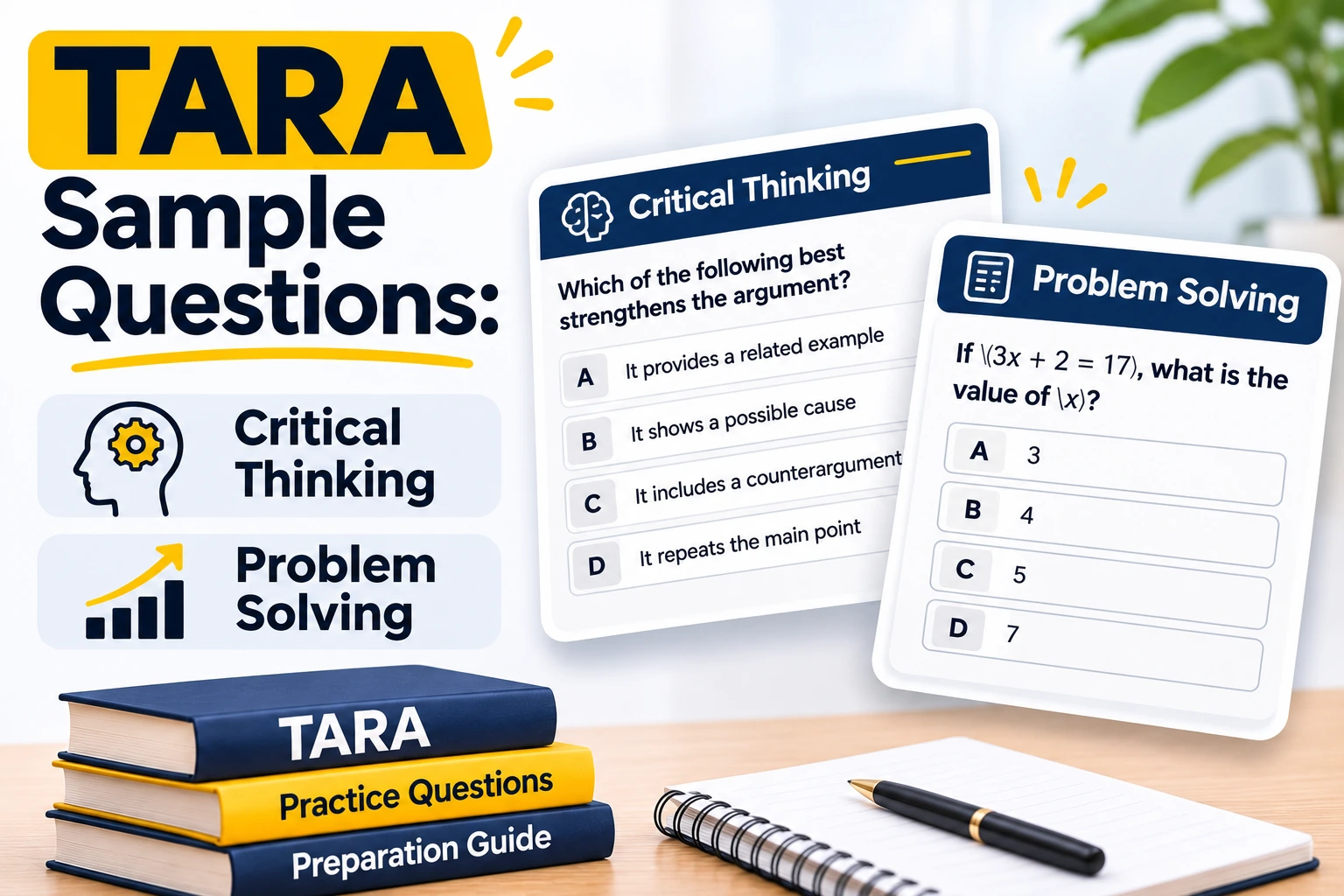
For worked examples and explanations, read our guide to TARA sample questions.
How to Use Mock Tests Effectively
Mock tests should be used to assess preparation and identify weaknesses.
A useful routine is:
Before the mock test: Review the module format and prepare your test environment.
During the mock test: Follow the time limits and use the same test interface where possible.
After the mock test: Review incorrect answers, identify slow question types and record improvement areas.
UAT-UK's specimen and sample tests provide feedback on correct and incorrect responses, but they do not generate an official scaled score. Performance in a practice test should not be treated as a guaranteed prediction of the live result.
UAT-UK recommends using its practice tests under timed conditions and becoming familiar with the Pearson test player.
Common TARA Preparation Mistakes to Avoid
Preparing Without a Structured Plan
Switching between random practice questions and unrelated resources can make preparation inefficient.
Use the official specification and create a timetable that covers all three modules.
Ignoring One or More Modules
Students sometimes focus heavily on multiple-choice questions and leave the Writing Task until the end.
All three modules are compulsory. Give each one consistent preparation time.
Not Practising Under Time Limits
Solving questions without a timer may help you understand the reasoning, but it does not prepare you fully for the 40-minute module limits.
Introduce timed sessions once you understand the question types.
Memorising Answers Instead of Understanding Reasoning
Remembering a correct answer does not guarantee that you can solve a different question using the same reasoning.
Always review the explanation and understand the method behind the answer.
Neglecting Essay Practice
Reading essay-writing tips is not a substitute for writing complete responses.
Practise selecting a prompt, planning your argument and completing an essay within 40 minutes.
Prepare for TARA with Study Ark
A clear preparation strategy can help you understand the different question types, identify weaknesses and organise your practice across all three modules.
Study Ark supports students preparing for UK university admissions tests through structured preparation guidance and learning resources.
Need a structured approach to TARA preparation?
Explore our practise question types, review explanations and identify areas that need further improvement.