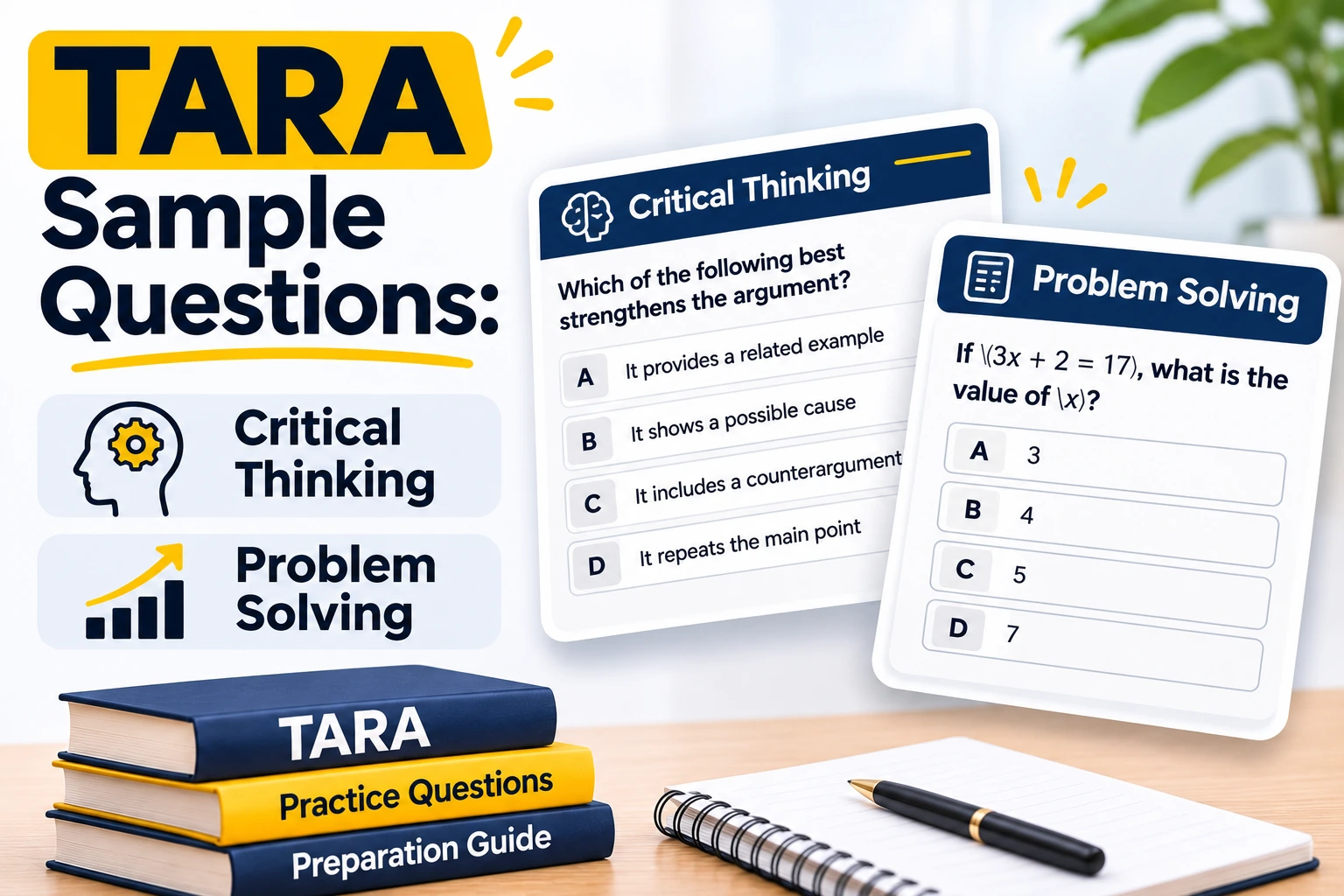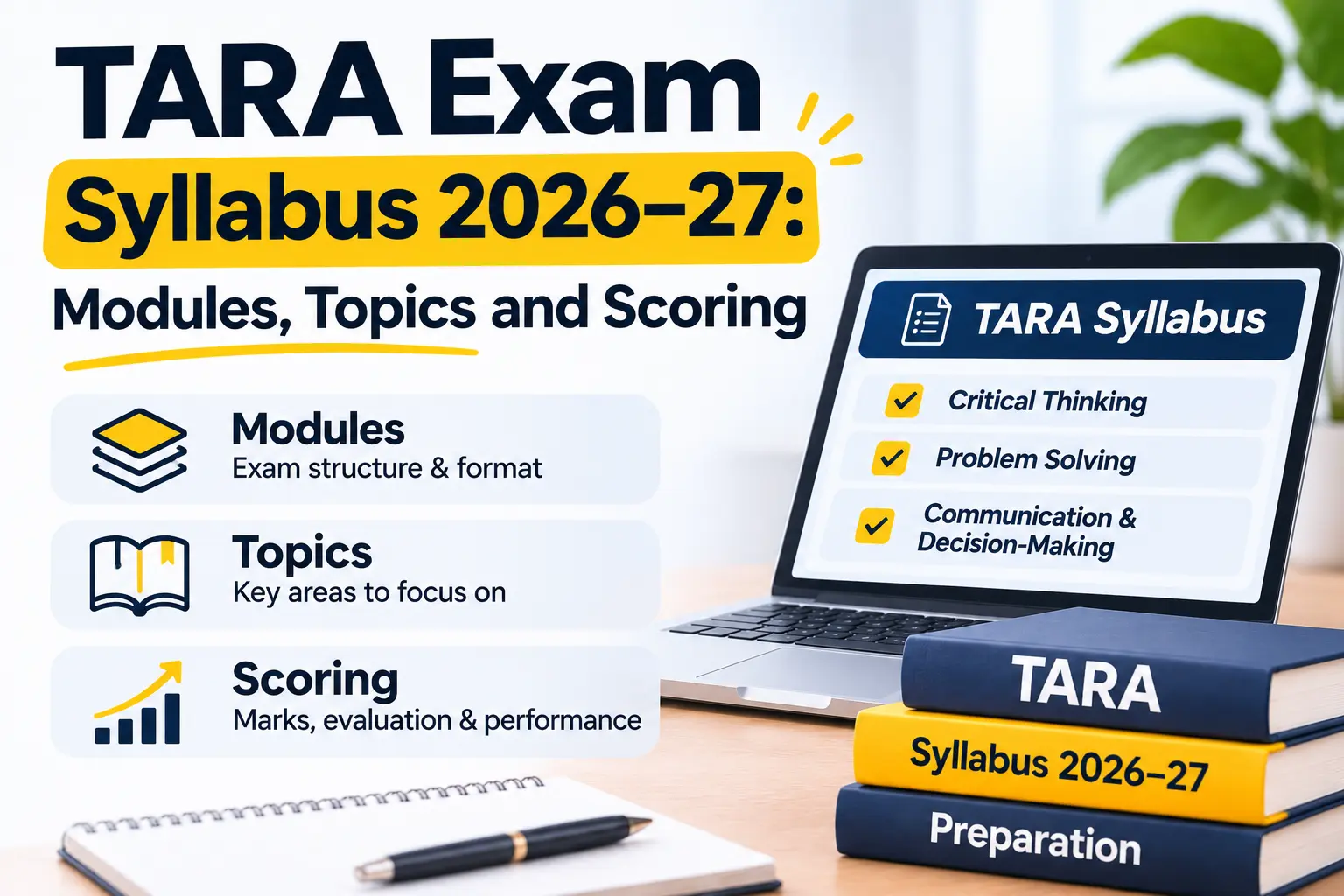
Understanding the TARA Exam Structure and Format
Before studying individual question types, it is important to understand the TARA exam guide for Indian Students . TARA is designed to assess general academic reasoning rather than knowledge of a particular school subject.
The examination has three compulsory modules, and candidates must complete all of them. Each module has a separate time limit, so unused time from one module cannot be transferred to another.
How Many Sections Are There in TARA?
There are three modules in the TARA examination:
Module | Assessment type | Number of questions or tasks |
Critical Thinking | Multiple-choice | 22 |
Problem Solving | Multiple-choice | 22 |
Writing Task | Essay-style response | 1 out of 3 prompts |
The first two modules assess reasoning through multiple-choice questions. The third module evaluates how effectively candidates develop and communicate an argument in writing.
Total Exam Duration and Number of Questions
The complete TARA examination takes 120 minutes.
Module | Duration | Format |
Critical Thinking | 40 minutes | 22 multiple-choice questions |
Problem Solving | 40 minutes | 22 multiple-choice questions |
Writing Task | 40 minutes | One essay from three choices |
Total | 120 minutes | Three compulsory modules |
There are 44 multiple-choice questions in total, followed by one written response.
Each module has its own 40-minute time limit. If you finish a module early, the remaining time does not carry over to the next one.
Is TARA a Computer-Based Test?
Yes. TARA is delivered as a computer-based test at authorised Pearson VUE test centres.
Candidates complete the multiple-choice modules and Writing Task using the computer-based examination interface.
Some important points about the format include:
All three modules are completed online at the test centre.
Each module has a separate timer.
Candidates cannot return to a previous module after moving forward.
Calculators and dictionaries are not permitted.
Candidates are provided with an erasable booklet for working during the test.
Because the examination is computer-based, candidates should become familiar with the test interface and practise managing their time without relying on a physical answer sheet.
TARA Exam Syllabus: Critical Thinking and Problem Solving
The first two TARA modules assess how candidates process information and reach conclusions. Although both involve reasoning, they test different abilities.
Critical Thinking focuses on evaluating arguments presented in written language. Problem Solving focuses on using information and basic mathematical skills to solve unfamiliar problems.
TARA Critical Thinking Syllabus
The Critical Thinking module contains 22 multiple-choice questions, which candidates must complete in 40 minutes.
According to the official UAT-UK Question Guide, there are seven types of Critical Thinking questions. These are based on the skills required to understand and evaluate arguments.
1. Identifying the Main Conclusion
This question type tests whether you can identify the central claim an argument is trying to establish.
An argument may contain several supporting statements, examples and intermediate conclusions. Your task is to identify the main point supported by the overall reasoning.
For example, a passage might explain that a particular policy has increased operating costs, reduced efficiency and created administrative difficulties. The main conclusion may be that the policy should be reconsidered.
The challenge is distinguishing the central conclusion from the supporting reasons.
What to practise:
Identifying the main claim in a passage.
Separating evidence from conclusions.
Recognising intermediate conclusions.
Understanding how different statements support an argument.
2. Drawing a Conclusion
These questions provide information and ask you to identify which conclusion logically follows from it.
Unlike identifying the main conclusion, the answer is not necessarily stated in the passage. You must infer what can reasonably be established using the information provided.
For example, if a passage explains that a particular product is unavailable in several stores and that demand has increased, you may be able to conclude that supply is currently insufficient in those locations.
What to practise:
Drawing conclusions from the information given.
Avoiding assumptions that are not supported by the passage.
Distinguishing a possible explanation from a conclusion that must follow.
Selecting the option that is most strongly supported by the evidence.
3. Identifying an Assumption
An assumption is an unstated idea that an argument depends on.
Questions in this category assess whether you can identify what must be accepted for an argument or conclusion to work.
For example, an argument may claim that introducing a new teaching method will improve examination results because students will receive more individual attention. This reasoning assumes that individual attention will help students perform better.
What to practise:
Identifying ideas that an argument takes for granted.
Distinguishing assumptions from supporting evidence.
Understanding the connection between premises and conclusions.
Testing whether an argument would weaken if an assumption were false.
4. Assessing the Impact of Additional Evidence
These questions examine how new information affects an existing argument.
You may be given an argument followed by an additional piece of evidence. Your task is to decide whether that evidence strengthens, weakens or has little effect on the original reasoning.
For example, a passage may argue that a new transport service will reduce traffic congestion. Additional evidence showing that most commuters still prefer private vehicles could weaken the argument.
What to practise:
Understanding the original argument before evaluating new evidence.
Identifying whether additional information supports or challenges a conclusion.
Separating relevant evidence from unrelated information.
Assessing the actual impact of new information rather than its wording.
5. Detecting Reasoning Errors
This question type tests your ability to recognise flaws in an argument.
An argument may appear convincing but contain a logical error. The task is to identify the weakness in the reasoning.
For example, assuming that one event caused another simply because it happened earlier is a possible reasoning error.
What to practise:
Identifying unsupported generalisations.
Recognising assumptions presented as facts.
Understanding the difference between correlation and causation.
Detecting conclusions that go beyond the available evidence.
6. Matching Arguments
Matching Arguments questions assess whether you can identify arguments that follow a similar logical structure.
The topics in two arguments may be completely different, but their underlying reasoning may be similar.
For example, two arguments might use the same pattern of reasoning even though one discusses education and the other discusses public transport.
What to practise:
Identifying the structure of an argument.
Separating the reasoning from the subject matter.
Recognising similar relationships between premises and conclusions.
Comparing how different arguments reach their conclusions.
7. Applying Principles
These questions require you to apply a general rule or principle to a particular situation.
You may be given a principle and several examples. Your task is to identify which situation follows the stated principle.
For example, if a rule states that a person should receive a refund when a service is not delivered as promised, you may need to determine which situation meets that condition.
What to practise:
Understanding the exact conditions of a principle.
Applying rules consistently to new situations.
Avoiding personal opinions that are not part of the stated principle.
Checking whether all required conditions are satisfied.
TARA Problem Solving Syllabus
The Problem Solving module contains 22 multiple-choice questions and lasts 40 minutes.
It assesses how candidates select relevant information, follow procedures and identify relationships while solving unfamiliar problems.
The official Problem Solving syllabus contains three question categories.
1. Relevant Selection
Relevant Selection questions test whether you can identify the information needed to solve a problem.
A question may contain several facts, conditions, figures or restrictions. Not all of them will necessarily be useful.
You need to determine which information is relevant and use it to reach the correct answer.
What to practise:
Identifying useful information in a question.
Ignoring details that do not affect the solution.
Working with conditions and restrictions.
Comparing quantities and selecting appropriate information.
2. Finding Procedures
Finding Procedures questions assess whether you can identify and follow a suitable sequence of steps to solve a problem.
You may need to work through a set of instructions, apply conditions in a particular order or determine which procedure produces the required result.
What to practise:
Following instructions accurately.
Applying steps in the correct sequence.
Understanding how one step affects the next.
Checking whether a procedure satisfies all the given conditions.
3. Identifying Similarity
Identifying Similarity questions test your ability to recognise patterns and relationships between different pieces of information.
You may need to compare numbers, arrangements, objects or situations and identify the relationship they share.
What to practise:
Recognising patterns and relationships.
Comparing different sets of information.
Identifying common properties.
Applying an observed relationship to another situation.
What Mathematical Knowledge Is Required for Problem Solving?
TARA does not require advanced subject-specific mathematical knowledge. However, the official specification expects candidates to be comfortable with basic numerical and mathematical skills.
These include:
Mathematical area | Skills to understand |
Number | Fractions, decimals, percentages and place value |
Arithmetic | Addition, subtraction, multiplication and division |
Everyday calculations | Money, measurements, time and calendar calculations |
Ratio | Understanding proportional relationships |
Averages | Calculating and interpreting the mean |
Geometry | Basic area, perimeter and volume |
Data interpretation | Reading tables, charts and graphs |
These skills are used to solve problems rather than test advanced mathematical theory.
The distinction is important: the Problem Solving module is not a substitute for a school mathematics examination. Its focus is on applying basic numerical skills to unfamiliar situations.
TARA Writing Task Syllabus, Exam Pattern and Scoring System
The Writing Task is the third compulsory module of TARA. While the first two modules evaluate reasoning through multiple-choice questions, this section assesses how effectively you can develop and communicate an argument.
Understanding the Writing Task Format
The Writing Task contains three essay-style prompts. Candidates must select and answer only one.
The prompts typically present a statement or proposition and ask candidates to consider different aspects of the issue.
You may be asked to:
Explain what a statement means.
Develop a reasoned argument against the statement.
Discuss the extent to which you agree with the statement.
The task is designed to evaluate how well you understand an issue, organise your thoughts and communicate your reasoning.
Choosing One Prompt from Three Options
Candidates receive three writing prompts but must answer only one.
Before choosing, read all three options carefully and consider:
Which topic do you understand most clearly?
Which question can you address with a logical argument?
Can you identify relevant supporting examples?
Can you consider an alternative viewpoint?
Choose the prompt that allows you to develop the strongest response within the available time.
Do not select a question simply because its topic appears familiar. You should also consider whether you can address the specific instruction in the prompt.
Essay Structure and Argument Development
A well-organised response is easier to follow and demonstrates clear communication.
A useful structure is:
1. Introduction
Introduce the issue and establish the position you intend to discuss.
2. Main argument
Present your central reasoning and explain why you support your position.
3. Supporting explanation
Develop your argument using relevant examples, evidence or logical reasoning.
4. Alternative viewpoint
Where appropriate, consider an opposing argument and explain why it does or does not change your position.
5. Conclusion
Summarise your reasoning and answer the original question directly.
The aim is not to use complicated vocabulary or write as much as possible. A focused argument with clear reasoning is more effective than a long response containing unrelated points.
The 750-Word Limit
The Writing Task has a maximum word limit of 750 words.
Candidates have 40 minutes to read the prompts, plan their response, write the essay and review it.
The word limit encourages students to select and organise their ideas carefully.
A practical approach is to:
Spend a few minutes understanding the prompt.
Plan the main argument before writing.
Use separate paragraphs for different points.
Avoid repeating the same idea.
Leave time to check clarity and grammar.
Do not treat 750 words as a target that must be reached. The important requirement is to answer the question effectively within the permitted limit.
Is the TARA Writing Task Scored?
The Writing Task is not given a separate numerical scaled score by UAT-UK.
Instead, the response is sent to the universities where the candidate has applied for a course requiring TARA. Universities can then use the response as part of their own admissions assessment.
The response gives admissions teams an opportunity to consider how candidates:
Understand and interpret a proposition.
Develop a coherent argument.
Present relevant supporting points.
Consider alternative perspectives.
Communicate ideas clearly and accurately.
There is no separate UAT-UK scaled score for the Writing Task, and it should not be combined with the Critical Thinking or Problem Solving scores.
TARA Exam Pattern and Time Allocation
The complete TARA examination takes 120 minutes.
Module | Questions | Time | Assessment |
Critical Thinking | 22 | 40 minutes | Scored |
Problem Solving | 22 | 40 minutes | Scored |
Writing Task | 1 of 3 prompts | 40 minutes | Shared with universities, not numerically scored by UAT-UK |
Total | 44 MCQs + 1 essay | 120 minutes | Three compulsory modules |
Each module is separately timed. Candidates should manage their time within each section rather than expect unused time to carry forward.
TARA Scoring System Explained
TARA does not produce one combined score across all three modules.
Instead, candidates receive separate scores for Critical Thinking and Problem Solving.
Module | Scoring method |
Critical Thinking | Scaled score from 1.0 to 9.0 |
Problem Solving | Scaled score from 1.0 to 9.0 |
Writing Task | Not numerically scored by UAT-UK |
The two multiple-choice scores are reported to one decimal place.
How Critical Thinking and Problem Solving Are Scored
Each question in the Critical Thinking and Problem Solving modules carries one mark.
The final results are based on the number of correct answers, with no marks deducted for incorrect answers.
However, the reported result is a scaled score rather than a simple percentage or raw mark out of 22.
UAT-UK uses a scoring process designed to account for differences in the difficulty of different test versions.
Understanding the 1.0–9.0 Score Scale
Both scored modules use a scale from 1.0 to 9.0.
1.0 represents the lower end of the scale.
9.0 represents the upper end of the scale.
Results are reported to one decimal place.
There is no single overall TARA score. A candidate can receive different results in Critical Thinking and Problem Solving.
For example, a candidate might receive 6.2 in Critical Thinking and 5.7 in Problem Solving. These are two separate module results, not a combined score of 5.95.
Is There Negative Marking?
No. Incorrect answers do not result in marks being deducted in either multiple-choice module.
This means candidates should generally attempt every question rather than leave questions unanswered simply because they are uncertain.
However, time management remains important. Spending too long on one difficult question can affect your ability to complete the rest of the module.
Is There a Pass or Fail Score?
No. TARA does not have a universal pass or fail score.
Universities use the test results as part of their admissions process and may consider them alongside academic qualifications, personal statements, interviews and other application requirements.
A score that is competitive for one course may not have the same significance for another. Applicants should check the admissions guidance of their chosen universities rather than assume that one score guarantees an offer.
Important TARA Rules and Instructions
Understanding the syllabus is only one part of getting ready for TARA. Candidates should also know the examination rules and test-day instructions.
Are Calculators Allowed?
No. Calculators are not permitted during any TARA module.
Candidates should practise basic numerical calculations without depending on a calculator.
Can Students Use a Dictionary?
No. Dictionaries are not permitted during the examination.
Candidates should be comfortable reading and interpreting written information without external reference materials.
What Happens If a Student Leaves a Question Unanswered?
There is no negative marking in the Critical Thinking and Problem Solving modules.
An unanswered question does not receive a mark, while an incorrect answer does not reduce the marks already earned.
Candidates should therefore try to attempt all multiple-choice questions within the available time.
Important Test-Day Instructions
Keep the following points in mind:
Arrive at the Pearson VUE test centre on time.
Carry an acceptable photographic identification document.
Follow the test-centre instructions.
Do not bring prohibited materials into the examination.
Remember that calculators and dictionaries are not allowed.
Manage each module within its individual time limit.
Complete all three compulsory modules.
Candidates should read the official UAT-UK test-day guidance before attending the examination.
TARA Success Story: Ananya's Preparation Journey
With structured preparation and focused practice at Study Ark, Ananya achieved:
- Critical Thinking: 8.0 / 9.0
- Problem Solving: 8.5 / 9.0
Through regular practice and targeted feedback, she strengthened her approach to TARA and achieved a strong performance.
How to Understand the TARA Syllabus Before Preparing
Reading the syllabus once is not enough. You should use it to identify the areas that require attention and create a practical preparation routine.
Identify Your Strong and Weak Modules
Start by understanding the difference between the three modules.
For example:
If you struggle to identify assumptions or conclusions, focus on Critical Thinking.
If you find unfamiliar numerical problems difficult, focus on Problem Solving.
If your essays lack structure or clear arguments, spend more time practising the Writing Task.
Attempting an initial set of official practice questions can help you understand where you need improvement.
Understand the Different Question Types
Do not prepare for TARA by practising random reasoning questions alone.
Become familiar with the official question categories:
Critical Thinking: Identifying the Main Conclusion, Drawing a Conclusion, Identifying an Assumption, Assessing the Impact of Additional Evidence, Detecting Reasoning Errors, Matching Arguments and Applying Principles.
Problem Solving: Relevant Selection, Finding Procedures and Identifying Similarity.
Understanding these categories helps you recognise what a question is asking and select an appropriate approach.
Practise Under Timed Conditions
Each module has a 40-minute time limit. Practising without a timer may not prepare you adequately for the actual examination.
Try to:
Complete 22 Critical Thinking questions in 40 minutes.
Complete 22 Problem Solving questions in 40 minutes.
Write one structured essay within 40 minutes.
Review incorrect answers after each practice session.
Identify question types that consistently take longer.
Use our mock tests and preparation materials to become familiar with the examination format.