What Is the TARA Exam and Why Does It Matter for Indian Students?
The Test of Academic Reasoning for Admissions (TARA) is an admissions assessment used by selected UK universities to evaluate applicants' reasoning and academic thinking skills.
Unlike a conventional subject-based examination, TARA focuses on how candidates analyse arguments, interpret information, solve unfamiliar problems and communicate their ideas.
For Indian students applying to undergraduate programmes in the UK, understanding whether a chosen course requires TARA is an important part of admissions planning.
What Does TARA Stand For?
TARA stands for the Test of Academic Reasoning for Admissions. It is administered through UAT-UK and delivered as a computer-based examination at authorised Pearson VUE test centres.
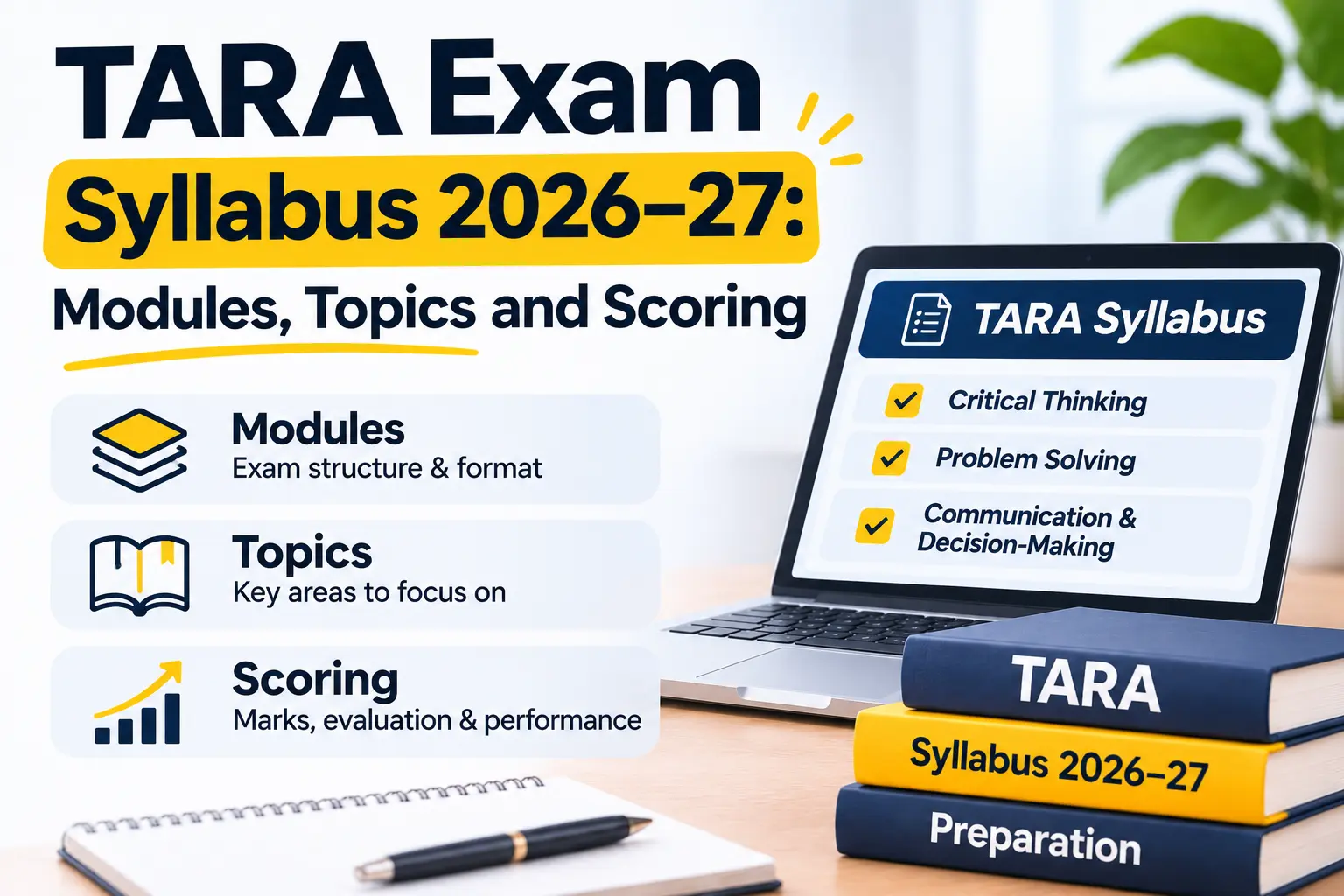
The assessment has three compulsory modules:
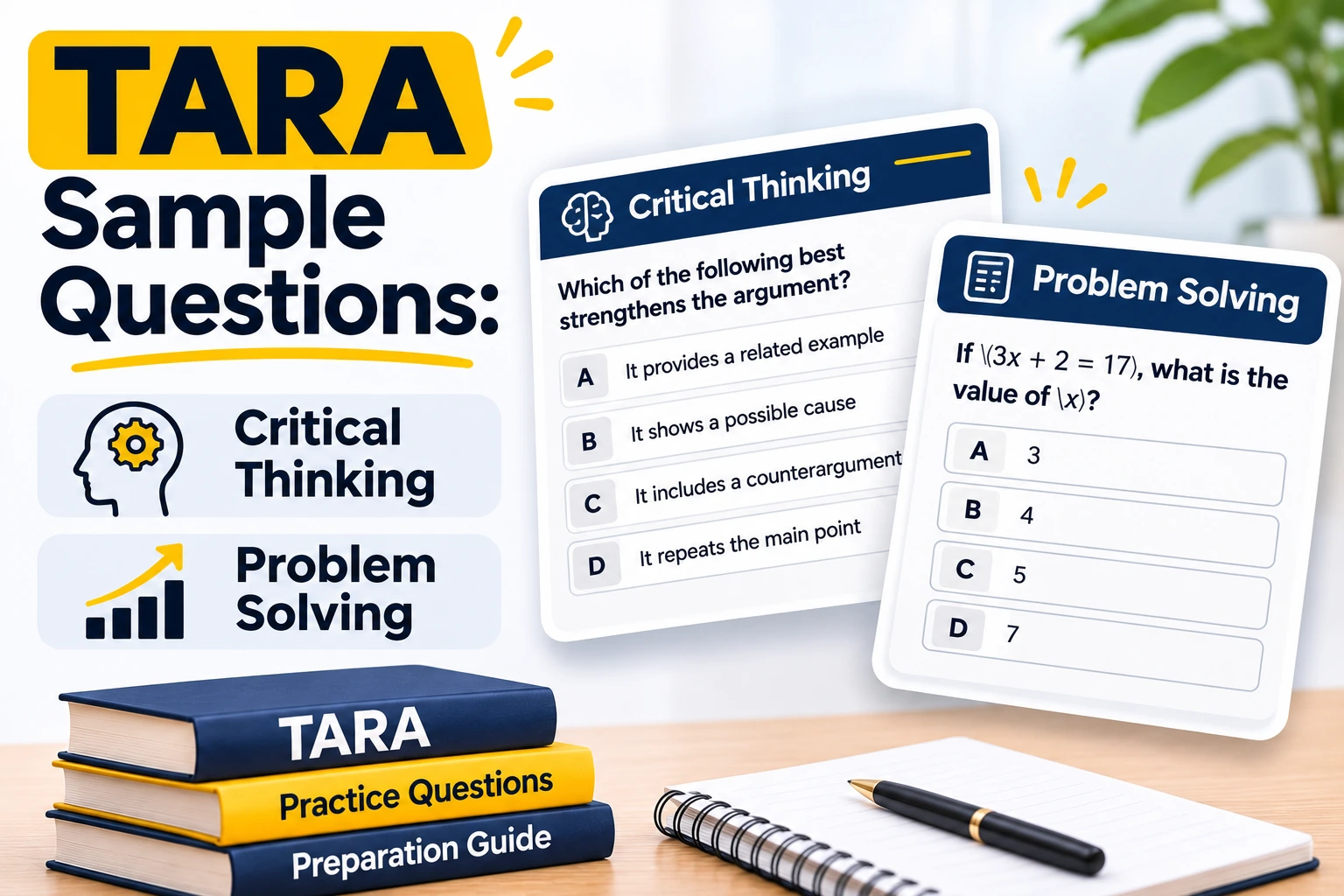
Critical Thinking: Analysing arguments, assumptions and evidence.
Problem Solving: Applying information and logical methods to unfamiliar problems.
Writing Task: Developing and communicating a reasoned argument.
Each module lasts 40 minutes. The two multiple-choice modules contain 22 questions each. In the Writing Task, candidates select one prompt from three available options and write a response of up to 750 words.
For a complete breakdown of the modules, question categories, scoring and examination rules, read our TARA Exam Syllabus 2026–27 guide.
Which Universities Use TARA?
TARA is used by selected courses at universities including the University of Oxford and University College London (UCL).
However, the requirements differ by university, course and admissions cycle.
For Indian applicants, it is important not to assume that every course at either institution requires TARA. Always check the admissions-test requirement for the exact degree programme and intended entry year.
Why Should Indian Students Check Their Test Requirements Early?
Admissions-test planning involves more than understanding the examination. Indian applicants should check:
Whether their chosen course requires TARA.
Which admissions test the university accepts.
When test booking opens and closes.
Whether an authorised Pearson VUE test centre has an available appointment.
The fee applicable to their chosen test-centre location.
How much preparation time they need for all three modules.
Checking these details early can help avoid booking the wrong test or missing an important deadline.
UCL 2027 Entry: TARA January Sitting, Courses and Deadlines
For Indian students applying to selected UCL undergraduate courses for 2027 entry, the January 2027 TARA sitting is an important opportunity.
The October 2026 sitting has already taken place. Applicants who still need to take TARA for an eligible UCL course should check the January test window and complete their booking before the deadline.
Which UCL Courses Require TARA for 2027 Entry?
UCL introduced UAT-UK admissions tests for selected undergraduate programmes in the 2027 admissions cycle.
According to the course requirements covered in this guide, TARA is required for the following programmes:
Department of Computer Science
Computer Science BSc
Computer Science MEng
Computer Science and Mathematics MEng
Robotics and Artificial Intelligence MEng
Department of Mechanical Engineering
Mechanical Engineering BEng
Mechanical Engineering MEng
UCL uses other admissions tests for some programmes. For example, Economics BSc requires TMUA, while selected Engineering courses require ESAT.
Therefore, do not assume that TARA is required for every UCL undergraduate programme. Check the official UCL admissions-test requirements and your individual course page before registering.
TARA January 2027: Important Dates for Indian Students
The January 2027 sitting is scheduled for 4–8 January 2027.
Event | Date and time |
January booking opened | 28 October 2026, 3:00 pm GMT |
Access arrangements request deadline | 7 December 2026, 6:00 pm GMT |
Bursary request deadline | 14 December 2026, 6:00 pm GMT |
Test booking closes | 21 December 2026, 6:00 pm GMT |
January test window | 4–8 January 2027 |
Results released | 8 February 2027 |
Important deadline for Indian applicants: The booking deadline of 21 December 2026 at 6:00 pm GMT is equivalent to 11:30 pm IST on 21 December 2026.
India is 5 hours and 30 minutes ahead of GMT during December. Make sure you use the Indian local time when planning your booking.
UAT-UK does not accept test bookings after the published deadline. Complete the booking process well in advance rather than waiting until the final day.
When Did January 2027 TARA Booking Open?
January 2027 test booking opened on 28 October 2026 at 3:00 pm GMT.
Candidates should distinguish between creating a UAT-UK account and completing a test booking. Creating an account alone does not reserve a test appointment.
Applicants must complete the booking process and select an available appointment at an authorised test centre.
Which TARA Sitting Should UCL Applicants Choose?
For the 2027 admissions cycle, applicants to UCL courses requiring TARA can use the January sitting.
The October 2026 sitting has already passed, so January 2027 is the remaining opportunity for eligible applicants who have not yet taken the test.
UCL has stated that it waits until results from both sittings are available before beginning to assess applications for the relevant programmes. It has also stated that there is no advantage or disadvantage to choosing October over January.
However, candidates should check their individual course requirements and application circumstances before deciding.
TARA Registration Process for Indian Students
TARA registration is completed through the UAT-UK booking system.
The general process involves the following steps:
Step 1: Create a UAT-UK account
Visit the official UAT-UK website and create an account using your personal details. Make sure your information is accurate and consistent with the identification document you intend to use on test day.
Step 2: Select TARA
Choose the Test of Academic Reasoning for Admissions when selecting your admissions test. Confirm that TARA is required for your chosen university course.
Step 3: Choose a Pearson VUE test centre
Select an available authorised test centre and appointment from the booking system. Indian candidates should check the available locations and appointment times before completing their booking.
Step 4: Complete the payment
Pay the applicable test fee and follow the booking instructions.
Step 5: Save your booking confirmation
Keep your confirmation details and review the test-day instructions before attending the centre.
TARA Exam Fees for Indian Students
For the 2027 admissions cycle, the published TARA fee for candidates taking the test outside the UK and Republic of Ireland is £130.
The applicable fee is based on the test-centre location, not simply the candidate's nationality.
Indian students booking a test at a centre in India should therefore budget for the international fee. Check the official UAT-UK booking system for the final amount and payment instructions before completing registration.
TARA Success Story: Ananya's Preparation Journey
With structured preparation and focused practice at Study Ark, Ananya achieved:
- Critical Thinking: 8.0 / 9.0
- Problem Solving: 8.5 / 9.0
Through regular practice and targeted feedback, she strengthened her approach to TARA and achieved a strong performance.
Oxford 2028 Entry: How Indian Students Should Prepare for TARA
Students planning to apply to the University of Oxford for 2028 entry should approach TARA preparation differently from applicants taking the January 2027 test for UCL.
The October 2026 sitting for the 2027 admissions cycle has already passed. Indian students targeting Oxford 2028 should prepare for the next admissions cycle.
For standard Oxford undergraduate courses with an October UCAS application deadline, applicants who are required to take TARA should plan around the expected October 2027 testing window. The exact dates and booking deadlines for the 2028 entry cycle must be confirmed when Oxford and UAT-UK publish them.
Which Oxford Courses Require TARA?
For the 2027 admissions cycle, Oxford listed TARA requirements for the following undergraduate courses:
Course | UCAS course code |
Economics and Management | LN12 |
History and Economics | LV11 |
History and Politics | LV21 |
Human Sciences | BCL0 |
Philosophy, Politics and Economics (PPE) | L0V0 |
Psychology (Experimental) | C830 |
Psychology, Philosophy and Linguistics | CV85 / CQ81 / VQ51 |
These requirements explain the courses included in Oxford's 2027 admissions guidance. Indian applicants targeting 2028 entry must verify the official course requirements for their own application cycle.
Do not assume that a course's admissions-test requirement will remain unchanged across different application years.
Why Oxford Applicants Should Plan for the October Sitting
Oxford's standard undergraduate courses generally have an October UCAS application deadline.
For applicants to these courses who are required to take a UAT-UK admissions test, the October sitting is the relevant sitting rather than the January one.
The January exception mentioned in the 2027 admissions guidance relates to Oxford's Astrophoria Foundation Year, which has a January application deadline. It should not be treated as a general option for Indian applicants to standard Oxford undergraduate degrees.
For Indian students planning to apply to Oxford in 2028, the practical approach is to prepare early and plan around the expected October 2027 window, subject to the official dates and course requirements when published.
When Should Indian Students Start Preparing for Oxford 2028?
Starting preparation early gives candidates time to understand the examination and improve their performance across all three modules.
A suggested preparation timeline is:
Preparation stage | Suggested focus |
Early preparation | Understand the TARA format and official specification |
Foundation stage | Develop Critical Thinking and Problem Solving skills |
Practice stage | Work through question types and timed exercises |
Writing development | Practise planning and writing structured arguments |
Final preparation | Complete specimen tests, review mistakes and revise weak areas |
The exact schedule should depend on your existing skills, academic commitments and the official 2028 admissions timeline.
How Should Oxford Applicants Prepare for TARA?
A balanced preparation plan should cover all three modules.
Critical Thinking
Practise identifying conclusions, assumptions, additional evidence, reasoning errors, matching arguments and applying principles. Focus on understanding how an argument is constructed and whether its conclusion follows from the information.
Problem Solving
Work on selecting relevant information, following procedures and identifying similarities. Build confidence with numerical calculations and unfamiliar problems.
Writing Task
Practise choosing a prompt, developing a clear position, supporting arguments and writing within the 750-word limit.
Do not leave the Writing Task until the final stage. It requires regular practice just like the multiple-choice modules.
For a practical module-wise strategy and a suggested four-week timetable, read our TARA Preparation: Study Plan, Strategy and Practice Tips article.
TARA Exam Pattern, Preparation Resources and FAQs for Indian Students
Whether you are preparing for UCL 2027 or Oxford 2028, understanding the examination structure is the first step towards building an effective preparation plan.
TARA Exam Pattern at a Glance
Module | Questions or task | Duration |
Critical Thinking | 22 multiple-choice questions | 40 minutes |
Problem Solving | 22 multiple-choice questions | 40 minutes |
Writing Task | One response selected from three prompts | 40 minutes |
Total | Three compulsory modules | 120 minutes |
The examination is computer-based and delivered at authorised Pearson VUE test centres.
For the complete breakdown of official question categories, scoring and examination rules, refer to our TARA Exam Syllabus 2026–27 guide.
How Is TARA Scored?
Critical Thinking and Problem Solving are scored on a scale from 1.0 to 9.0, with one decimal place.
The Writing Task is handled separately. It is not assigned an official numerical scaled score by UAT-UK; instead, the response is made available to the universities for their admissions assessment.
There is no conventional pass-or-fail score that automatically determines admission. Universities consider the test as part of the wider application.
How Should Indian Students Prepare for TARA?
A practical preparation strategy should involve the following steps:
Understand the specification: Read the official TARA specification and become familiar with the three modules.
Practise each question type: Do not focus only on the question categories you find comfortable.
Improve reasoning skills: Learn to evaluate arguments and solve unfamiliar problems rather than memorising answers.
Practise timed sessions: Work within the individual 40-minute module limits.
Review mistakes: Maintain a record of incorrect answers and understand why your approach did not work.
Practise writing: Complete essays under timed conditions and work on clarity, structure and argument development.
Official TARA Preparation Resources
Indian students can use the official UAT-UK preparation materials, including:
TARA Content Specification.
TARA Question Guide.
Official specimen materials.
Pearson VUE practice tests.
Test-day guidance.
Visit the official UAT-UK page to access the available resources.
Students can also explore the Study Ark TARA practice page to practise question types and review explanations.