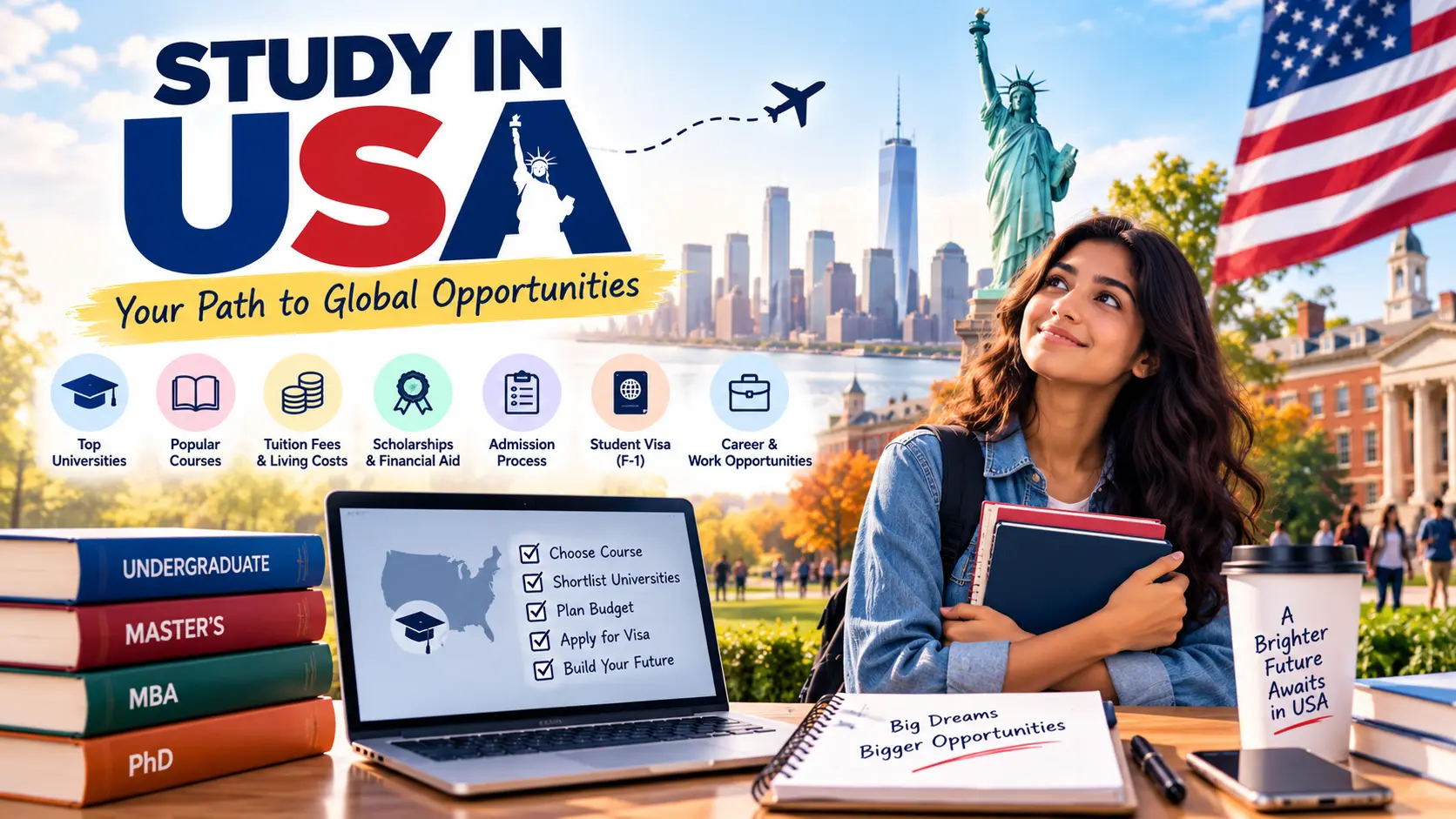
60-Second Summary
- Why choose the USA? Students can explore a wide range of academic programmes, research opportunities, flexible course structures and industry connections.
- Admission requirements: Academic transcripts, English-language proficiency where required, essays or statements of purpose, recommendations and programme-specific test scores.
- Cost: Tuition and living expenses vary significantly by university, programme and location.
- Student visa: Most full-time academic international students use the F-1 student visa route, subject to the programme and institution.
- Why Study in USA?
- 1. A wide range of universities and programmes
- 2. Flexible academic pathways
- 3. Research and practical learning
- 4. International exposure and campus life
- 5. Potential career and post-study opportunities
- Best Courses to Study in USA for Indian Students
- Computer Science and Artificial Intelligence
- Data Science and Business Analytics
- Engineering
- Business, Finance and Economics
- MBA Programmes
- Biotechnology and Life Sciences
- Top Universities to Consider When You Study in USA
- How to build a balanced university shortlist
- Study in USA After 12th: Undergraduate Admission
- Academic requirements
- SAT or ACT requirements
- English-language proficiency
- Essays and extracurricular activities
- Study in USA for Master's and MS Programmes
- Academic qualifications and prerequisites
- GRE and GMAT requirements
- Statement of Purpose and recommendation letters
- Research experience and work experience
- Study in USA: MBA Admission Requirements
- Eligibility to Study in USA for Indian Students
- Cost of Studying in USA for Indian Students
- Tuition fees
- Living expenses
- Additional application and relocation costs
- How to calculate your actual study budget
- Scholarships to Study in USA
- University merit scholarships
- Need-based financial aid
- Graduate assistantships and research funding
- External scholarships and fellowships
- Scholarship planning tips
- Intakes in the USA: When Should You Apply?
- Fall intake
- Spring intake
- How early should Indian students start?
- How to Apply to U.S. Universities: Step-by-Step Process
- Step 1: Define your academic and career goals
- Step 2: Research and shortlist universities
- Step 3: Check admission and test requirements
- Step 4: Prepare your application documents
- Step 5: Submit applications and track deadlines
- Step 6: Compare admission offers and funding
- Step 7: Complete the university's enrolment process
- F-1 Student Visa for Studying in USA
- What is Form I-20?
- General F-1 visa application process
- What documents may be needed?
- How should you prepare for the visa interview?
- Can International Students Work While Studying in USA?
- Post-Study Work Opportunities in USA
- Optional Practical Training (OPT)
- STEM OPT extension
- What should students understand before choosing a course?
- Common Mistakes to Avoid When Planning to Study in USA
- Choosing a university only by ranking
- Underestimating the total cost
- Applying without checking programme requirements
- Treating scholarships as guaranteed
- Starting the application too late
- Assuming a degree guarantees employment or immigration benefits
- Plan Your Study in USA Journey with StudyArk
Why Study in USA?
The United States attracts students from many countries because its higher education system offers a broad selection of institutions, degree programmes and learning environments.
However, studying in the USA is a major financial and academic decision. The advantages are most meaningful when the programme you choose supports your specific goals.
1. A wide range of universities and programmes
The American higher education system includes public universities, private universities, liberal arts colleges, community colleges and specialised institutions.
This variety allows students to compare different learning environments, academic strengths, campus settings and tuition structures.
For example, a student interested in computer science might compare a large public research university with a private university known for its technology programmes. The better fit depends on curriculum, research opportunities, cost and career objectives—not just the university name.
2. Flexible academic pathways
Many U.S. undergraduate programmes allow students to explore different subjects before finalising or refining their academic specialisation, depending on the institution and degree.
This can be helpful for students who have broad interests or want to combine disciplines. A student might explore economics, computer science and statistics before focusing on a particular field.
Flexibility varies by university and programme, so review the curriculum and degree requirements before applying.
3. Research and practical learning
Universities may provide access to research laboratories, faculty-led projects, internships, entrepreneurship programmes and industry collaborations.
These opportunities can be particularly valuable in fields such as engineering, biotechnology, computer science and business.
However, access is not automatic. Some research positions and internships are competitive, and availability depends on the department, programme, student's preparation and applicable work authorisation rules.
4. International exposure and campus life
Studying in the USA can expose students to classmates, faculty and professional networks from different backgrounds.
Campus clubs, student organisations, academic societies and career services can help students build communication skills and explore interests outside the classroom.
The experience varies considerably by institution and location. Research campus culture, student support and the surrounding community when shortlisting universities.
5. Potential career and post-study opportunities
The United States has established industries across technology, finance, healthcare, consulting, manufacturing and research.
Eligible international students may also qualify for practical training authorization connected to their studies, subject to immigration rules.
Nevertheless, studying in the USA does not guarantee a job, a particular salary or long-term immigration status. Career outcomes depend on factors such as skills, experience, programme quality, employer demand and work authorisation.
Best Courses to Study in USA for Indian Students
The right course depends on your previous education, interests, strengths and career plans. Rather than selecting a programme only because it is popular, examine what you will learn and which opportunities it can realistically support.
Here are several fields worth exploring.
Computer Science and Artificial Intelligence
Computer Science programmes may cover programming, algorithms, operating systems, software development and computing theory. Depending on the university, students can specialise in artificial intelligence, machine learning, cybersecurity or related areas.
Consider this field if: You enjoy problem-solving, programming, mathematics or building technology-based solutions.
When comparing programmes, review the curriculum, research facilities, internship access and total cost of attendance.
Data Science and Business Analytics
These programmes focus on using data to understand problems, develop models and support decisions.
Coursework may include statistics, programming, data visualisation, machine learning, business intelligence and analytical methods.
Consider this field if: You enjoy working with numbers, identifying patterns and turning information into practical recommendations.
Check whether the programme is designed for students with a technical background or accepts applicants from other disciplines.
Engineering
The USA offers programmes in areas such as mechanical engineering, electrical and computer engineering, civil engineering, aerospace engineering and biomedical engineering.
Depending on the specialisation, students may combine theoretical study with laboratories, design projects and research.
Consider this field if: You want to develop technical expertise in designing, analysing or improving systems and products.
Check prerequisite subjects, laboratory access, accreditation where relevant and the curriculum's alignment with your intended career.
Business, Finance and Economics
Business-related programmes cover areas such as accounting, finance, marketing, economics, operations, management and organisational strategy.
Some degrees provide broad business training, while others concentrate on a particular function or industry.
Consider this field if: You are interested in business decisions, markets, financial analysis, management or entrepreneurship.
Compare the programme's quantitative content, practical projects, employer connections and career support before applying.
MBA Programmes
An MBA is a graduate-level management degree designed for students who want to develop business and leadership capabilities.
Many MBA programmes value professional experience, career progression, leadership examples and a clear explanation of why the degree fits the applicant's next career step.
Consider this field if: You have professional experience and want to strengthen your management skills, change functions or explore a new industry.
Work-experience expectations, test requirements and programme formats vary. Review each school's admissions criteria before preparing your application.
Biotechnology and Life Sciences
Programmes in biotechnology, molecular biology, biomedical science and related disciplines may combine biological sciences with research methods and laboratory work.
Consider this field if: You are interested in biological systems, scientific research, healthcare innovation or related industries.
Investigate the programme's research focus, laboratory facilities and opportunities for further study. Career requirements may differ between laboratory research, clinical work and regulated healthcare professions.
Top Universities to Consider When You Study in USA
There is no single university that is best for every student. The right shortlist should balance academic fit, admission competitiveness, affordability, location and career opportunities.
The following institutions illustrate the range of options available; this is not a ranking or a guarantee of admission.
University | Areas students may explore |
Massachusetts Institute of Technology (MIT) | Engineering, computing, science and technology |
Stanford University | Engineering, computing, entrepreneurship and interdisciplinary study |
Harvard University | Broad undergraduate study, graduate programmes, business and research |
University of California, Berkeley | Engineering, computing, science, economics and business-related fields |
Carnegie Mellon University | Computer science, technology, engineering and selected business programmes |
University of Michigan, Ann Arbor | Engineering, business, research and a broad range of academic disciplines |
Purdue University | Engineering, technology, computing and applied sciences |
University of Texas at Austin | Engineering, business, computing and research |
These universities have different admission standards, programme structures and costs. A highly selective university may not be the best financial or academic fit for every applicant.
How to build a balanced university shortlist
Instead of applying based only on rankings, divide your options into three broad groups:
Ambitious choices: Institutions where admission may be particularly competitive for your profile.
Target choices: Institutions where your academic background and other application factors appear reasonably aligned with the published admissions expectations.
More attainable choices: Institutions where your profile appears comparatively well aligned with the stated requirements.
These categories are planning tools, not predictions. Admission decisions remain uncertain, and no category guarantees an offer.
For each university, compare the curriculum, academic requirements, total annual cost, scholarship availability, location and graduate outcomes.
You can also explore StudyArk's USA destination for a starting point when researching your options.
Study in USA After 12th: Undergraduate Admission
Students planning to study in the USA after Class 12 generally apply for undergraduate bachelor's programmes.
Unlike systems where admission is determined mainly by a single entrance examination, U.S. universities may consider several parts of an application. The exact approach depends on the institution and programme.
Academic requirements
Universities typically request school transcripts and information about previous academic performance.
Depending on the institution, applicants may need to provide predicted or final grades, course details and proof of completing an appropriate school-leaving qualification.
There is no universal Class 12 percentage that guarantees admission to U.S. universities. Requirements differ by institution, selectivity and programme.
SAT or ACT requirements
Some undergraduate institutions require standardised test scores, while others have test-optional or other testing policies.
These policies can change by application cycle and may differ between programmes. Confirm the current requirements on each university's official admissions website.
If you plan to take the SAT, see StudyArk's SAT preparation for information about preparation support.
English-language proficiency
International applicants may need to demonstrate English proficiency through a test such as TOEFL, IELTS or Duolingo English Test, depending on the university's policy.
Some institutions offer exemptions for applicants who meet specific conditions, but exemptions should never be assumed.
Check the accepted tests, minimum scores, validity rules and exemption criteria for each university.
Essays and extracurricular activities
Some undergraduate applications include personal essays, activity descriptions, recommendations and other materials that help universities understand an applicant beyond grades.
Useful application material should show genuine interests, initiative, personal development and thoughtful reflection. Students do not need to invent extraordinary achievements to create a compelling application.
Focus on accurately explaining what you have done, what you learned and why your intended academic direction makes sense.
Study in USA for Master's and MS Programmes
Indian students applying for a master's degree typically need a recognised bachelor's degree and must meet the academic and other requirements of their chosen programme.
Requirements vary considerably across disciplines.
Academic qualifications and prerequisites
Universities review previous academic performance and whether an applicant has the background needed for the programme.
For technical degrees, prerequisites may include particular mathematics, computing, engineering or scientific subjects. Other programmes may accept applicants from a broader range of undergraduate disciplines.
Check the specific prerequisites rather than assuming every master's programme accepts the same undergraduate background.
GRE and GMAT requirements
Some graduate programmes require or consider GRE or GMAT scores. Others do not require these tests or apply different policies across departments.
A test score should be planned around the actual requirements of your shortlist. Do not register for an examination simply because it is commonly associated with graduate admissions.
Statement of Purpose and recommendation letters
A Statement of Purpose should explain your academic interests, relevant preparation, reasons for choosing the programme and future objectives.
Recommendation letters should come from people who can credibly discuss your academic ability, research potential or professional performance.
Avoid using the same generic statement for every university. Explain why the particular curriculum, faculty interests or academic environment aligns with your plans, using accurate details.
Research experience and work experience
Research-oriented programmes may value research projects, technical experience, publications or relevant academic work.
Professional master's programmes may place more emphasis on work experience, applied skills or professional objectives.
The importance of each factor depends on the programme. Read the admissions guidance carefully before deciding which parts of your profile to emphasise.
Study in USA: MBA Admission Requirements
MBA admissions often involve a different profile assessment from undergraduate or technical master's admissions.
Many MBA programmes value professional experience, leadership, career progression and evidence of how an applicant has contributed to an organisation or community.
Typical application components may include:
An undergraduate degree or recognised equivalent
Academic transcripts
GMAT or GRE scores, where required or accepted
Essays and career-goal statements
Professional resume
Recommendation letters
English-language proficiency evidence, where required
An interview for selected applicants
Work-experience expectations differ across MBA programmes. Some programmes are designed for candidates with several years of professional experience, while others offer early-career or specialised pathways.
Before applying, assess whether an MBA is the right degree for your career stage and whether its cost and opportunity cost make sense for your goals.
Eligibility to Study in USA for Indian Students
There is no single eligibility rule that applies to every U.S. institution. The requirements depend on your study level, programme and the university you choose.
Requirement | What to check |
Academic qualification | Whether your existing degree or school qualification meets entry requirements |
Academic performance | Minimum grades, GPA guidance and prerequisite subjects |
English proficiency | Accepted tests, minimum scores and exemptions |
Standardised tests | SAT, ACT, GRE or GMAT policies, where relevant |
Application materials | Essays, recommendations, resume, portfolio or research documents |
Financial planning | Tuition, living expenses, funding and required financial documentation |
Student visa | Whether the institution and programme support the appropriate student visa route |
A student should distinguish between minimum eligibility and a competitive application. Meeting published minimum requirements does not guarantee admission, especially at selective institutions.
For official guidance on researching universities and checking that a school is authorised to enrol international students, consult EducationUSA's guide to researching U.S. study options.
Cost of Studying in USA for Indian Students
Cost is one of the most important factors to evaluate before committing to a U.S. university.
The total expense can vary significantly depending on the institution, degree, city, housing arrangement, health insurance and personal spending. A lower tuition fee does not always mean a lower total cost if living expenses are high.
Tuition fees
Tuition depends on the institution and programme. Public universities, private universities, professional schools and specialised programmes may have very different fee structures.
Graduate programmes can also vary substantially in price, even within the same university.
Do not rely on a single nationwide average as a substitute for checking the university's official cost estimate.
Living expenses
Your budget should account for more than tuition. Common expenses include:
Accommodation and utilities
Food and groceries
Local transportation
Books, equipment and study materials
Health insurance and healthcare-related expenses
Phone and internet
Personal expenses
Travel between India and the United States
Housing costs can vary considerably between cities and even between neighbourhoods within the same city.
Additional application and relocation costs
Before travelling, you may also need to budget for application fees, test fees, visa-related charges, travel, initial accommodation and other one-time expenses.
Some costs are non-refundable, so check the relevant terms before making payments.
How to calculate your actual study budget
Build a university-specific budget instead of relying on an approximate national figure.
A practical calculation is:
Total annual budget = Tuition and university fees + Housing + Food + Insurance + Transportation + Personal expenses
Then add any one-time costs that apply to your first year.
Compare this total with the funding you can realistically access. Consider the full programme duration, likely fee increases and how you would manage unexpected expenses.
EducationUSA recommends researching the actual costs of each institution and evaluating funding early in the process. Read its official guide to financing U.S. studies.
Scholarships to Study in USA
Scholarships and financial aid can make studying in the United States more affordable, but availability depends on the institution, degree level, nationality, academic profile and financial circumstances.
Some awards cover a portion of tuition, while others may contribute to tuition and living expenses. The conditions vary.
University merit scholarships
Some universities award scholarships based on academic performance, achievements, talent or other stated criteria.
Check whether international students are eligible, whether a separate application is required and whether the scholarship is renewable.
Also confirm whether an award covers tuition only or includes other expenses.
Need-based financial aid
Some U.S. institutions provide financial aid based on a family's financial circumstances.
Eligibility rules differ. Policies for international undergraduate students can be particularly institution-specific, and financial aid availability should never be assumed.
Check the university's official financial aid policy, documentation requirements and deadlines before applying.
Graduate assistantships and research funding
Certain graduate programmes offer teaching assistantships, research assistantships, tuition support or stipends.
These opportunities depend on the department, programme, funding availability and the student's qualifications. They are not guaranteed for every graduate student.
Research funding options early, especially for research-based master's programmes and doctoral study.
External scholarships and fellowships
External organisations and selected government-supported programmes may fund particular fields, study levels or professional objectives.
Always confirm eligibility, application dates, funding conditions and whether the award supports your intended degree in the United States.
Scholarship planning tips
Start researching funding before you finalise your university shortlist.
Apply by the relevant scholarship deadline.
Check whether admission and scholarship applications are separate.
Read renewal conditions and minimum academic requirements.
Avoid assuming that a scholarship will cover every expense.
Calculate your remaining cost after any confirmed funding.
Intakes in the USA: When Should You Apply?
U.S. universities have different academic calendars and application deadlines. Two commonly discussed entry periods are Fall and Spring, although availability depends on the institution and programme.
Fall intake
Fall programmes commonly begin around August or September. Many universities offer a broad range of undergraduate and graduate options during this period.
Because application and financial aid deadlines can occur well before classes begin, students should research their target programmes early.
Spring intake
Spring programmes commonly begin around January, where offered.
Not every programme accepts Spring applicants. Some scholarships, research opportunities and specialised courses may be available only during particular entry periods.
How early should Indian students start?
EducationUSA recommends beginning university research approximately 12–18 months before the academic year in which you plan to enrol.
A practical timeline may look like this:
Approximate stage | Main tasks |
12–18 months before enrolment | Research courses, universities, costs and entry requirements |
9–12 months before enrolment | Prepare tests if needed, develop essays and request recommendations |
6–9 months before enrolment | Submit applications and eligible scholarship applications according to deadlines |
After admission decisions | Compare offers, funding and programme fit |
After accepting an offer | Complete university documentation and prepare for the student visa process |
Before departure | Arrange accommodation, travel and required pre-departure preparations |
This is a planning framework, not a universal deadline schedule. Individual universities and programmes may require earlier applications.
How to Apply to U.S. Universities: Step-by-Step Process
The application process becomes easier to manage when you treat it as a sequence of decisions rather than a collection of disconnected forms.
Step 1: Define your academic and career goals
Start by identifying what you want to study and why.
Consider your preferred subjects, current academic background, career interests, budget and preferred learning environment. These factors will help you identify programmes that are relevant to your goals.
Step 2: Research and shortlist universities
Compare universities based on curriculum, prerequisites, admissions policies, location, total cost and funding opportunities.
Check whether each university is authorised to enrol international students and whether the programme matches your intended qualification.
Avoid choosing institutions based only on rankings or social media recommendations.
Step 3: Check admission and test requirements
Read the official admissions page for every shortlisted programme.
Confirm academic prerequisites, English-language tests, standardised testing policies, application deadlines and required documents.
This step can prevent unnecessary testing and help you allocate preparation time appropriately.
Step 4: Prepare your application documents
Depending on the programme, you may need:
Academic transcripts and degree certificates
English-language test results, where required
SAT, ACT, GRE or GMAT results, where applicable
Essays or a Statement of Purpose
Recommendation letters
Resume or CV
Portfolio or research documents, where relevant
Application fee or fee-waiver documentation, if eligible
Keep documents accurate and consistent. Follow each institution's formatting and submission instructions.
Step 5: Submit applications and track deadlines
Some universities use centralised application platforms, while others have their own systems.
Track each application separately. Record submission dates, missing documents, scholarship deadlines and any interview requirements.
Do not assume that submitting an application automatically completes the scholarship process.
Step 6: Compare admission offers and funding
If you receive multiple offers, compare more than the university's reputation.
Review the programme, total cost, scholarship conditions, location, academic support, internship opportunities and likely career relevance.
A lower-cost programme that fits your goals may be a better decision than a more expensive alternative.
Step 7: Complete the university's enrolment process
After accepting an offer, follow the university's instructions for deposits, financial documentation and international student records.
Eligible students who plan to study in F-1 status will need the appropriate documentation from a school certified by the Student and Exchange Visitor Program.
F-1 Student Visa for Studying in USA
Most international students pursuing full-time academic study at an eligible U.S. institution use the F-1 student visa route. Other visa categories may apply to different study arrangements, so confirm which category is appropriate for your programme.
Receiving an admission offer does not itself grant a student visa. Students must complete the relevant immigration process and meet the applicable requirements.
What is Form I-20?
After admission and completion of the school's required steps, an eligible institution may issue Form I-20 for a student seeking F-1 status.
The document contains information about the student and the intended programme and is part of the student visa process.
Follow the school's instructions carefully and check that your information is accurate.
General F-1 visa application process
The process generally involves:
Obtaining admission to an eligible institution and the required Form I-20.
Paying the applicable SEVIS fee.
Completing the DS-160 nonimmigrant visa application.
Paying the applicable visa application fee.
Scheduling and attending the required visa appointment.
Preparing the documents requested for your application and interview.
The exact process and appointment availability may change. Check the official U.S. Department of State guidance and the U.S. Embassy or Consulate instructions relevant to your application.
Official reference: U.S. Department of State — Student Visas.
What documents may be needed?
The precise checklist depends on your circumstances, but students should be prepared to follow instructions regarding:
A valid passport
Form I-20
DS-160 confirmation
Visa appointment and fee records, where applicable
Evidence of admission
Academic records
Financial documentation
Other supporting documents requested by the authorities
Do not assume that a particular document guarantees visa approval. The consular officer assesses the application under the applicable rules.
How should you prepare for the visa interview?
Be ready to explain your study plans clearly and truthfully.
Understand why you selected the university and programme, how the course relates to your background and goals, and how you plan to fund your education.
Your answers should reflect your genuine plans rather than memorised scripts. Ensure that the information you provide is consistent with your application and supporting documents.
No consultant or university can guarantee a visa outcome.
Can International Students Work While Studying in USA?
Eligible international students may have limited employment options, but work is subject to visa status and applicable rules.
Students in F-1 status may generally work in qualifying on-campus jobs for up to 20 hours per week while school is in session, subject to the relevant conditions.
Off-campus employment is subject to additional restrictions and may require specific authorisation. Students should not assume that they can freely take any off-campus job or work without approval.
Before accepting employment, consult your institution's designated school official and the official government rules.
Post-Study Work Opportunities in USA
Post-study work options can be an important part of your planning, but eligibility depends on your programme, immigration status and the rules in effect at the relevant time.
Optional Practical Training (OPT)
Eligible F-1 students may apply for Optional Practical Training, which permits qualifying temporary employment related to their field of study, subject to the applicable requirements and authorisation.
The standard post-completion OPT period can be up to 12 months for eligible students.
STEM OPT extension
Certain students who meet the requirements may qualify for a further 24-month STEM OPT extension.
Eligibility depends on factors including the degree's STEM designation, the employer and compliance with the relevant training and reporting requirements.
Not every degree qualifies, and the extension is not automatic.
What should students understand before choosing a course?
Consider how the programme builds relevant skills and whether it offers academic or practical opportunities that support your career plans.
However, do not select a programme solely because you expect a particular immigration or employment outcome. Work authorisation rules, employer hiring decisions and future immigration policies can affect your options.
For current information, refer to ICE's official practical training guidance.
Common Mistakes to Avoid When Planning to Study in USA
Choosing a university only by ranking
A ranking cannot tell you whether a programme suits your academic interests, finances or career goals.
A better approach: Compare curriculum, total cost, admission requirements, faculty or research opportunities and student support.
Underestimating the total cost
Tuition is only one part of the expense. Housing, insurance, transportation and other living costs can materially change your budget.
A better approach: Build a full programme-duration budget using the university's official cost estimates.
Applying without checking programme requirements
Requirements can differ between departments at the same university.
A better approach: Verify the current programme-specific admissions page before registering for tests or submitting applications.
Treating scholarships as guaranteed
Scholarship availability and eligibility vary. Some awards are highly competitive or cover only part of the cost.
A better approach: Identify confirmed funding separately from funding you hope to receive, and plan for the remaining expenses.
Starting the application too late
Essays, recommendations, test preparation and financial documents take time to prepare.
A better approach: Begin research early and work backwards from each university's official deadlines.
Assuming a degree guarantees employment or immigration benefits
A qualification can support your career development, but it does not guarantee a job, salary or long-term immigration status.
A better approach: Research career outcomes and applicable work authorisation rules while making your academic decision.
Plan Your Study in USA Journey with StudyArk
Choosing to study in the United States involves more than securing an admission offer. You need to find a programme that fits your profile, understand its costs, prepare a strong application and plan the visa process carefully.
Start by identifying your intended course and degree level. Then compare universities, verify requirements, explore funding options and work backwards from your application deadlines.
If you want support with your university research and application planning, explore StudyArk's USA study-abroad guidance.
Use the available guidance to assess your options, ask specific questions about your profile and make decisions based on your academic goals and realistic budget.
Your next step: Build a university shortlist that balances programme fit, admission requirements, affordability and career relevance before committing to an application plan
Not sure where to start?
Get a free personalised strategy session with a StudyArk mentor.
Book Free ConsultationFrequently Asked Questions
How much does it cost to study in the USA for Indian students?
The total cost depends on the university, programme, location, housing and personal expenses. Your budget should include tuition, fees, accommodation, food, health insurance, transportation and other costs. Use the university's official cost-of-attendance estimate rather than relying on a single nationwide average.
Can I study in the USA after Class 12?
Yes. Indian students can apply to eligible undergraduate programmes after Class 12 if they meet the institution's academic and application requirements. These may include transcripts, English-language proficiency evidence, standardised test scores where required, essays and recommendations.
Which courses are popular among Indian students in the USA?
Students explore fields including Computer Science, Engineering, Data Science, Business Analytics, Finance, Biotechnology and MBA programmes. The right choice depends on your academic background, interests and career goals rather than popularity alone.
Can I get a scholarship to study in the USA?
Yes, international students may be eligible for university merit scholarships, need-based aid at participating institutions, graduate assistantships and external scholarships. Eligibility and funding vary, so review official conditions and deadlines carefully.
How early should I apply to U.S. universities?
EducationUSA recommends beginning university research around 12–18 months before your intended academic start. Individual application and scholarship deadlines vary, so create a timeline based on the specific programmes you plan to apply to.
Which visa do Indian students need to study in the USA?
Many international students pursuing full-time academic programmes use the F-1 student visa route. The appropriate visa category depends on the programme and study arrangement. Follow official U.S. Department of State guidance and your institution's instructions.
This article was reviewed by StudyArk's expert review panel, comprising experienced professionals and subject-matter experts.
Panel of Reviewers
Manish Sahoo
Masters Student at University of Tokyo · University of Tokyo
Shailendra Nama
Director at Alvarez & Marsal · Oxford