60-Second Summary
- Test format: Digital and adaptive, delivered through the Bluebook application.
- Best preparation approach: Understand the syllabus, take a diagnostic test, practise weak topics and review mistakes systematically.
- Two sections: Reading and Writing, and Math.
- Total duration: 2 hours and 14 minutes, plus a 10-minute break.
- What Is the SAT Exam Syllabus?
- SAT Exam Pattern 2026: Sections, Questions and Duration
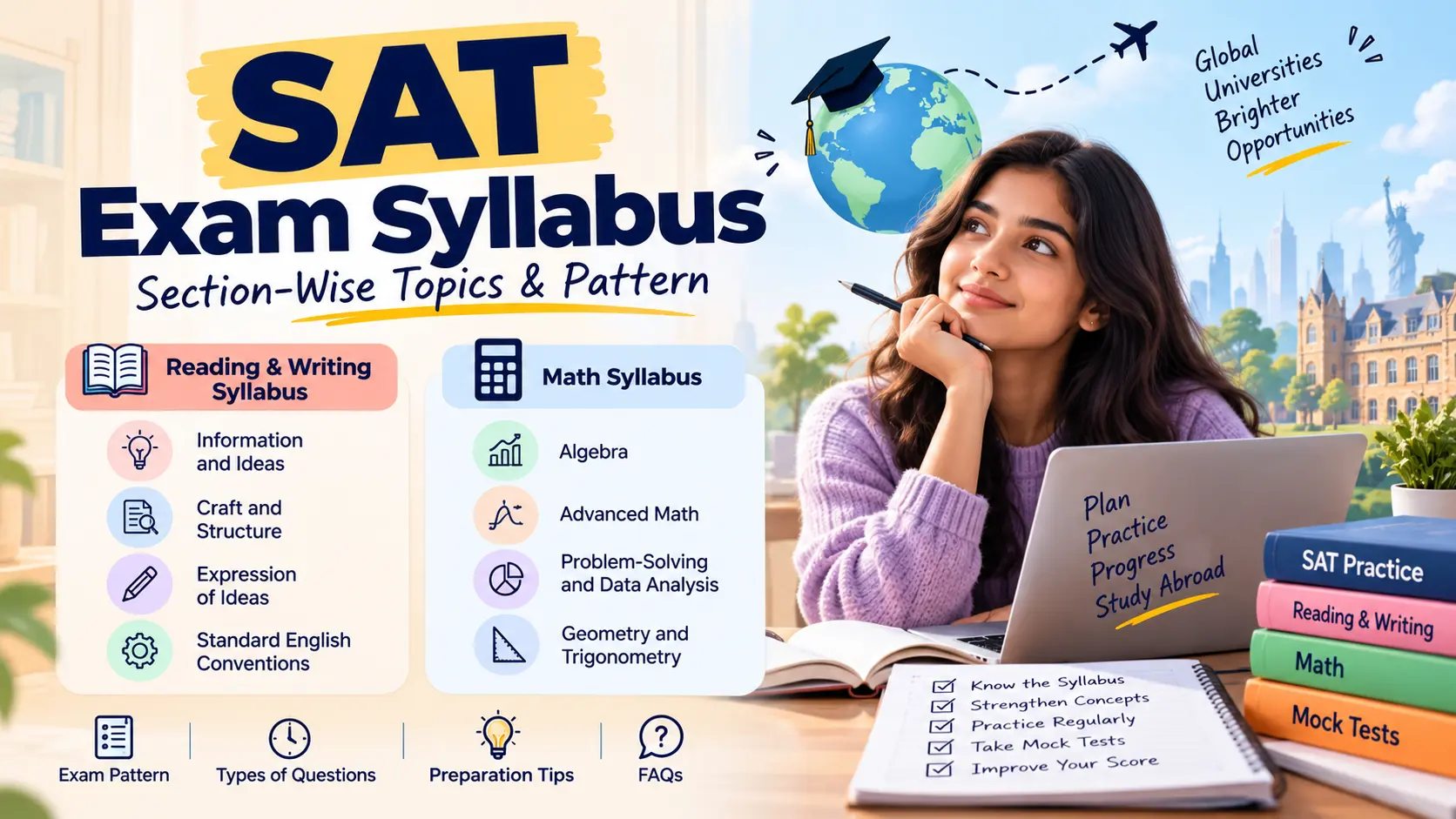
- SAT Exam Syllabus for Reading and Writing
- 1. Information and Ideas
- 2. Craft and Structure
- 3. Expression of Ideas
- 4. Standard English Conventions
- SAT Digital Math Syllabus: Complete Section-Wise Topics
- 1. Algebra
- 2. Advanced Math
- 3. Problem-Solving and Data Analysis
- 4. Geometry and Trigonometry
- Which SAT Syllabus Topics Should You Prioritise?
- SAT Exam Syllabus Preparation: A Practical Study Plan
- Step 1: Take a diagnostic test
- Step 2: Build a topic-wise syllabus checklist
- Step 3: Strengthen weak concepts
- Step 4: Practise by topic
- Step 5: Maintain an error log
- Step 6: Practise the digital format
- Step 7: Review and adjust
- How Long Does It Take to Complete the SAT Exam Syllabus?
- Final Thoughts: Prepare for the SAT Syllabus With a Clear Strategy
- Prepare for the SAT With StudyArk
What Is the SAT Exam Syllabus?
The SAT Exam Syllabus is the set of academic skills and concepts assessed through two sections: Reading and Writing, and Math. Rather than testing every topic taught in school, the exam focuses on skills that demonstrate readiness for undergraduate-level study.
For Indian students planning to study abroad, understanding the syllabus helps answer three practical questions:
Which concepts do I already know?
Which skills need more practice?
How should I divide my preparation time between English and Math?
The digital SAT does not have a separate essay-writing section. Its Reading and Writing questions assess comprehension, grammar, vocabulary in context and the ability to improve written passages. Math questions assess mathematical reasoning and the application of concepts to both abstract and real-world situations.
The official syllabus is organised into eight content domains—four in each section. These domains form the foundation of an effective preparation plan.
SAT Exam Pattern 2026: Sections, Questions and Duration
Before studying individual topics, understand how the test is organised.
Exam component | Reading and Writing | Math |
Number of questions | 54 | 44 |
Total time | 64 minutes | 70 minutes |
Modules | 2 | 2 |
Question format | Primarily multiple-choice | Multiple-choice and student-produced responses |
Score range | 200–800 | 200–800 |
Total testing time: 134 minutes, or 2 hours and 14 minutes, excluding the 10-minute break.
The two sections use a multistage adaptive format. Your performance in the first module determines the difficulty level of the second module within that section. Each module is separately timed.
This matters because knowing the syllabus alone is not enough. You also need to manage time, interpret questions accurately and become comfortable with the digital testing environment.
Official reference: Digital SAT format and scoring — College Board.
SAT Exam Syllabus for Reading and Writing
The Reading and Writing section measures how well you understand short passages, interpret evidence, recognise relationships between ideas and improve written expression.
Passages may cover literature, history and social studies, the humanities, and science. You do not need specialist knowledge of every subject. The focus is on using the information and language presented in the question.
The section contains four content domains.
1. Information and Ideas
This domain evaluates your ability to understand what a passage communicates and distinguish supported conclusions from assumptions.
Important topics and skills include:
Central ideas and key details
Making inferences from a passage
Identifying relevant textual evidence
Interpreting information presented in tables, graphs and other graphics
Connecting evidence to a conclusion
Distinguishing a supported claim from an unsupported interpretation
What might a question look like?
You could read a short passage about a scientific study and answer a question about its main conclusion. Another question might ask which piece of evidence most strongly supports a particular claim.
How to prepare:
Practise identifying the main point of a passage before looking at the answer choices. For evidence questions, return to the passage and verify that your chosen answer is supported by the text or data.
Avoid choosing an answer simply because it sounds reasonable. The correct answer must fit the information provided.
2. Craft and Structure
This domain focuses on how language works, how passages are organised and how authors communicate ideas.
Important topics and skills include:
Words in context
Vocabulary and academic word usage
Text structure and purpose
Author's purpose and rhetorical choices
Connections between two related texts
Comparing or evaluating different viewpoints
Understanding how a word or phrase affects meaning
What might a question look like?
A word may have several dictionary meanings, but only one fits the passage. Alternatively, two short texts might present different interpretations of the same issue, requiring you to understand their relationship.
How to prepare:
Build vocabulary through context rather than memorising isolated word lists alone. After answering a question, explain why the chosen meaning fits the sentence and why the other options do not.
For cross-text questions, summarise each passage in one sentence before deciding how the authors' positions relate to each other.
3. Expression of Ideas
Expression of Ideas assesses your ability to make writing clearer, more logical and more effective for a specific purpose.
Important topics and skills include:
Rhetorical synthesis
Selecting relevant information for a stated goal
Organising ideas logically
Choosing suitable transitions
Improving coherence between sentences
Combining information without changing its intended meaning
What might a question look like?
A question may provide brief research notes and ask you to select the sentence that best achieves a stated writing goal. Another may ask which transition creates the most logical relationship between two ideas.
How to prepare:
Focus on the purpose of the sentence, not just its grammar. Ask yourself what the writer is trying to communicate and which option achieves that goal most directly.
When practising transitions, learn the relationships they express—contrast, cause and effect, addition or conclusion—rather than memorising a list of transition words.
4. Standard English Conventions
This domain tests your ability to recognise and correct grammatical and punctuation errors.
Important topics and skills include:
Sentence boundaries
Complete and incomplete sentences
Independent and dependent clauses
Sentence structure
Subject–verb agreement
Verb forms and tense
Pronouns and their references
Punctuation
Apostrophes and possessives
Commas, colons and semicolons where appropriate
Form, structure and sense
What might a question look like?
You may need to choose the correct punctuation between two clauses, identify a sentence fragment or select a verb form that agrees with its subject.
How to prepare:
Learn grammar rules through examples and practise applying them in short passages. When you make a mistake, identify the underlying rule instead of memorising the correct answer.
For example, if you repeatedly confuse independent clauses with fragments, spend time understanding complete sentence structure before attempting more timed questions.
Reading and Writing takeaway: Strong performance requires more than fluent English. You need precise reading, contextual vocabulary, logical reasoning and a reliable understanding of grammar.
SAT Digital Math Syllabus: Complete Section-Wise Topics
The Math section measures your ability to understand mathematical relationships, solve equations, interpret data and apply concepts to unfamiliar problems.
It includes both multiple-choice and student-produced response questions. In student-produced response questions, you enter your answer rather than selecting one of the given options.
The Math syllabus has four content domains.
1. Algebra
Algebra is a major component of the SAT Math section. It focuses on linear relationships and your ability to represent and solve equations.
Topics to prepare:
Linear equations in one variable
Linear equations in two variables
Linear functions
Systems of two linear equations
Linear inequalities in one variable
Linear inequalities in two variables
Representing relationships using equations and graphs
Example of the skill involved:
You may be asked to solve an equation, interpret the meaning of a variable or determine where two linear relationships intersect.
Preparation advice:
Practise solving equations accurately, rearranging expressions and moving between equations, graphs and real-world descriptions.
Do not focus only on memorising procedures. You should also understand what a solution represents and how a change in one variable affects another.
2. Advanced Math
Advanced Math focuses on nonlinear relationships and more complex algebraic expressions.
Topics to prepare:
Equivalent expressions
Quadratic equations and functions
Polynomial expressions and equations
Exponential functions
Nonlinear equations in one variable
Systems involving nonlinear equations
Rational expressions and equations
Radical expressions and equations
Absolute-value expressions and equations
Interpreting nonlinear functions
These topics may appear in different forms. A question might require you to simplify an expression, identify an equivalent form or interpret the behaviour of a function.
Preparation advice:
Start with algebraic manipulation and factorisation. Then practise solving equations and interpreting functions. Learn how different representations describe the same mathematical relationship.
If you struggle with advanced questions, check whether the underlying issue is actually a gap in basic algebra.
3. Problem-Solving and Data Analysis
This domain tests your ability to apply mathematics to quantitative information and practical situations.
Topics to prepare:
Ratios and proportions
Rates and unit rates
Percentages
Units and conversions
One-variable data distributions
Measures of centre and spread
Two-variable data
Models and scatterplots
Probability and conditional probability
Inference from sample statistics
Margin of error
Evaluating statistical claims
Observational studies and experiments
Questions may use tables, charts, graphs, research findings or everyday scenarios.
Example of the skill involved:
You might need to calculate a percentage change, compare two rates, interpret a scatterplot or determine whether a conclusion is justified by the data.
Preparation advice:
Practise translating written information into mathematical expressions. Pay attention to units, percentages and what a graph actually shows.
For data questions, distinguish between what the evidence supports and what it merely suggests. This is particularly important when interpreting statistics or comparing groups.
4. Geometry and Trigonometry
Geometry and Trigonometry covers spatial relationships, measurements and selected trigonometric concepts.
Topics to prepare:
Area and volume
Lines and angles
Triangles
Properties of parallel lines
Similarity and congruence concepts
Right triangles
The Pythagorean theorem
Right-triangle trigonometry
Circles
Relevant geometric relationships and formulas
Example of the skill involved:
A question might ask you to calculate a missing side of a triangle, determine an angle relationship or use geometric information to find an unknown measurement.
Preparation advice:
Learn the relevant formulas, but practise recognising when and how to use them. Draw a diagram when it helps you understand the relationships, and check whether the answer is reasonable for the given dimensions.
Do not assume that every geometry question can be solved by recalling one formula. Some questions combine multiple concepts.
Math takeaway: Algebra, Advanced Math, Problem-Solving and Data Analysis, and Geometry and Trigonometry are the four official content domains. A good preparation plan develops conceptual understanding, accuracy and the ability to apply mathematics under time pressure.
Official reference: College Board Math content and specifications.
Which SAT Syllabus Topics Should You Prioritise?
There is no single topic order that works equally well for every student. Your priorities should depend on your diagnostic performance and the skills assessed in each domain.
The following is a practical starting point, not an official College Board ranking.
Section | Initial priority | What to practise |
Reading and Writing | Standard English Conventions | Sentence structure, punctuation and grammar |
Reading and Writing | Information and Ideas | Main ideas, evidence and inferences |
Reading and Writing | Craft and Structure | Vocabulary in context and text purpose |
Reading and Writing | Expression of Ideas | Transitions and rhetorical synthesis |
Math | Algebra | Linear equations, functions and inequalities |
Math | Advanced Math | Nonlinear equations, functions and equivalent expressions |
Math | Problem-Solving and Data Analysis | Ratios, percentages, statistics and graphs |
Math | Geometry and Trigonometry | Measurement, triangles, circles and trigonometry |
Once you have established your baseline, use official practice-test feedback to identify the domains that need the most attention.
A topic that feels difficult may not always be your biggest score-improvement opportunity. Consider both your accuracy and the amount of practice required to improve.
SAT Exam Syllabus Preparation: A Practical Study Plan
A useful SAT preparation plan begins with diagnosis and becomes more targeted as you learn where you are losing marks.
Step 1: Take a diagnostic test
Start with an official digital SAT practice test in Bluebook. Attempt it under realistic testing conditions.
Record your overall score and review your performance by section and content domain.
Step 2: Build a topic-wise syllabus checklist
Divide your study plan into the eight content domains. Under each domain, record specific skills that you need to learn or revise.
For example, under Algebra, you might track linear equations, systems of equations and inequalities separately.
Step 3: Strengthen weak concepts
Before attempting large volumes of questions, make sure you understand the concepts behind your mistakes.
For grammar, learn the rule. For mathematics, revisit the relevant concept and practise solving different question types.
Step 4: Practise by topic
Solve targeted questions for each skill. Begin with untimed practice if you need to understand the concept, then introduce time limits as your accuracy improves.
Use official resources wherever possible, including the College Board SAT practice resources.
Step 5: Maintain an error log
After every practice session, record:
The topic or skill tested
The mistake you made
The reason for the mistake
The correct method
What you will do differently next time
This helps you distinguish between a knowledge gap, a reasoning error, a time-management problem and a careless mistake.
Step 6: Practise the digital format
Use the Bluebook environment to become comfortable with the digital SAT. Practise moving through questions, monitoring time and working within separately timed modules.
Remember that once you leave a module, you cannot return to it under the standard test rules.
Step 7: Review and adjust
Repeat practice tests at appropriate intervals and compare your performance over time. If your accuracy improves in one domain but remains weak in another, adjust your study plan accordingly.
Avoid taking mock tests simply to accumulate scores. The real value comes from analysing what each test teaches you.
How Long Does It Take to Complete the SAT Exam Syllabus?
There is no fixed preparation duration for every student. The time required depends on your current academic foundation, English proficiency, target score, available study hours and familiarity with the digital format.
A student who is comfortable with algebra and grammar may need more time for advanced question types and test strategy. Another student may need to revisit foundational concepts before progressing to timed practice.
A sensible way to estimate your preparation time is to:
Take a diagnostic test.
Identify your strongest and weakest domains.
Set a target based on your university plans.
Estimate the time needed to address the main gaps.
Schedule regular practice and full-length simulations.
Leave time to review mistakes and adjust your approach.
Your plan should be based on measurable progress rather than an arbitrary number of study hours.
Final Thoughts: Prepare for the SAT Syllabus With a Clear Strategy
The SAT Exam Syllabus becomes easier to manage when you break it into individual skills instead of treating it as one large list of topics.
Start with the official syllabus, identify your current level, strengthen weak concepts and practise questions that reflect the digital format. Review your mistakes carefully and use your progress to decide what to study next.
Most importantly, connect your preparation to your undergraduate application goals. The right approach is not simply to finish every topic; it is to build the skills required to perform confidently on test day.
Prepare for the SAT With StudyArk
If you would benefit from structured preparation, expert guidance or a more organised study plan, explore StudyArk's SAT preparation service.
Review the available program information and choose an approach that fits your current level, preparation timeline and university goals.
Not sure where to start?
Get a free personalised strategy session with a StudyArk mentor.
Book Free ConsultationFrequently Asked Questions
What is included in the SAT Exam Syllabus?
The SAT Exam Syllabus has two sections: Reading and Writing, and Math. Reading and Writing covers Information and Ideas, Craft and Structure, Expression of Ideas, and Standard English Conventions. Math covers Algebra, Advanced Math, Problem-Solving and Data Analysis, and Geometry and Trigonometry.
Is the SAT syllabus based on Class 11 and Class 12?
The SAT assesses selected mathematical and English-language skills that overlap with some school-level learning, but it is not simply a test of the complete Indian Class 11 and Class 12 syllabus. Students should prepare according to the official SAT content domains and question formats rather than relying only on their school textbooks.
Does the SAT Exam include calculus?
Calculus is not one of the four official SAT Math content domains. The syllabus focuses on Algebra, Advanced Math, Problem-Solving and Data Analysis, and Geometry and Trigonometry.
Is the SAT Reading and Writing section only about grammar?
No. Grammar is one part of the section. Students also need to interpret passages, understand vocabulary in context, identify evidence, make inferences, analyse text structure and improve written expression.
How many questions are there in the digital SAT?
The standard digital SAT contains 54 Reading and Writing questions and 44 Math questions, for a total of 98 questions. The standard timing is 64 minutes for Reading and Writing and 70 minutes for Math, with a 10-minute break between sections.
Where can I find official SAT syllabus topics?
Use the College Board Reading and Writing guide and the College Board SAT content-domain resources. These explain the skills assessed in the current test.
This article was reviewed by StudyArk's expert review panel, comprising experienced professionals and subject-matter experts.
Panel of Reviewers
Manish Sahoo
Masters Student at University of Tokyo · University of Tokyo
Shailendra Nama
Director at Alvarez & Marsal · Oxford