You finish a GRE practice test, see your score, and immediately start planning your next steps.
But there is one question you should ask before trusting that score:
Was the test actually adaptive in the way the GRE is?
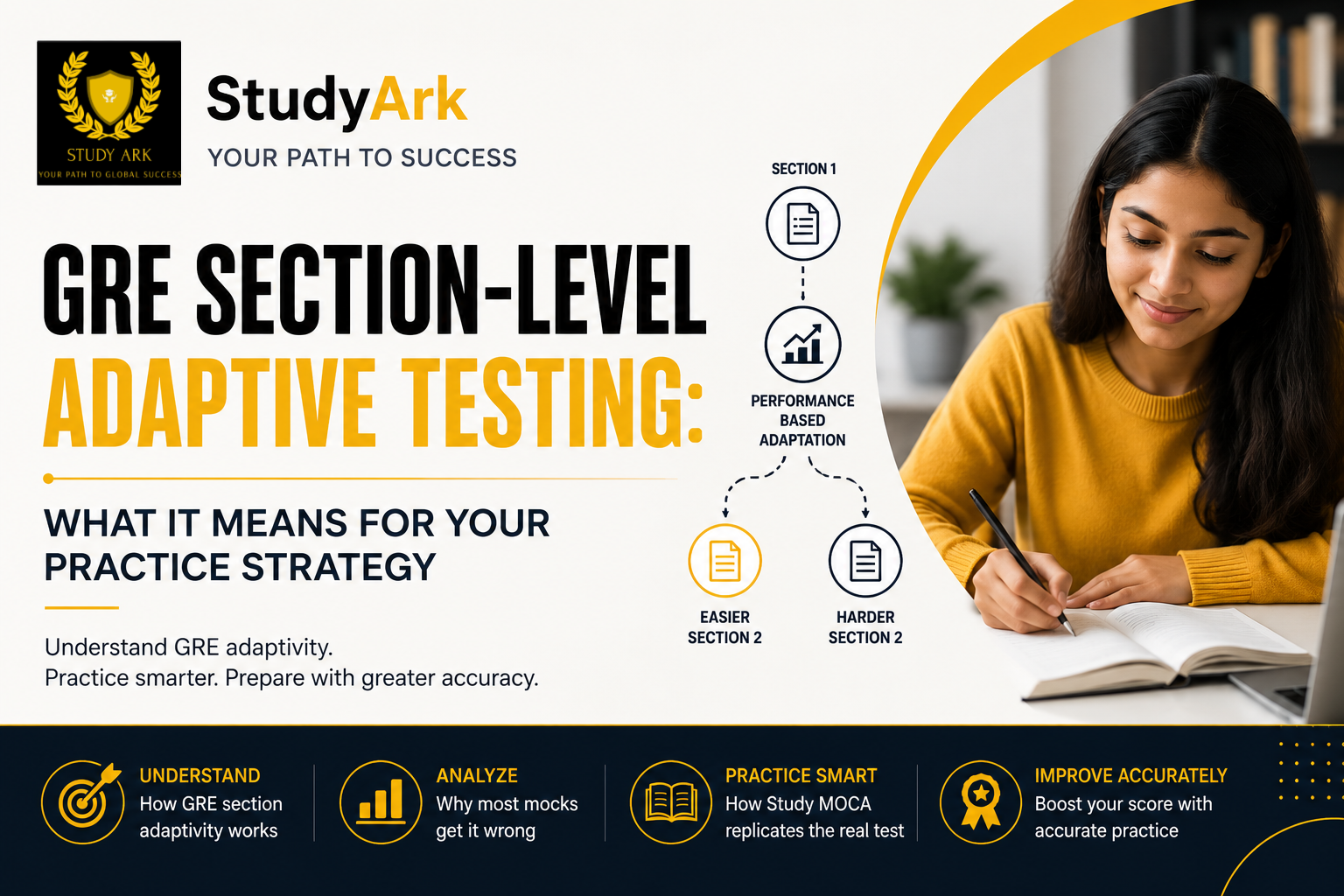
The GRE General Test uses section-level adaptivity for both Verbal Reasoning and Quantitative Reasoning. That means the difficulty of your second section is influenced by how you perform on the first. A practice test that simply gives everyone the same sequence of questions may still test your knowledge but it may not accurately reproduce the experience of the real GRE.
Understanding how the adaptive model works can completely change how you should interpret mock scores, identify weaknesses, and plan your preparation.
What "Adaptive" Actually Means on the GRE
The GRE uses a multistage adaptive test (MST) design not the older question-by-question adaptive model you might be picturing.
Here's how it actually works:
The GRE has two Verbal sections and two Quant sections (only one of each counts toward your score; the other may be an unscored/research section, but you don't know which).
Your performance on the first Verbal section determines the difficulty of your second Verbal section. The same logic applies to Quant, independently.
If you do well on Section 1, Section 2 pulls from a harder question pool and importantly, correct answers on that harder set are worth more toward your scaled score.
If you struggle on Section 1, Section 2 shifts easier capping how high your final scaled score can climb, even with a flawless second section.
This is section-level adaptivity, not item-level. The GRE doesn't recalculate difficulty after every single question like the old CAT-style GRE (pre-2011) or like the GMAT does. It's making one big adjustment between section one and section two, per subject area.
Why does this matter for your prep? Because it means:
Your first section performance has outsized consequences. A shaky start doesn't just cost you those points, it locks you into an easier, lower-ceiling second section.
Verbal and Quant adapt independently. Bombing Quant Section 1 doesn't affect your Verbal difficulty at all.
The difficulty jump is real but not infinite. There is essentially a "hard" and "easier" version of section two not fifty micro-tiers.
Why Most Practice Tests Get This Wrong
Most GRE prep resources official and third-party fall into one of three buckets, and none of them replicate real adaptivity:
1. Linear, fixed-difficulty sets. You get the same 20 Verbal questions regardless of how you're doing. This is the most common format for free practice tools and question banks. It's useful for skill-building, but it tells you nothing about how you'd perform under the GRE's actual scoring logic because there's no difficulty escalation or de-escalation happening at all.
2. Randomized "mixed difficulty" sets. Some platforms shuffle easy, medium, and hard questions together to simulate variety. This feels adaptive but the difficulty isn't responding to your performance, it's just randomly distributed. You could ace the hard questions and bomb the easy ones and get a "score" that means nothing in GRE terms.
3. Full-length tests that adapt once, badly. Some paid mocks attempt section-level adaptivity but use poorly calibrated question pools meaning their "hard" second section isn't actually harder in the way ETS's is, or their scoring conversion (raw score → scaled score) doesn't reflect ETS's real scoring table. You get a number, but it's not predictive.
The result across all three: your practice score inflates your confidence, or deflates it unpredictably, because the mechanism generating that score doesn't match the mechanism generating your real GRE score.
How Study MOCA Replicates Real GRE Adaptivity
Study MOCA is built around the actual multistage structure ETS uses, not an approximation of it:
True two-stage branching per section. Your performance on Verbal Section 1 routes you into a calibrated harder or easier Verbal Section 2 mirroring the real exam's routing logic, not a random shuffle.
Independently adaptive Quant and Verbal, just like the real test, no cross-contamination between your Quant and Verbal difficulty paths.
Difficulty-weighted scoring, so a correct answer on the harder second section counts more toward your scaled score, the same way ETS weights it.
Calibrated question pools, built and leveled so that "hard section two" actually sits at the difficulty band ETS's hard section two sits at not just longer or more convoluted questions.
The practical effect: your Study MOCA scaled score is far more likely to land within a few points of your real GRE performance, because the test is generating that score the same way the real GRE does not just produce a number that feels proportionate.
How to Actually Use Adaptive Practice in Your Study Plan
Knowing the mechanism only helps if it changes how you train. A few concrete adjustments:
1. Treat Section 1 pacing as its own skill. Don't practice "answering GRE questions." Practice answering the first 20 minutes of a section with the accuracy needed to route into the harder tier. Time-boxed, high-focus reps on early-section questions should be a distinct drill, not just a byproduct of full-length tests.
2. Take full adaptive mocks, not just topic drills. Topic-specific practice (e.g., "just do 50 Reading Comprehension questions") builds skill but doesn't tell you how you handle the stakes of adaptive routing. Schedule full adaptive mocks on Study MOCA every 1–2 weeks so you get real signal on where your scaled score actually sits.
3. Review by section, not just by question. After an adaptive mock, don't just look at which questions you missed, look at which section you were routed into and why. If you're consistently landing in the easier Section 2, that's a diagnostic clue that your Section 1 pacing or accuracy is the actual bottleneck, not your ceiling knowledge.
4. Don't over-trust non-adaptive practice scores. A high score on a linear question bank or randomized-difficulty set tells you about your raw skill, not your GRE scaled score. Use those tools for targeted skill-building, but calibrate your actual score expectations only from properly adaptive mocks.
5. Simulate fatigue, not just difficulty. Since Quant and Verbal adapt independently but you take both in one sitting, practice full-length adaptive tests under real test-day conditions same section order, same timing, same breaks so fatigue doesn't quietly tank your Section 1 accuracy and cap your ceiling without you realizing why.
Practice That Actually Predicts Your Score
The GRE isn't testing you once, it's testing you, checking how you did, and then testing you again at a difficulty level calibrated to your first answer. Practice tools that don't replicate that two-stage branching are giving you a number, but not a forecast.
If you want practice scores that actually predict your test-day performance, you need practice that adapts the way the real GRE adapts section by section, subject by subject, with scoring that rewards you for reaching the harder tier.
Take a free Study MOCA adaptive GMAT mock → studyark.in/study-moca/gmat
Not sure where to start?
Get a free personalised strategy session with a StudyArk mentor.
Book Free ConsultationThis article was reviewed by StudyArk's expert review panel, comprising experienced professionals and subject-matter experts.
Panel of Reviewers
Manish Sahoo
Masters Student at University of Tokyo · University of Tokyo
Shailendra Nama
Director at Alvarez & Marsal · Oxford