- What "Adaptive" Actually Means on the GMAT
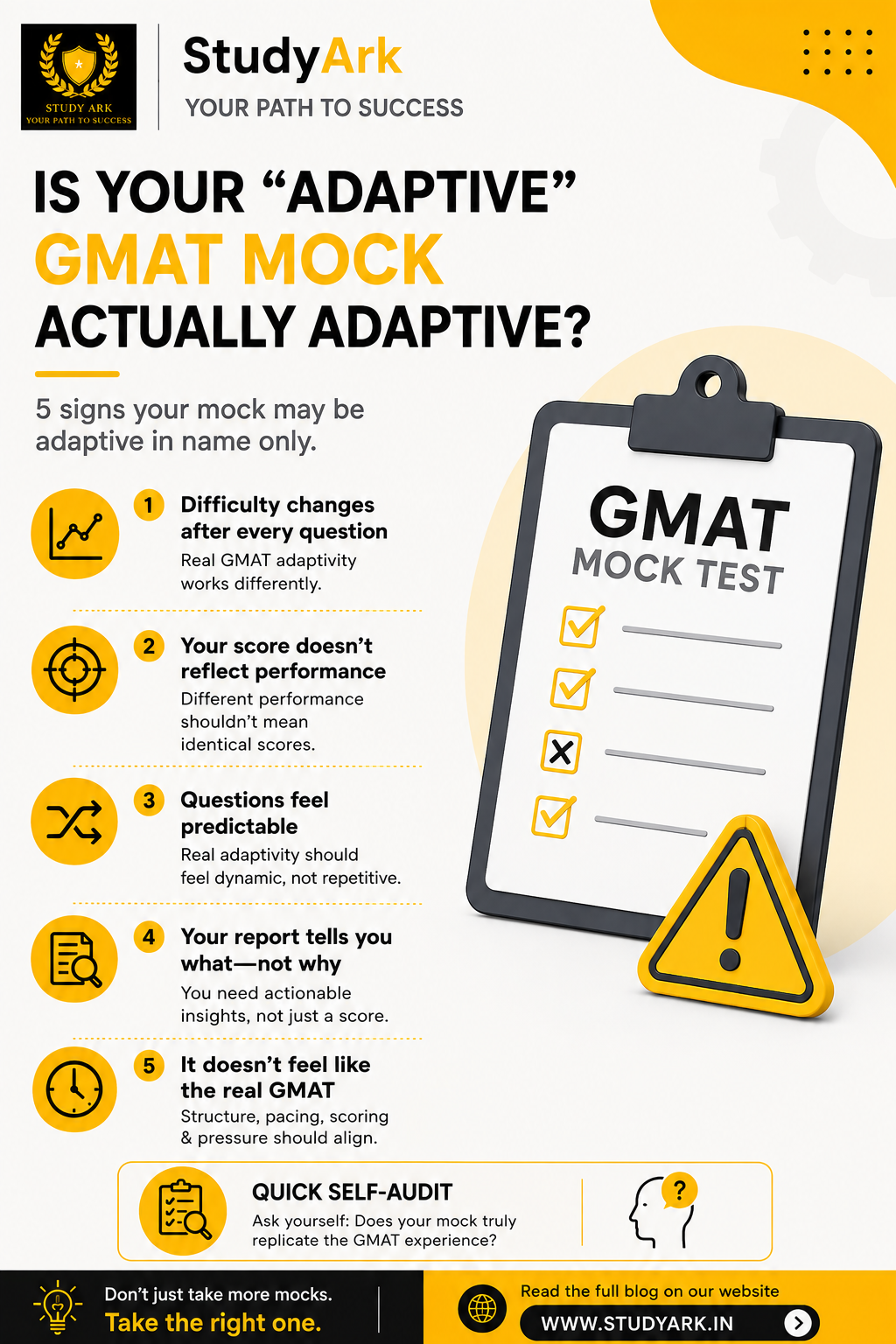
- 5 Signs Your GMAT Mock Isn't Actually Adaptive
- 1. The Difficulty Changes After Every Single Question
- 2. Your Score Doesn't Reflect Your Actual Performance
- 3. The Questions Feel Predictable
- 4. Your Score Report Tells You What Happened— Not Why!
- 5. The Mock Doesn't Feel Like the Real GMAT
- How to Use Your Mock Results the Right Way
- The Bottom Line: A Quick Self-Audit
- Stop Guessing Your GMAT Score
Is Your "Adaptive" GMAT Mock Actually Adaptive?
You take a mock test. You get a score. You assume that score reflects your GMAT readiness, after all, the platform calls itself "adaptive."
But adaptivity isn't a single, standardized feature. It means very different things across different test-prep platforms, and the gap between "adaptive" as a marketing label and adaptive as a genuine testing methodology can quietly distort months of preparation.
The real GMAT uses a section-level adaptive model: your performance on earlier questions within a section shapes the difficulty of what follows, and your section-level performance ultimately determines your score. For a mock test to be useful, it needs to replicate that structure, not just the difficulty curve, but the pacing, the scoring logic, and the overall test-taking experience.
This article walks through five signs that your mock test may be "adaptive" in name only, and how to run a quick self-audit on your current prep tool.
What "Adaptive" Actually Means on the GMAT
Before you can spot a fake adaptive test, it helps to know what a real one looks like. On the GMAT, adaptivity operates at the section level, not the question level. Your responses within a section inform the difficulty of subsequent questions in that section, and your overall section performance, not a simple percentage of correct answers , determines your score.
Many mock platforms simplify this into something that looks adaptive but behaves quite differently. That's where the trouble starts.
5 Signs Your GMAT Mock Isn't Actually Adaptive
1. The Difficulty Changes After Every Single Question
Why it's a red flag: If your mock makes the very next question easier or harder immediately after each response, it's likely using a simplistic, question-level adaptation model rather than the GMAT's section-level approach. This kind of over-correction doesn't reflect how the real exam evaluates you, and it can produce difficulty swings that feel jarring and unrealistic.
How a genuinely adaptive mock handles it: A well-built adaptive test evaluates your performance across a meaningful stretch of questions within a section, mirroring the GMAT's actual progression rather than reacting to each individual answer in isolation.
Scoring impact: Question-by-question adaptation can make your mock score behave nothing like an official GMAT score, causing you to overestimate or underestimate your real performance level.
2. Your Score Doesn't Reflect Your Actual Performance
Why it's a red flag: Take two mock tests with noticeably different accuracy, pacing, and overall performance, if the final scores come back nearly identical, the platform's scoring algorithm likely isn't responsive enough to what actually happened during the test.
How a genuinely adaptive mock handles it: Reliable scoring evaluates your performance in context, factoring in difficulty progression and section-level outcomes, rather than treating your raw percentage of correct answers as the whole story.
Scoring impact: An unresponsive scoring model creates a false sense of consistency. You may believe you're steadily performing at a certain level when your actual results say otherwise.
3. The Questions Feel Predictable
Why it's a red flag: A genuinely adaptive test shouldn't feel like the same fixed sequence every time you sit for it. If question types, difficulty patterns, or overall distribution start to feel repetitive across attempts, the platform may be relying on a predetermined structure dressed up as adaptivity.
How a genuinely adaptive mock handles it: A dynamic testing experience varies question distribution and section flow in a way that mirrors the range and progression you'll actually encounter on the GMAT.
Scoring impact: Predictability trains you to perform well on that specific mock, not on the exam itself. The result is often inflated confidence with little real improvement in exam readiness.
4. Your Score Report Tells You What Happened— Not Why!
Why it's a red flag: A final score plus a list of right and wrong answers isn't enough to prepare effectively. You need to understand why you performed the way you did. Was it a weak concept? A careless error? Poor time management? A specific question type that consistently trips you up?
How a genuinely adaptive mock handles it: Detailed analytics should break down your sectional performance, accuracy, and timing, and point clearly to the areas that need work — not just report the outcome.
Scoring impact: Without meaningful analytics, the same mistakes tend to repeat. A lower score is only useful if you can pinpoint what caused it and act on that information.
5. The Mock Doesn't Feel Like the Real GMAT
Why it's a red flag: This is the simplest test of all: does the experience actually resemble the exam you're preparing for? Compare pacing, section structure, question distribution, adaptive behavior, scoring, and overall test pressure. If the experience feels meaningfully different from the real GMAT, the resulting score is unlikely to be a reliable indicator of your readiness.
How a genuinely adaptive mock handles it: The closer a platform brings together section-level adaptivity, realistic pacing, exam-style question distribution, accurate scoring logic, and detailed performance analysis, the more trustworthy the simulation becomes.
Scoring impact: The closer the mock experience mirrors the real exam, the more useful the resulting score and data become — and the better prepared you'll be to manage pacing and pressure on test day.
How to Use Your Mock Results the Right Way
A GMAT mock shouldn't just answer one question — "What score did I get?" It should help you answer three more important ones:
Where am I performing well? Identify the sections, question types, and concepts where you're consistently strong.
Where am I losing marks? Look beyond accuracy alone — examine timing, careless mistakes, and recurring weak points.
What should I change before my next mock? Use the data to build a focused study plan, rather than simply repeating another test and hoping for a different outcome.
If several of the red flags above sound familiar, your current mock may not be giving you an accurate picture of your GMAT readiness — no matter what the platform calls itself.
The Bottom Line: A Quick Self-Audit
Run your current mock test through these five questions:
Does it follow a realistic, section-level adaptive model — rather than adjusting after every single question?
Does its scoring meaningfully reflect differences in your performance across attempts?
Do the questions and difficulty progression feel genuinely dynamic, not predictable?
Does the score report explain why you performed the way you did, not just what happened?
Does the overall test experience closely resemble the real GMAT in pacing, structure, and pressure?
If you answered "no" to two or more of these, your mock may be adaptive in name — but not in practice.
Stop Guessing Your GMAT Score
Your mock score is only as useful as the mock itself. If you're preparing for the GMAT, don't settle for a test that simply labels itself "adaptive." Practice with a platform built to replicate the real exam experience, help you understand your performance, and show you exactly where to improve.
Take a free Study MOCA adaptive GMAT mock → studyark.in/study-moca/gmat
Not sure where to start?
Get a free personalised strategy session with a StudyArk mentor.
Book Free ConsultationThis article was reviewed by StudyArk's expert review panel, comprising experienced professionals and subject-matter experts.
Panel of Reviewers
Manish Sahoo
Masters Student at University of Tokyo · University of Tokyo
Shailendra Nama
Director at Alvarez & Marsal · Oxford