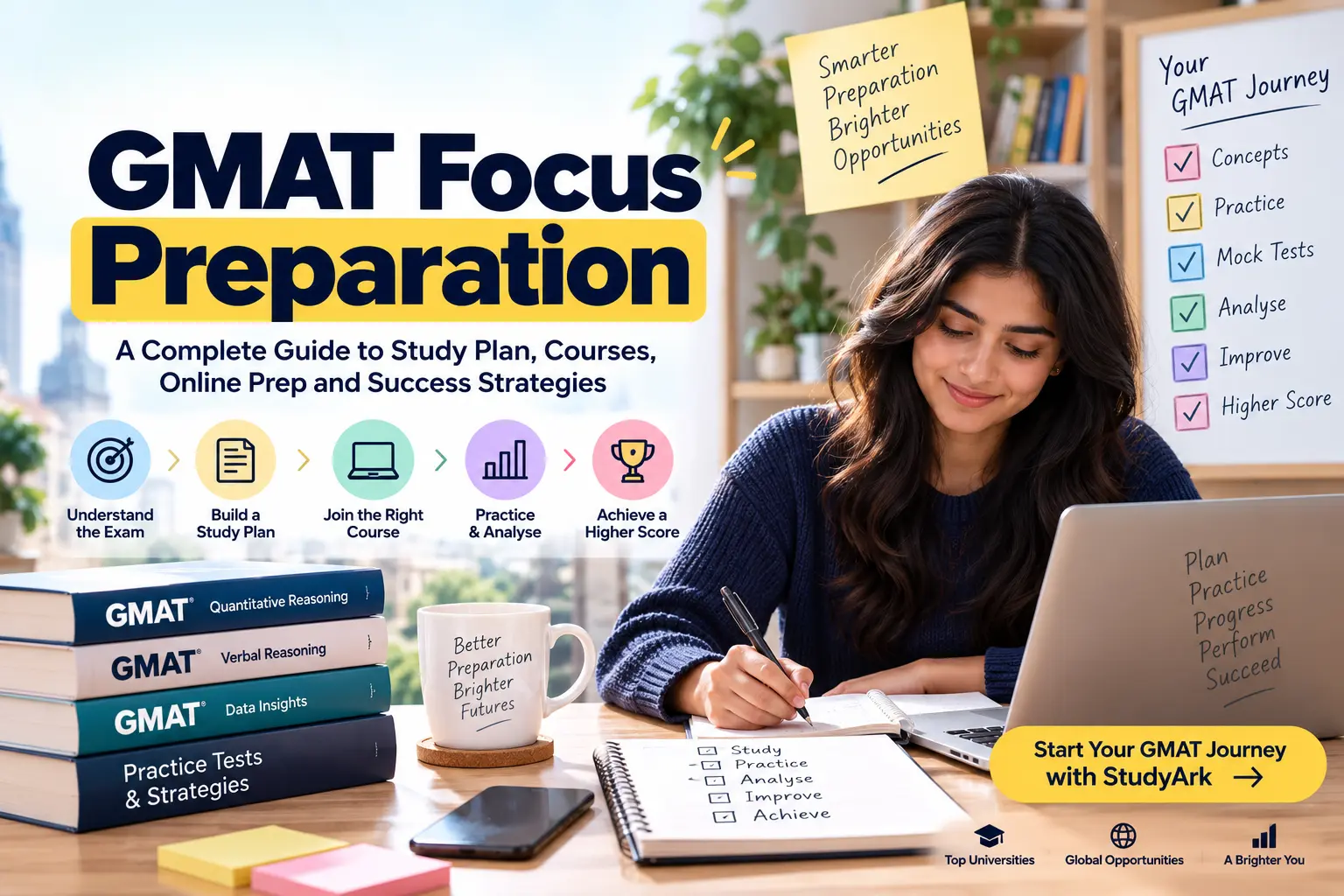
60-Second Summary
- Understand the current GMAT: The exam has three sections — Quantitative Reasoning, Verbal Reasoning, and Data Insights.
- Set the right target: Start with a diagnostic test, understand your current level, and set a realistic target based on your target business schools.
- Choose coaching carefully: Look for personalised study plans, expert guidance, realistic mock tests, performance analysis, doubt support, and preparation aligned with the current GMAT.
- Prepare strategically: Focus on concepts, practice, timing, mock tests, and analysing mistakes rather than simply studying for more hours.
- GMAT Focus Coaching
- GMAT Focus Edition Overview
- What does this mean for your preparation?
- GMAT Focus Edition Exam Structure
- Quantitative Reasoning
- Verbal Reasoning
- Data Insights
- GMAT Focus Edition Score Analysis
- Start with your baseline
- What Should Be Your Target GMAT Score?
- A practical target-setting framework
- Why Do You Need GMAT Focus Edition Coaching?
- Coaching can help when you:
- How to Choose the Best Coaching for GMAT Focus Edition
- 1. Does the program follow the current GMAT?
- 2. Do they start with a diagnosis?
- 3. Do they analyse your mistakes?
- 4. Do they provide realistic mock tests?
- 5. Is there individual feedback?
- What Makes StudyArk Different?
- Student A
- Student B
- StudyArk's approach
- Advantages of a Structured StudyArk Approach
- Personalised preparation
- Adaptive practice
- Mock-test analysis
- Human guidance
- Flexible preparation
- Application connection
- Why Choose Online GMAT Coaching?
- Flexible scheduling
- Location independence
- Recorded revision
- Digital performance tracking
- Faster access to practice
- GMAT Coaching vs Self-Study: Which Approach Should You Take?
- Self-study may work well if:
- Coaching may be useful if:
- A hybrid approach can also work
- What Should a GMAT Focus Coaching Program Include?
- A Better Way to Think About GMAT Preparation
- Phase 1 — Diagnose
- Phase 2 — Identify
- Phase 3 — Build
- Phase 4 — Practice
- Phase 5 — Time
- Phase 6 — Simulate
- Phase 7 — Analyse
- Phase 8 — Refine
- What About GMAT Focus Mock Tests?
- GMAT Focus Coaching for Working Professionals
- GMAT Focus Coaching for Beginners
- Start Your GMAT Preparation With a Clear Plan
GMAT Focus Coaching
If you're searching for GMAT Focus coaching, you're probably not just looking for someone to teach you Quant and Verbal.
You are looking for a system that answers a much more important question:
“What should I do differently to reach my target GMAT score?”
That distinction matters.
The GMAT has changed significantly from the older version. What many students still call the “GMAT Focus Edition” is now officially referred to by GMAC as the GMAT Exam. The current exam has three sections—Quantitative Reasoning, Verbal Reasoning and Data Insights—and takes 2 hours and 15 minutes, plus an optional 10-minute break.
So, choosing a GMAT coaching program today should not be based simply on the number of classes offered.
It should be based on how well the coaching approach matches the current exam, your starting level, your target score and the way you learn.
GMAT Focus Edition Overview
The term GMAT Focus Edition is still widely used by students, coaching institutes and older online resources.
However, GMAC's current official material refers to the exam simply as the GMAT Exam. The current version replaced the previous GMAT format in late 2023.
The current exam consists of:
Section | Questions | Time |
Quantitative Reasoning | 21 | 45 minutes |
Verbal Reasoning | 23 | 45 minutes |
Data Insights | 20 | 45 minutes |
Total | 64 | 2 hours 15 minutes |
The three sections contribute to the total score, and the exam is designed around skills such as quantitative reasoning, critical reasoning, reading comprehension and data interpretation.
What does this mean for your preparation?
It means old-style preparation alone isn't enough.
You need to prepare for:
Problem solving
Reading comprehension
Critical reasoning
Data interpretation
Data sufficiency
Time management
Adaptive testing
Section strategy
Reviewing and learning from mistakes
And that is where structured coaching can become useful.
GMAT Focus Edition Exam Structure
Before choosing GMAT Focus coaching, you should understand what you're actually preparing for.
Quantitative Reasoning
Quantitative Reasoning tests foundational arithmetic and algebra along with your ability to apply those concepts to solve problems.
The current section contains 21 Problem Solving questions and does not allow a calculator.
This doesn't mean you need advanced mathematics.
What matters is being able to:
Understand the problem quickly
Identify the relevant information
Build the right approach
Calculate efficiently
Avoid unnecessary steps
Make decisions under time pressure
A good coach should therefore teach you how to think through a problem, not just which formula to use.
Verbal Reasoning
The Verbal section contains Reading Comprehension and Critical Reasoning questions.
It measures your ability to understand written material, draw inferences and evaluate arguments.
This is particularly important for students who approach GMAT Verbal as a vocabulary test.
It isn't.
You can know hundreds of difficult words and still struggle if you cannot identify:
The author's main point
The conclusion of an argument
An assumption
Evidence supporting a conclusion
A logical gap
What an answer choice actually changes
Good GMAT preparation should therefore develop reasoning, not simply memorisation.
Data Insights
Data Insights is one of the defining features of the current GMAT.
It measures your ability to analyze and interpret different types of information and apply it to business-related situations.
The section includes:
Data Sufficiency
Multi-Source Reasoning
Table Analysis
Graphics Interpretation
Two-Part Analysis
This is an area where structured practice can make a meaningful difference because you need to become comfortable switching between numbers, tables, graphs and written information.
GMAT Focus Edition Score Analysis
One of the first questions you should ask before joining coaching is:
“What score am I actually trying to achieve?”
Not because one number guarantees admission—it doesn't—but because your target score affects how you should prepare.
For example, someone starting around a relatively strong baseline may need a very different strategy from someone who is still building fundamental concepts.
Start with your baseline
Before committing to a preparation plan, take a realistic diagnostic test.
The official GMAT Starter Kit currently provides more than 70 sample questions and two full-length practice exams. Official practice exams are designed to mirror the actual GMAT's timing, structure and scoring approach.
Your diagnostic should help you understand:
Current score → Target score → Gap → Preparation required
For example:
If your baseline is already close to your target, spending months relearning everything may be inefficient.
On the other hand:
If there is a substantial gap, jumping straight into difficult questions without fixing your fundamentals may create frustration rather than progress.
This is why personalised diagnosis matters.
What Should Be Your Target GMAT Score?
There is no universal GMAT score that guarantees admission to every business school.
Your target should be based on the programs you are applying to, the competitiveness of those programs, your academic profile and the rest of your application.
Instead of asking:
“What is a good GMAT score?”
ask:
“What score makes sense for the schools and programs I am targeting?”
You should also avoid treating a GMAT score as the only part of an MBA application.
Business schools evaluate applications holistically, and the importance of the GMAT can vary between programs.
A practical target-setting framework
Use four numbers:
1. Baseline score
Where are you today?
2. Target score
What score are you aiming for?
3. Gap
How far are you from your target?
4. Deadline
How much time do you have?
That gives you something far more useful than choosing an arbitrary number because someone on social media said it was “good.”
Why Do You Need GMAT Focus Edition Coaching?
You don't necessarily need coaching to prepare for the GMAT.
Some students can prepare effectively using official resources, a structured study plan and disciplined self-study.
GMAC itself provides official preparation resources, including practice questions, practice exams, an Official Guide and a free Starter Kit.
So when does coaching become useful?
Coaching can help when you:
Don't know where to start
Have difficulty creating a realistic study plan
Keep making the same mistakes
Struggle with time management
Need accountability
Want regular performance analysis
Have a specific score target
Are balancing GMAT preparation with college or work
Need help identifying your weakest areas
Have already studied but aren't seeing meaningful improvement
The biggest value of coaching shouldn't be “someone gives you more questions.”
You can find questions everywhere.
The value should be:
Diagnosis → Strategy → Practice → Feedback → Adjustment
That is the cycle that turns practice into improvement.
How to Choose the Best Coaching for GMAT Focus Edition
There are plenty of GMAT coaching options available.
Instead of choosing based on advertisements, compare the actual preparation system.
Here are the questions I would ask before paying for a course.
1. Does the program follow the current GMAT?
This should be your first check.
If a course still heavily revolves around the old four-section GMAT structure, be careful.
The current exam has three sections:
Quantitative Reasoning + Verbal Reasoning + Data Insights.
2. Do they start with a diagnosis?
You shouldn't receive the exact same study plan as every other student.
Your preparation should reflect your starting point.
Ask:
“How will you determine what I need to work on first?”
If the answer is simply “Attend our classes and solve our material,” ask for more detail.
3. Do they analyse your mistakes?
A mock score tells you what happened.
Analysis should tell you why it happened.
For example:
Wrong answer
↓
Was it a concept gap?
↓
A timing problem?
↓
A careless mistake?
↓
A misunderstanding of the question?
↓
A poor strategy?
↓
What should you do differently next time?
That final step is where learning happens.
4. Do they provide realistic mock tests?
This is particularly important for GMAT preparation.
Official GMAT practice exams use the same scoring algorithm as the actual exam and adapt question difficulty based on performance.
So don't choose a course simply because it advertises “50+ mocks.”
Ask:
How realistic are those mocks?
Quantity is not the same as quality.
5. Is there individual feedback?
A large class can teach concepts.
But individual feedback can help answer:
“Why am I personally stuck at this score?”
That is a very different problem.
What Makes StudyArk Different?
StudyArk's approach combines AI-powered learning with human mentorship, rather than treating every student as if they have the same starting point. StudyArk describes its test-preparation system as including adaptive learning paths, mock tests and personalised study plans.
For GMAT preparation, that distinction matters because two students can take the same test and need completely different next steps.
Student A
Strong Quant
Weak Data Insights
Good concepts
Poor timing
Their preparation should focus heavily on DI strategy and pacing.
Student B
Weak Quant fundamentals
Average Verbal
Strong DI
Their preparation may need more concept-building before intensive timed practice.
Giving both students the same weekly plan isn't necessarily efficient.
StudyArk's approach
The broader StudyArk model follows a sequence of:
Assess → Prepare → Shortlist → Apply → Succeed
For test preparation, the platform describes personalised study plans, adaptive practice, mock tests and AI-powered support as part of the preparation experience.
The important idea isn't that technology replaces a mentor.
It is that data can help the mentor understand where the student actually needs help.
Advantages of a Structured StudyArk Approach
Personalised preparation
Your preparation can be built around your current level rather than starting everyone from the same chapter.
Adaptive practice
Practice can focus more heavily on areas where you need improvement.
Mock-test analysis
A mock should become a diagnostic tool rather than simply a score report.
Human guidance
When you are stuck on a concept or strategy, having someone to discuss the problem with can be useful.
Flexible preparation
StudyArk describes flexible scheduling and access to learning materials, mock tests and AI-powered doubt resolution as part of its preparation model.
Application connection
For MBA applicants, GMAT preparation doesn't exist in isolation.
The score eventually becomes part of a broader application that may include academics, professional experience, essays, recommendations and interviews.
That makes it useful to think about your GMAT timeline alongside your application timeline.
Why Choose Online GMAT Coaching?
Online coaching isn't automatically better than classroom coaching.
It is simply a different format.
For some students, however, it can solve a very practical problem:
time.
If you're studying at university or working full-time, travelling to coaching classes several times a week can become difficult.
Online GMAT coaching can give you:
Flexible scheduling
You can fit preparation around college or work.
Location independence
You don't need to live near a coaching center.
Recorded revision
If the program provides recordings, you can revisit difficult concepts.
Digital performance tracking
Online platforms can make it easier to track questions, mocks and progress.
Faster access to practice
Your preparation environment and study resources can remain in one place.
But there is one thing to watch for.
Online does not automatically mean personalised.
A 100% recorded course is still generic if everyone receives exactly the same content.
When comparing online GMAT coaching, ask whether you receive:
Live interaction
Doubt support
Individual performance analysis
Mock-test analysis
Personalised study plans
Mentor access
Adaptive practice
That's where the difference between online content and online coaching becomes clear.
GMAT Coaching vs Self-Study: Which Approach Should You Take?
This isn't a question with one universal answer.
Self-study may work well if:
You are disciplined
You can build your own schedule
You understand your weaknesses
You can analyse your mistakes objectively
You are comfortable finding resources independently
Coaching may be useful if:
You need accountability
You don't know how to structure preparation
Your progress has stalled
You want personalised feedback
You struggle to identify why you're making mistakes
You have limited preparation time
A hybrid approach can also work
You can use official GMAT resources for authentic practice while using coaching for:
planning + strategy + feedback + accountability.
GMAC itself recommends using official preparation resources because they provide authentic GMAT questions and practice exams designed to reflect the actual test experience.
The goal isn't to collect the maximum number of resources.
It's to use the right resources consistently.
What Should a GMAT Focus Coaching Program Include?
Before enrolling, use this checklist.
Feature | Why it matters |
Diagnostic test | Establishes your baseline |
Personalised study plan | Gives preparation direction |
Quant preparation | Builds mathematical problem-solving |
Verbal preparation | Develops reasoning and comprehension |
Data Insights preparation | Builds data interpretation skills |
Timed practice | Improves pacing |
Mock tests | Measures readiness |
Mock analysis | Identifies recurring weaknesses |
Doubt support | Helps resolve blockers |
Mentor guidance | Adds accountability and strategy |
Progress tracking | Shows whether your approach is working |
If a coaching program doesn't explain how it will measure your progress, that's a question worth asking before you enrol.
A Better Way to Think About GMAT Preparation
Here's a simple framework:
Phase 1 — Diagnose
Take a realistic mock.
Phase 2 — Identify
Find your strongest and weakest areas.
Phase 3 — Build
Fix the underlying concepts.
Phase 4 — Practice
Solve targeted questions.
Phase 5 — Time
Introduce timed sets.
Phase 6 — Simulate
Take realistic full-length mocks.
Phase 7 — Analyse
Understand every important mistake.
Phase 8 — Refine
Adjust your strategy based on evidence.
This is more meaningful than simply counting how many hours you studied.
You could study for four hours a day and still make little progress if you keep repeating the same mistakes.
What About GMAT Focus Mock Tests?
Mock tests should play a central role in your preparation—but don't use them simply to chase higher numbers.
Use them to answer questions such as:
Am I improving?
Which section is holding me back?
Am I losing marks because of concepts or timing?
Which question types consistently cause problems?
Is my section order working?
Can I maintain concentration for the full exam?
Official GMAT practice exams are designed to replicate the exam's structure, timing, adaptive delivery and scoring.
That makes realistic mocks particularly useful for measuring readiness.
And after the mock?
Analyse it.
That's where the real preparation begins.
GMAT Focus Coaching for Working Professionals
Working professionals have a different constraint from full-time students:
time.
You may have only one or two hours available on weekdays.
In that situation, a good preparation plan shouldn't simply say:
“Study more.”
It should answer:
“What should I study during the limited time I have?”
A working professional's week might involve:
Weekdays:
Concept building + targeted practice
Weekend:
Longer practice sessions + mock analysis
Every week:
Review progress and adjust the next week's priorities
The exact schedule will vary, but the principle is simple:
Consistency beats occasional marathon sessions.
GMAT Focus Coaching for Beginners
If you're completely new to the GMAT, don't worry about mastering everything immediately.
Your first goal should be understanding the exam.
Start with:
Current exam structure
Question types
Diagnostic test
Basic concepts
Study plan
Targeted practice
Timed practice
Mock tests
Trying to solve the hardest questions on your first week isn't necessarily productive.
Build the foundation first.
Then increase difficulty.
Start Your GMAT Preparation With a Clear Plan
Choosing GMAT Focus coaching shouldn't begin with:
“Which institute has the most classes?”
Start with:
“Where am I now, where do I want to reach, and what is stopping me from getting there?”
Once you know those three things, the right preparation approach becomes much easier to identify.
The current GMAT rewards more than knowing formulas or memorising question patterns. It tests how effectively you can reason, interpret information, solve problems and make decisions under time constraints.
That's why effective preparation should combine:
Concepts + Strategy + Practice + Feedback + Mock Tests + Analysis
If you're looking for a structured GMAT preparation system, explore StudyArk's GMAT preparation program, which combines adaptive preparation, mock testing and personalised support. StudyArk's broader preparation model is built around assessing the student first and then creating a more personalised preparation path.
Your GMAT preparation shouldn't be about studying everything. It should be about knowing what to work on next.
Not sure where to start?
Get a free personalised strategy session with a StudyArk mentor.
Book Free ConsultationFrequently Asked Questions
What is GMAT Focus Coaching?
GMAT Focus Coaching generally refers to preparation programs built around the GMAT Focus Edition format. The term is still widely used, although GMAC now officially refers to the current test as the GMAT Exam.
Is GMAT Focus still the current exam?
The current exam is officially called the GMAT Exam. “GMAT Focus” or “GMAT Focus Edition” are terms commonly used to refer to the newer format introduced in 2023.
What are the sections of the GMAT?
The current GMAT has three sections: Quantitative Reasoning Verbal Reasoning Data Insights Each section is 45 minutes.
Is online GMAT coaching effective?
Online coaching can be effective when it includes more than recorded lectures—for example, personalised planning, mentor support, realistic mocks, performance analysis and targeted practice.
What should I look for in GMAT coaching?
Look for a program that understands the current GMAT structure and provides a clear system for diagnosis, personalised preparation, practice, mock testing and feedback.
Can I prepare for GMAT while working?
Yes. Many working professionals prepare alongside their jobs. The key is to build a realistic schedule around the hours you can consistently dedicate to preparation.
This article was reviewed by StudyArk's expert review panel, comprising experienced professionals and subject-matter experts.
Panel of Reviewers
Manish Sahoo
Masters Student at University of Tokyo · University of Tokyo
Shailendra Nama
Director at Alvarez & Marsal · Oxford