If you've ever taken a GRE mock test and walked away with a score that didn't survive contact with the real exam, you're not imagining things. Most "GRE mock test 2026" products floating around online aren't actually adaptive they just look adaptive. That gap is exactly why we built the GRE Study MOCA.
Here's the story of what we built, why it was harder than it sounds, and how it changes the way you should be prepping.
What "Adaptive" Actually Means on the GRE
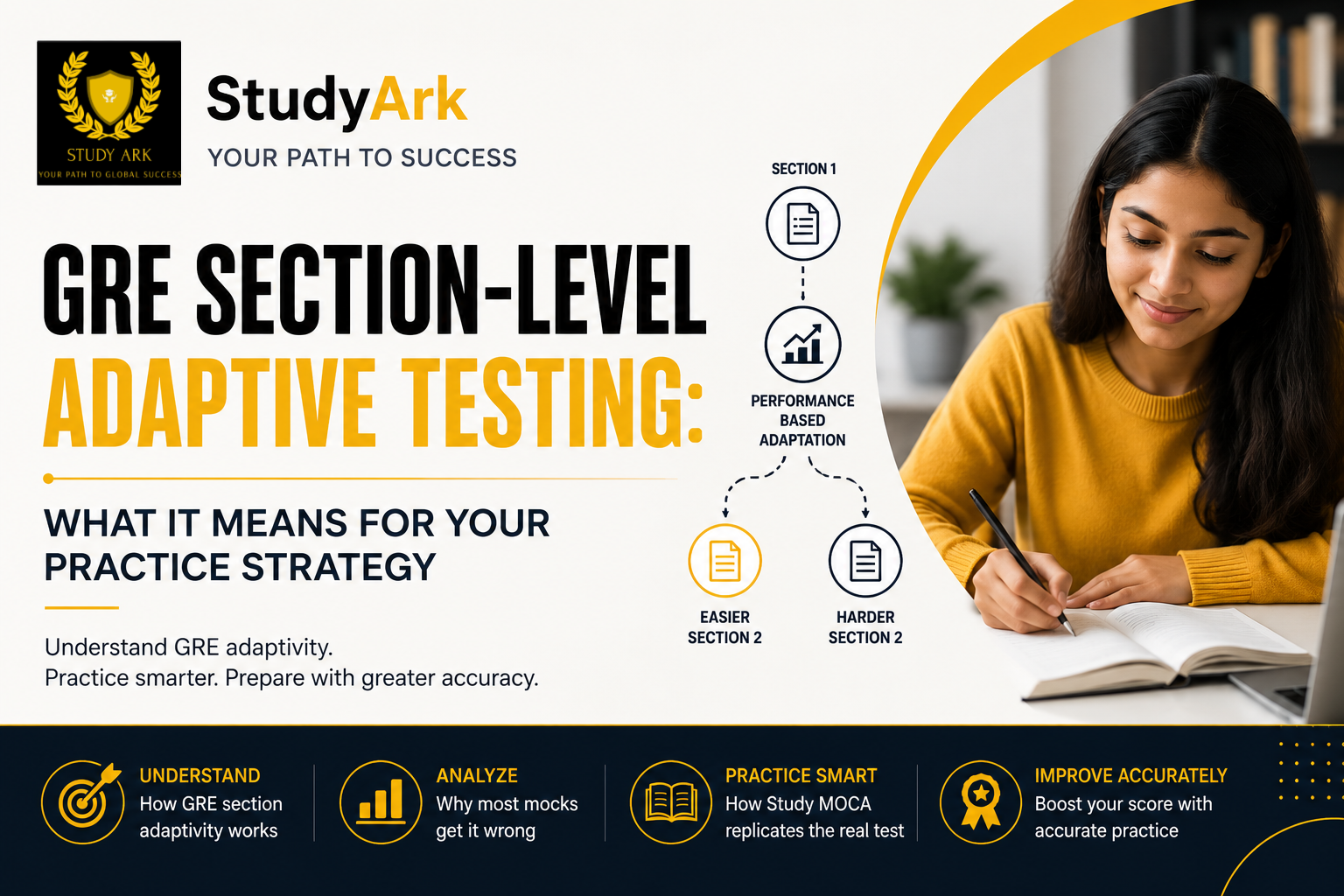
The GRE isn't a fixed-difficulty test. It uses a section-level adaptive model, sometimes called Multi-Stage Adaptive Testing (MST). Here's the mechanic:
You get two Verbal sections and two Quant sections.
Your performance on the first Verbal section determines the difficulty of your second Verbal section. Same for Quant.
Do well on Section 1, and Section 2 pulls from a harder question pool with a higher ceiling on your scaled score.
Struggle on Section 1, and Section 2 shifts easier capping how high you can climb, regardless of how well you do afterward.
This is the single biggest structural difference between the GRE and, say, the SAT or a straightforward practice PDF. Every question you answer in Section 1 isn't just being scored it's steering which pool of questions you see next. Get this wrong in your prep, and you're training for a test that doesn't exist.
Why Most GRE Mocks Get This Wrong
Scan through the average "adaptive GRE practice test India" search result and you'll find one of three patterns:
Fixed-difficulty sets rebranded as "adaptive." Every test-taker sees the same questions in the same order, no matter how they perform. The word "adaptive" is marketing, not mechanics.
Randomized difficulty, not routed difficulty. Some platforms shuffle in a few harder or easier questions at random. That's variety, not adaptivity; it doesn't respond to your Section 1 performance.
Item-level adaptivity (wrong model entirely). A few tools adjust difficulty question-by-question, like the old GRE format or other CAT exams. That's a different testing architecture altogether, and it trains the wrong instinct: the current GRE won't punish or reward you mid-section the way these tools simulate.
The result: students walk in on test day, hit a Section 2 routing decision they've never trained for, and get a score that swings 5-10 points from every mock they took. The mock wasn't lying to them exactly, it just wasn't testing the thing that matters.
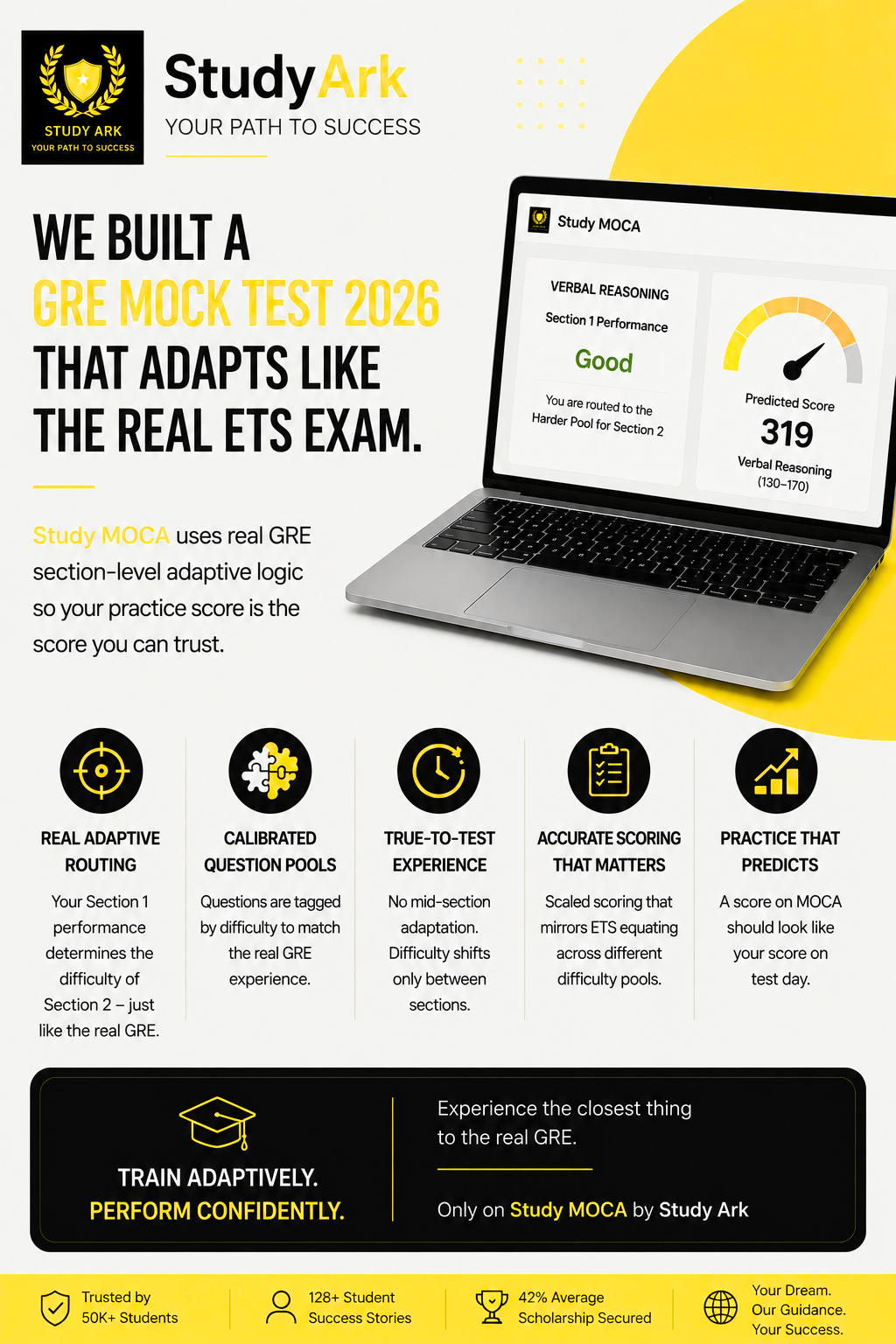
How Study MOCA Replicates the Real Routing Logic
We built MOCA (Study Ark's mock engine) around the actual MST structure ETS uses, not an approximation of it:
Real section-routing logic: Your Section 1 Verbal and Quant performance is scored in real time and determines which difficulty pool easier, medium, or harder populates your Section 2.
Calibrated item pools: Questions are tagged and weighted by difficulty band so the "harder" pool is actually harder in the way ETS's harder pool is harder, not just longer or more obscure.
No mid-section adjustment: True to the real exam, difficulty only shifts between sections, never within one. This matters because it trains the right pacing instinct: don't panic and slow down if one question feels tough mid-section the stakes are at the section boundary, not the question level.
Scaled scoring that mirrors ETS's curve: Your raw performance is converted using a scaled model built to reflect how ETS's own equating works across difficulty pools, not a flat percentage-correct formula.
In practice, this means two students who get the same number of questions right on Section 1 but take different paths through Section 2 will end up with meaningfully different scaled scores exactly as they would on test day.
The Scoring Impact: Why This Changes Your Number
This is the part students underestimate. On a non-adaptive mock, your score is a fairly direct function of how many questions you got right. On the real GRE and on MOCA your score is a function of how many you got right, weighted by which pool you earned access to.
Two consequences follow:
Section 1 matters more than it feels like it does. A shaky first Verbal section can cap your ceiling even if you ace the second section. Practicing on MOCA surfaces this early, so you learn to lock in early rather than "warming up" into the test.
Your practice score becomes trustworthy. Because the routing and scaling mirror the real exam, a 315 on MOCA should look like a 315 on test day not a 315 that turns into a 305 because the mock never tested the routing decision at all.
A quick note on how the equating actually works
One clarification worth making, since it trips people up: the GRE does not use negative marking. There's no penalty for a wrong answer or a guess in either Verbal or Quant you're scored purely on correct answers, so an educated guess is never a bad bet.
Where Verbal and Quant do differ is in how each is equated and scaled:
Each section is scored independently. Verbal Reasoning and Quantitative Reasoning each produce their own scaled score (130–170), calculated separately there's no shared or blended difficulty curve between them. Doing well in Quant doesn't offset a weak Verbal Section 1, or vice versa.
Equating adjusts for pool difficulty, not question count. Because your Section 2 pool might be objectively harder or easier than another test-taker's, ETS equates raw scores against the specific difficulty of the pool you were routed into so two students who get, say, 15 of 20 right can end up with different scaled scores if one was working through the harder pool.
MOCA mirrors this per-section, not as a combined average. Your Verbal and Quant results are equated separately in the same way, which is why your MOCA score report shows independent Verbal and Quant ceilings rather than one blended difficulty number.
How to Actually Use Study MOCA in Your Prep
A realistic mock is only useful if you use it at the right moments:
Baseline early: Take one MOCA test in week one, before heavy prep, to see your natural routing pattern which section tends to determine your ceiling.
Diagnose, don't just score: After each mock, look at where you got routed, not just your final number. If you keep landing in the medium Verbal pool, that's your signal for where to spend study hours.
Simulate full-length under real conditions: Take at least 3-4 full MOCA tests in the 6 weeks before your exam, timed, in one sitting, to build the stamina the adaptive structure demands.
Review the Section 1 decisions specifically: Go back through your Section 1 answers and identify the 2-3 questions that likely swung your routing. These are usually medium-difficulty questions you rushed or second-guessed, not the hardest ones.
Retest, don't just re-read: Adaptive routing means your prep should be tested, not just reviewed. Retake a fresh MOCA every couple of weeks to confirm your ceiling is actually moving up.
Try It Yourself
If your current prep score doesn't feel like it matches your actual ability or you've never trained against real section-level routing it's worth finding out where you actually stand.
Take a full-length Study MOCA test and see which pool you route into. It's the closest you can get to test day without walking into the test center.
Have questions about how MOCA's scoring compares to your target score range? Reach out to the Study Ark team. We're happy to walk through your diagnostic results with you.
Take a free Study MOCA adaptive GMAT mock → https://studyark.in/study-moca/gre