The GMAT Isn't Trying to Trick You—It's Trying to Understand How You Think
For years, the word adaptive has been surrounded by myths in the GMAT preparation community. Some candidates believe that every question determines the difficulty of the next one. Others assume that an early mistake can permanently damage their chances of achieving a competitive score. These misconceptions often lead to unnecessary stress and ineffective preparation strategies.
The truth is more nuanced.
In reality, the GMAT Focus Edition is built on a section-level adaptive framework that evaluates performance holistically across an entire section, delivering a more accurate and reliable assessment of a candidate's reasoning and problem-solving abilities.
This evolution reflects a broader shift towards evaluating sustained analytical thinking, sound judgment, and decision-making rather than isolated performance on individual questions. Consequently, effective preparation extends beyond mastering the syllabus—it requires practice that faithfully replicates the GMAT Focus test structure. Mock tests that do not align with the official exam's adaptive design can lead to inaccurate score projections, ineffective pacing strategies, and an incomplete understanding of overall readiness.
What Does "Adaptive" Really Mean in the GMAT Focus Edition?
The term adaptive in the GMAT Focus Edition represents a far more sophisticated assessment methodology than simply adjusting question difficulty. Rather than evaluating candidates based on isolated responses, the exam employs a section-level adaptive framework that measures performance across an entire section. Each of the three sections—Quantitative Reasoning, Verbal Reasoning, and Data Insights—is designed to assess a distinct set of competencies, enabling the scoring model to evaluate consistency, critical reasoning, and decision-making over the course of the section. This approach provides a more accurate representation of a candidate's aptitude while reducing the disproportionate impact of occasional errors.
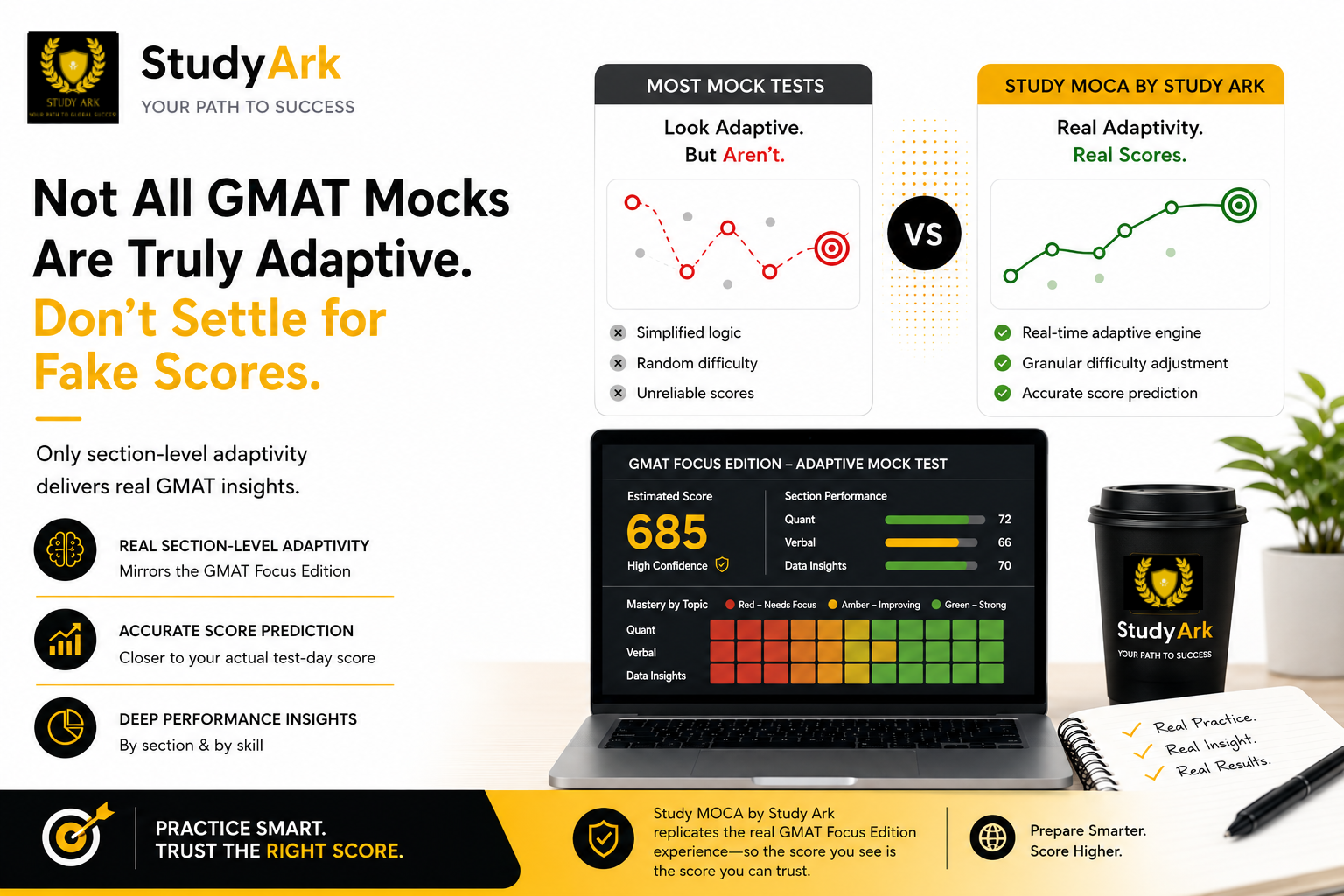
Recognising the importance of preparing within the same assessment philosophy, Study MOCA has been designed to closely reflect the GMAT Focus test structure and its section-level adaptive approach. Instead of focusing solely on individual question outcomes, the platform evaluates sectional performance, pacing, and response patterns to provide meaningful insights into a candidate's strengths and areas for improvement. By recreating the logic behind the official exam, Study MOCA enables aspirants to develop the strategic thinking, consistency, and confidence required to perform effectively on test day.
Why the Right Mock Test Makes All the Difference
The effectiveness of GMAT preparation depends not only on the quality of the study material but also on how accurately a mock test replicates the actual examination experience. Since the GMAT Focus Edition follows a section-level adaptive framework, an effective practice test should mirror the exam's structure, pacing, scoring methodology, and analytical depth. A simulation that does not align with these elements may offer limited insight into a candidate's true readiness, making it difficult to build the right test-taking strategy.
Recognising this, Study MOCA has been developed to closely reflect the official GMAT Focus test structure by incorporating section-level adaptivity, realistic timing, comprehensive performance analytics, and detailed score interpretation. Rather than presenting only an overall score, it enables candidates to understand how consistency, pacing, and decision-making influence their performance across each section. This data-driven approach transforms every mock test into a meaningful learning experience, helping aspirants refine their strategy with greater accuracy and confidence before test day.
Why Simulation Matters More Than Difficulty
Many students judge a mock test by one criterion alone: "Was it difficult?"
Difficulty, however, is only one component of effective preparation.
A high-quality simulation should replicate:
The structure of the official assessment
Section timing
Question distribution
Navigation experience
Adaptive behaviour
Score interpretation
Performance analytics
Without these elements, even a challenging mock may fail to prepare candidates effectively.
Professional athletes rarely train by making workouts harder than competition. Instead, they train in environments that closely resemble actual match conditions. The same principle applies to standardized testing.
Authentic simulation develops familiarity, confidence, and strategic decision-making—qualities that cannot be built through random question practice alone.
How Study MOCA Replicates the GMAT Focus Experience
Preparing for the GMAT requires more than solving practice questions—it demands an environment that accurately reflects the structure, scoring methodology, and adaptive nature of the actual exam. Study MOCA is designed with this philosophy in mind, offering a realistic simulation of the GMAT Focus Edition while equipping aspirants with actionable insights to strengthen their preparation and test-day strategy.
Authentic GMAT Focus Simulation: Replicates the official exam's section-level adaptive framework, structure, and pacing for a realistic test-day experience.
Intelligent Performance Analytics: Delivers detailed section-wise insights, enabling candidates to identify strengths, address learning gaps, and monitor progress effectively.
Advanced Time Management Analysis: Tracks time spent across sections and question types, helping aspirants optimise pacing and improve decision-making under timed conditions.
Data-Driven Learning: Provides personalised feedback and performance trends, transforming every mock test into a structured learning opportunity.
Exam-Ready Preparation: Builds familiarity with the GMAT Focus Edition, allowing candidates to approach the actual exam with greater confidence, accuracy, and strategic awareness.
Understanding the Impact of Adaptive Scoring
Understanding GMAT Focus Edition adaptive scoring helps candidates prepare with greater clarity and confidence. Since the exam evaluates performance across an entire section rather than individual questions, success depends on consistency, strategic decision-making, and effective time management.
Prioritise Consistency: Steady performance throughout each section has a greater impact than striving for perfection on every question.
Make Strategic Decisions: Knowing when to move ahead from a difficult question is key to maintaining momentum and optimising time.
Adopt a Balanced Approach: Equal attention to Quantitative Reasoning, Verbal Reasoning, and Data Insights supports stronger overall performance.
Practise with Purpose: Use mock tests that replicate the GMAT Focus Edition to strengthen reasoning, pacing, and exam readiness.
How to Make the Most of Your GMAT Practice
Preparing effectively involves more than completing multiple mock tests. Students who achieve meaningful score improvements often follow a structured review process.
Begin with a Diagnostic Assessment: Establish your baseline by taking a full-length test under exam-like conditions.
Analyse Before You Practise Again: Analyse mistakes to identify conceptual gaps, time-management issues, and recurring patterns.
Build Targeted Improvement Plans: Prioritise weaker areas instead of adopting a one-size-fits-all study approach.
Simulate the Real Environment: Practise in a distraction-free environment to build endurance and familiarity with the exam.
Track Progress, Not Individual Scores: Track performance trends across multiple mocks rather than focusing on a single score.
Final Thoughts
The GMAT Focus Edition represents a more advanced approach to assessment, placing greater emphasis on analytical reasoning, consistency, and strategic decision-making than on isolated performance. Understanding the principles of the GMAT section adaptive test enables candidates to prepare with greater confidence and adopt a more effective test-taking strategy.
Equally important is practising in an environment that reflects the official GMAT Focus test structure. By combining realistic simulation with meaningful performance insights, candidates can make every mock test a valuable learning opportunity. Ultimately, success on the GMAT is not defined by the volume of questions attempted, but by the quality, precision, and purpose of the preparation behind them.
Ready to Experience Smarter GMAT Preparation?
Study MOCA combines realistic exam simulation, insightful performance analytics, and a learning-first approach to help candidates prepare with confidence for the GMAT Focus Edition.
Whether you're aiming to establish your baseline, improve sectional performance, or refine your test-day strategy, practicing in an environment that mirrors the official exam can make all the difference.
Take a free Study MOCA adaptive GMAT mock → studyark.in/study-moca/gmat