
From Dreams to Degrees: How Fully Funded Scholarships in South Korea Can Change Your Life

Over the past few years, South Korea has slowly become a place where many Indian students are allowed to dream bigger. One major reason is that South Korea is the home of global giants like Samsung, Kia, and Coupang. Knowing that these global names are part of the country’s foundation makes students feel that they are stepping into an ecosystem where real opportunities exist. It gives a sense of reassurance that their hard work can lead to something meaningful after graduation. You can see this change in the growing Indian community itself. What was once around 7,000 people has now grown to over 20,000. Behind this number are real stories. Students who once left home feeling unsure are now finding jobs, becoming independent, and slowly building a life of their own. What once felt unfamiliar starts to feel like a second home. Scholarships have played a huge role in making this possible. For many students, the biggest fear is not ability, but affordability. South Korea changes that. Many scholarships cover tuition, living costs, and sometimes everything. It removes that constant financial stress and replaces it with relief, confidence, and hope. Because of this, South Korea no longer feels like a distant dream. It starts to feel like a place where hard work can truly change your life. To explore everything about studying, living, and building your future in South Korea, a complete guide to studying in South Korea for Indian students Government Scholarships: Coverage: Covers full tuition fees, a monthly stipend (KRW 900,000 – 1,500,000), round-trip airfare, medical insurance, settlement allowance, and 1 year of Korean language training. Eligibility: Open to international students whose parents are not Korean citizens. Applicants must have a Bachelor’s degree for Master’s programs, strong academic performance, and good physical and mental health. Application Tracks: Embassy Track – Apply through the Korean Embassy in your country University Track – Apply directly through participating Korean universities Deadline for the 2026 intake: Applications usually open between September and October 2025 (Embassy Track) and between February and March 2026 (University Track).Global Korea Scholarship(GKS): KOICA Scholarships: Coverage: Fully funded scholarship covering full tuition, a monthly stipend, accommodation, airfare, and medical insurance. Eligibility: Open to international students with a Bachelor’s degree and usually 1-2 years of work experience, especially in public or professional sectors. Application Process: Apply through KOICA partner organizations or nominated institutions in your home country. Deadline for 2026 intake: Applications generally open between February and April 2026, depending on the program. University & Research Institute Scholarship: KAIST Scholarship: Coverage: Covers full tuition, a monthly stipend, and medical insurance. Eligibility: Open to international students with strong academics applying for Master’s or PhD programs. Programs Covered: Available for MS and PhD in Engineering, AI, Data Science, Robotics, and Sciences. Application Process: Apply directly to KAIST. Scholarship is awarded automatically with admission. Seoul National University Scholarship: Coverage: Covers full or partial tuition and provides a monthly stipend. Eligibility: Open to international students applying for a Master’s or PhD with strong academics. Programs Covered: Available for MS, MBA, and PhD across Engineering, Business, Science, and more. Application Process: Apply directly to Seoul National University. Scholarship is awarded with admission. Fellowships and Specialized Programs: POSCO Scholarship: Financial Support: Helps students by covering full or partial tuition and giving a monthly stipend. It reduces the financial pressure and allows students to focus on their studies and life in Korea. Who Can Apply: Open to international students applying for Master’s programs in fields like Engineering, Business, and Technology. Funded by POSCO, it supports students who are serious about building their future. Academy of Korean Studies Fellowship: What You Get: Covers tuition, gives a monthly stipend, and often includes accommodation and other support. This allows students to focus on learning and research without constant financial stress. Who Can Apply: Open to international students interested in Korean Studies, Humanities, and Social Sciences. Offered by the Academy of Korean Studies, it is perfect for students who want to understand Korea more deeply while building a strong academic future. Quick Overview: Type Scholarships Coverage Level Deadline Government Global Korea Scholarship(GKS) Tuition, stipend, airfare Master’s, PhD Sept/March Government KOICA Scholarship Tuition, stipend, airfare Master’s April University KAIST Scholarship Tuition, stipend Master’s, PhD With admission University Seoul National University Scholarship Tuition, stipend Master’s, PhD With Admission Fellowship POSCO Scholarships Tuition, stipend Mater’s Varies Fellowship Academy of Korean Studies Fellowship Tuition, stipend Master’s, Research Varies How To Apply: How to Maximize Your Selection Chances: Selection is not just about grades. It’s about presenting your story, your goals, and your potential in the right way. Apply strategically – Choosing the right scholarships and universities based on your profile makes a huge difference. Build a strong SOP and CV – This is where your journey, ambitions, and clarity truly stand out. Prepare early and avoid mistakes – Timely applications with complete and accurate documents increase your chances. Show a clear purpose – Students who know why they chose South Korea and their field always leave a stronger impression. And we at Study Ark will help you at every step, from checking your eligibility to building strong SOPs and CVs, and guiding you through your full application journey. Because we’ve been there and done that, we know exactly what it takes to turn your dream of studying in South Korea into a reality.
Master’s in South Korea: The Complete Guide to Level Up Your Global Career

For many Indian students, going abroad for a Master’s is a big dream, but it can also feel expensive. This is where South Korea excels. It offers globally recognised universities, modern research facilities, and strong career opportunities, at a cost that is far more affordable than traditional destinations like the US or UK. With generous scholarships, industry exposure, and high-quality education, South Korea gives students the chance to build a global career without putting extreme financial pressure on themselves or their families. Over the past decade, South Korea has actively invested in becoming a global education hub, increasing its international student population from around 85K to over 300K through government scholarships, research funding, and global recruitment initiatives. Alongside this, the Indian community has quietly grown to more than 17K people, creating a sense of familiarity, support, and belonging, so when Indian students arrive, they don’t feel alone; they feel part of something bigger. Top Master’s Programs and Career Paths Fields Specializations Career Roles Average Salary after Graduation Computer Science & Artificial Intelligence Artificial Intelligence, Data Science, Machine Learning, Cybersecurity, Software Engineering AI Engineer, Data Scientist, ML Engineer, Software Developer ₹28 – ₹47 lakhs Engineering & Technology Electrical, Mechanical, Semiconductor, Robotics, Automotive Engineering Semiconductor Engineer, Robotics Engineer, Automotive Engineer, R&D Specialist ₹25 – ₹44 lakhs Business & Management MBA, International Business, Finance, Marketing, Supply Chain Business Analyst, Marketing Manager, Operations Manager, Consultant ₹22 – ₹38 lakhs Biotechnology & Life Sciences Biotechnology, Biomedical Engineering, Pharmaceutical Sciences, Bioinformatics Research Scientist, Clinical Research Associate, Biotech Analyst ₹22 – ₹34 lakhs Where to Study: South Korea’s Top Universities South Korea has quietly become one of Asia’s strongest education hubs and is home to around 2429 universities, offering students a wide mix of public and private institutions. What makes it special is the balance. You get a strong education, but also real industry exposure. Many universities work closely with companies like Samsung, Hyundai, and LG. So students don’t just study from books. They work on real projects. They learn skills that actually help in jobs. Some top universities include: Seoul National University – QS Rank: 31 globally KAIST – QS Rank: 53 globally Yonsei University – 56 globally Korea University – QS Rank: 67 globally POSTECH – 98 globally Sungkyunkwan University – 123 globally Want to check if you’re eligible for these universities? Try our 100% accurate AI-powered CV Matcher and get instant clarity. Tuition Fees and Living Costs Tuition in South Korea depends on the type of university and the course you choose. On average, public universities cost around ₹3 to ₹7 lakhs per year, while private universities range between ₹6 to ₹11 lakhs per year, with technical courses like AI, Engineering, and Biotechnology usually on the higher side. Average Living Costs per Year in South Korea Accommodation: ₹2 – 4lakhs/year (dorm or shared housing) Food: ₹1.2 – 2lakhs/year (student cafeterias are cheaper) Transportation: ₹30,000 – 60,000/year (metro, buses, student discounts) Health Insurance: ₹20,000 – 40,000/year (mandatory) Miscellaneous: ₹50,000 – 1lakh/year (mobile, personal, study expenses) Total Living Cost: ₹4.0 – ₹7.0 lakhs per year, depending on lifestyle and city. IELTS and TOPIK Requirements The Language requirement mainly depends on whether your course is taught in English or Korean. For English-taught programs: Most universities ask for an IELTS score of 6.0 to 6.5. Some universities may even waive IELTS if your bachelor’s degree was fully taught in English. For Korean-taught programs: You’ll need TOPIK Level 3 or 4. This shows you can understand lectures and manage daily life in Korea. Pro tip: Try learning basic Korean – it makes day-to-day life way easier, from ordering food and using transport to making friends and feeling comfortable faster. Scholarships & Funding: Making Your Korea Dream Affordable For many students, the dream of studying abroad often feels limited by financial worries – but South Korea is changing that reality. With generous support from the government, universities, and research foundations, students are given real opportunities to pursue world-class education without carrying the weight of financial stress, making the journey feel not just possible but truly within reach. Government Scholarships: Global Korea Scholarship (GKS): The Global Korea Scholarship (GKS-Graduate) is the primary scholarship offered by the Korean government for Master’s students. Key Benefits: Full tuition fees (100% covered) Monthly Stipend (₹60,000+) Medical insurance coverage Thesis and research support Valid for top public and private universities KOICA Scholarship: The Korea International Cooperation Agency offers KOICA grants. It is mainly designed for students who want to build careers in public policy, development, engineering, and leadership roles. University & Research Institute Scholarships: KAIST Scholarships: KAIST offers one of the best-funded scholarship programs for international Master’s students, especially in STEM fields. UST Scholarship (University of Science and Technology): University of Science and Technology (UST) is a unique government-funded research university that partners with national research institutes. Research and Assistantships: Earn While You Learn One of the biggest advantages of doing a Master’s in South Korea is the chance to be part of real research. You don’t just attend lectures and go home. You spend time in labs. You work on real projects. You learn directly from professors. This hands-on experience helps you understand your field better and prepares you for a real career after graduation. Research Assistant (RA): Work closely with professors on live research projects. Monthly stipend of ₹40,000 – 1,00,00 Gain practical experience in your field Teaching Assistant (TA): Help professors in classes, labs, or assignments Receive stipend or financial support To know more about student part-time jobs in South Korea, click here. From Studying to Settling: Korea’s Visa Roadmap for Students Graduating from a Korean university doesn’t mean you have to pack your bags and leave right away. After spending years studying, adjusting to a new culture, and building your skills, you get the chance to stay back and turn your student life into a real career. Here is a simple roadmap to help you understand how your student journey can turn into a career in South Korea. Smart
From K-Pop to Classrooms: Why South Korea Is the Next Big Education Hub for Indian Students
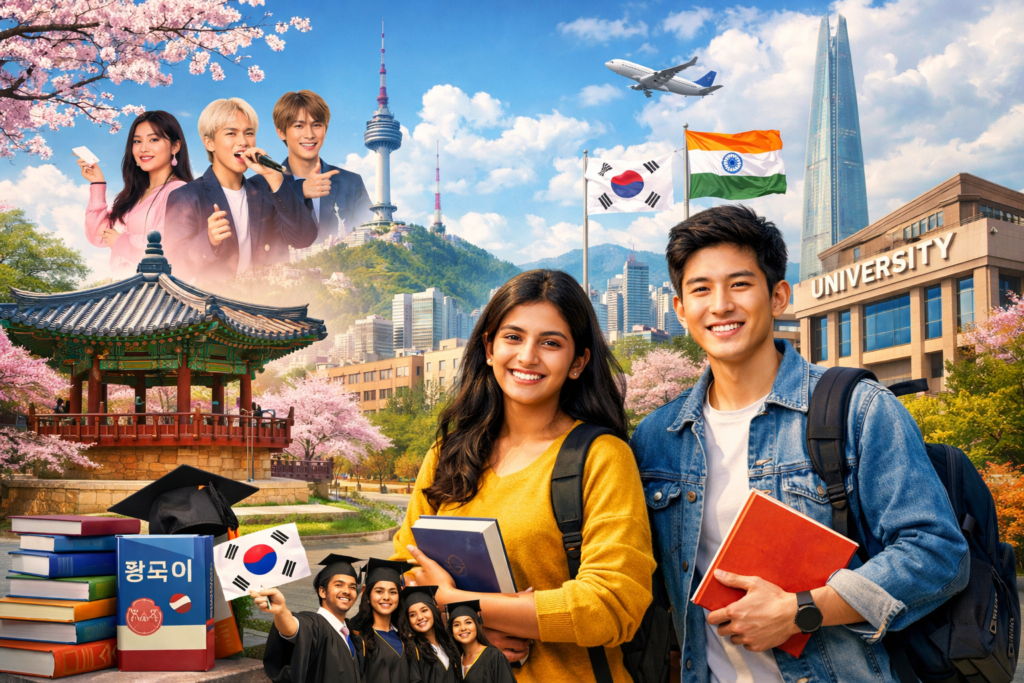
When we hear South Korea, our minds often jump to BTS, BLACKPINK, the K-dramas that Gen Z can’t get enough of and the irresistible charm of Korean cuisine. But beyond its global pop culture influence lies a country that is shaping the future through innovation, research, and world-class technology. Today, South Korea stands as a powerful destination for international students, offering high-end education, globally ranked universities, and a dynamic academic ecosystem that blends tradition with advanced learning. South Korea is becoming a serious alternative to traditional destinations like the US, UK, and Canada. Why Study In South Korea? South Korea is becoming a popular choice for Indian students seeking quality education abroad. With affordable tuition at public universities, globally ranked institutions, and strong career prospects, it offers excellent value without the high costs of Western countries. It’s a practical, future-focused option for students who want global exposure at a smart price. A Global Leader in Technology & Innovation South Korea is at the forefront of AI, robotics, semiconductors, 5G technology, and smart manufacturing. For students interested in future-driven careers, the country offers unmatched exposure to cutting-edge industries. Home to Global Giants Studying in South Korea means being close to companies like Samsung, Hyundai, LG, Kia, POSCO, and Coupang. This opens doors to internships, industry projects, and real-world exposure while you study. Industry Meets Academia Korean universities actively collaborate with industries, ensuring students gain hands-on experience through internships, research projects, and applied learning, making graduates job-ready from day one. Safe, Student-Friendly & Modern Consistently ranked as one of the safest countries in the world, South Korea offers a secure and welcoming environment. Add to that smart cities, cashless payments, high-speed internet, and a 24/7 convenience culture, and student life here is smooth and comfortable. CATEGORY SOUTH KOREA INDIA Top Global Universities SNU, KAIST, POSTECH, Yonsei University, Korea University, Sungkyunkwan University (strong presence in global Top 100-200) IITs, IISc Bangalore, IIMs, AIIMS (globally respected but with a limited number consistently ranking in the Top 200) Average Graduate Salary ₹2-5 lakh per month (depending on role and experience) ₹30,000-70,000 per month Job Market Stability Structured economy with strong demand in tech & manufacturing Highly competitive due to a large population Quality of Life Index Quality of life ratings are significantly higher; longer life expectancy (~83 years). Lower life expectancy (~67 years) and lower quality of life indices. Lifestyle Modern, fast-paced, student-friendly Traditional and diverse lifestyle Human Freedom / Safety Higher indexes of safety and governance. Lower on safety and governance indexes. Inside South Korea’s Advanced Education System South Korea has quietly become one of Asia’s top study destinations for students who want a high-quality education at a lower price than in India. Universities follow a structured academic framework that balances theory with practical application. What truly sets Korea apart is its deep commitment to research and development. The country consistently ranks among the world’s top investors in R&D, and this is reflected directly in its universities, labs, and classrooms. South Korea offers a diverse range of academic options, backed by strong industry connections and advanced infrastructure. CS – Artificial Intelligence & Data Science Roles: AI Engineer, Data Scientist, Machine Learning Engineer. Engineering and Technology Roles: Mechanical/Electrical Engineer, Semiconductor Engineer, Automotive Engineer, R&D Specialist. Management (Business Administration and International Relations) Roles: Business Analyst, Marketing Manager, Operations. Korean Language & Culture Roles: Embassy Staff, Cultural Coordinator, Tourism Professional. Fashion Design Roles: Fashion Designer, Merchandiser, Brand Manager, Product Developer. Biotechnology Roles: Research Scientist, Clinical Research Associate, Pharmaceutical Analyst. The country’s universities are equipped with advanced labs and strong industry partnerships, giving students hands-on experience and improving both learning outcomes and career prospects. Rooted in tradition yet driven by innovation, South Korea’s higher education landscape is shaped by a unique blend of public and private universities. Together, they form a dynamic academic ecosystem that welcomes students from around the world. Public universities, backed by government funding, offer high-quality education at relatively affordable costs, making them a popular choice among students worldwide. It includes universities such as Seoul National University – QS World Ranking 31 KAIST (Korea Advanced Institute of Science & Technology) – Ranking: 53 POSTECH (Pohang University of Science & Technology) – Ranking: 98 Private universities, equally prestigious, stand out for their state-of-the-art infrastructure, industry-aligned programs, and strong global collaborations. Some of them are Yonsei University Korea University Sungkyunkwan University Hanyang University Many universities are supported by programs like Brain Korea 21 (BK21) and the National Research Foundation of Korea (NRF), offering research funding, scholarships, and stipends to international students. This means real research, real impact, and real global exposure. Admission requirement For Indian Students Every year, hundreds of students from India turn their dream of studying abroad into reality by choosing South Korea as their academic destination. General Eligibility- For undergraduate programs: Completion of 12th grade(higher secondary education) For postgraduate programs: A recognised bachelor’s degree Language Proficiency: For Korean-taught programs, (TOPIK Level 3 or above) or for English-taught programs (IELTS/TOEFL), depending on the program. Most universities also require- A Statement of Purpose Letters of recommendation Academic transcripts Proof of finances Cost of Studying in Korea for Indian Students – Tuition Fees Undergraduate: KRW 2,000,000 – 5,000,000 per semester (₹1.25 – 3.25 lakhs) Postgraduate: KRW 2,500,000 – 6,500,000 per semester(₹1.6 – 4.2 lakhs) Living Expenses Accomodation: KRW 3,000,000 – 700,000/ month (₹ 20,000 – 45,000) Food & transportation: KRW 400,000 – 600,000/month ( ₹26,000 – 40,000) Total Monthly Expenses: ₹50,000 – ₹85,000 Yes, studying in South Korea can feel a bit overwhelming at first, especially when you think about the costs. But that’s where scholarships and part-time jobs come to the rescue, making the journey feel lighter and far more achievable. Scholarship South Korea offers a wide range of scholarships that make studying abroad accessible and affordable for international students. Government-Funded Scholarships The Global Korea Scholarship (GKS) is a fully funded South Korean government scholarship covering tuition, living expenses, accommodation, insurance, and airfare for undergraduate and postgraduate international students.
MFE vs MiM vs MBA: Which Degree Will Actually Get You the Career You Want?
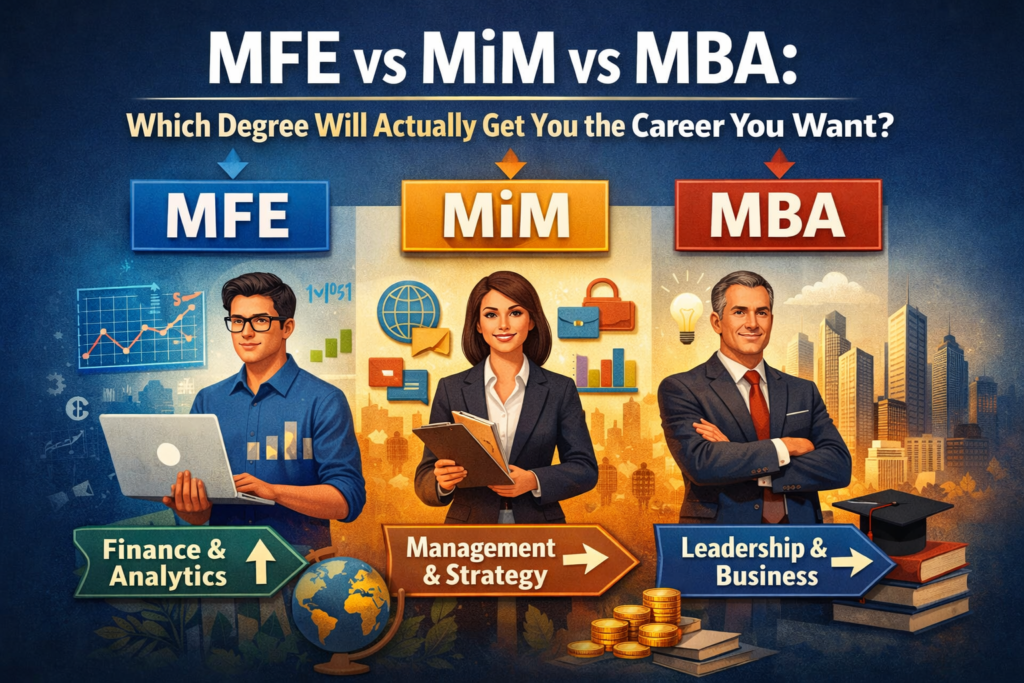
Choosing between MFE, MiM, and MBA is one of the most confusing decisions for students planning to study abroad. Everyone has an opinion – friends, relatives, YouTube, consultants – but none of them know your background, your finances, or your career goals. Some students are freshers. Some already have work experience. Some love numbers. Some hate finance but want high salaries. Some want to settle abroad. So the real question is not “Which degree is best?” It is “Which degree is right for me?” Why Students Feel Stuck Between MFE, MiM & MBA Most students get stuck because these three degrees look similar from the outside – all promise foreign education and good jobs. But they are built for very different people and lead to different outcomes when you plan a study abroad career counselling strategy. You might be asking: I’m a fresher. Can I even do an MBA? Everyone says MFE pays more, but am I good enough at math? MiM looks easier, but will it get me a real job? What if I take a big loan and choose the wrong one? These are not academic questions — these are life decisions. What Is MFE (Master of Financial Engineering)? MFE is for students who like numbers, coding, and finance. It focuses on: Financial modeling Trading systems Risk analysis Data-driven finance FinTech If you enjoy Excel, Python, probability, or data, MFE is designed for you. MFE graduates work in banks, hedge funds, and trading firms, often earning some of the highest finance salaries abroad. But MFE is not for everyone. If you dislike math or coding, it will feel overwhelming. What Is MiM (Master in Management)? MiM is for fresh graduates who want to start a global business career. It focuses on: Management Marketing Consulting Business strategy Leadership MiM is popular in Europe and is perfect if you: Have 0-2 years of work experience Want international exposure Want to work in consulting, marketing, or business roles MiM gives you access to European job markets without waiting years for an MBA. What Is MBA? MBA is for people who already have work experience and want to move into leadership or management. It helps with: Career switching Promotions Entrepreneurship Consulting and leadership roles An MBA is powerful but expensive and not meant for freshers. COMPARISION BETWEEN MFE, MIM AND MBA Factor MFE (Master of Financial Engineering) MiM (Master in Management) MBA (Master of Business Administration) Who it’s for Students strong in math, data, and finance 0-2 years of experience Professionals with 3-5+ years of work experience Ideal background Engineering, mathematics, physics, CS, economics Any bachelor’s degree Any degree + work experience Main focus Quantitative finance, analytics, trading Business, management, consulting Leadership, strategy, management Skills needed Math, statistics, programming, and financial modelling Communication, problem solving, business basics Leadership, decision-making, business experience Experience required Not mandatory (0-3 years accepted) Not required Usually required (3-5 years) Cost Medium to high Low to medium High Salary potential Very high (one of the highest in finance) Moderate, grows with experience High in the long term Common job roles Quant Analyst, Risk Analyst, Trader, FinTech roles Business Analyst, Consultant, Marketing, Operations Manager, Consultant, Strategy, Leadership roles Best countries USA, Germany, UK, Singapore France, Germany, the Netherlands, UK USA, UK, Canada, Europe Visa & job demand Strong in global finance hubs Strong in European job markets Depends on the country and industry Return on investment (ROI) Very high if you like finance and analytics Good for freshers starting their careers High if used for career growth or leadership Which Degree is Best for You? Let’s look at real student profiles. If you are a fresher with no experience: MiM is usually best because it gives you management exposure and global job opportunities without waiting years. If you have 1–2 years of experience and like finance or analytics: MFE can give you a fast track to high-paying finance roles. If you have 3+ years of experience: An MBA is better for leadership, promotion, and career switching. If you have a finance or economics background: MFE or MBA, depending on experience. If you have a tech or engineering background: MFE works very well for finance + tech roles. MFE salary abroad: Often $120,000–$160,000+ in finance hubs. MiM salary: Usually moderate at first, but grows with experience. MBA salary: High in the long term, especially in leadership roles. If money and technical finance excite you, MFE wins. If growth and management excite you, an MBA or MiM fits better. FAQS 1. Is MiM better than an MBA for freshers? A: Yes. An MBA needs experience. MiM is designed for fresh graduates. 2. Can I do MFE without a finance background? A: Yes, if you are strong in math, coding, or engineering. 3. Which degree has the highest salary? A: MFE usually offers the highest starting salary. 4 . Which degree has better job opportunities abroad? A: MFE in finance hubs and MiM in Europe have strong job markets. 5. Is an MBA worth the cost? A: Yes, but only if you have experience and a clear career plan. 6. Which degree helps with PR or work visas? A: MiM and MFE often work well in Europe and Germany due to post-study work options in Germany. 7. Can I switch careers with MiM or MBA? A: Yes — MBA is especially good for career switches. Common Mistakes Students Make When planning to study abroad, many students unintentionally make decisions that cost them time, money, and career growth. Some of the most common mistakes include: Choosing an MBA too early Many students jump into an MBA without the required work experience or a clear career direction, which often leads to limited job opportunities and low return on investment. Ignoring ROI and job demand Students focus on famous universities but forget to check whether their chosen course actually leads to good-paying jobs or is in demand in that country. Following friends or trends What works for a friend may not work
Scholarships to Study in Germany for Indian Students (2026)
Key Takeaways Germany offers hundreds of scholarships for Indian students each year, making world-class education more affordable. Funding options include government-backed, university-level, and private foundation scholarships. Success relies on early planning, clear academic goals, strong SOPs, and proper positioning, not chance. Scholarships are competitive, but well-prepared Indian students often win them. The Real Problem Indian Students Face For many Indian students, the dream of studying in Germany is limited by money, uncertainty, and misinformation. Even though public universities in Germany charge little to no tuition, costs for living, blocked accounts, visas, and initial setup can create anxiety. Many students think scholarships are “too competitive” or “only for top performers,” and they never apply. The reality is different. Each year, over 40,000 international students in Germany receive scholarships. Indian students are significant beneficiaries, especially through organizations like DAAD. This guide outlines which scholarships really matter, who can realistically get them, and how Indian students can position themselves to succeed, with practical insights from the StudyArk advisory perspective. Why Germany Makes Financial Sense for Indian Students Germany’s appeal goes beyond low tuition fees. Public universities charge €0 – €350 per semester. Degrees are globally recognized. There are strong post-study work and PR pathways. STEM, management, and research degrees match global job markets. With scholarships added, Germany becomes one of the most cost-effective study abroad destinations for Indian students. This supports what we discussed in our previous content: Germany is not just affordable, it is designed for international talent. Understanding Scholarships in Germany (Without the Confusion) Scholarships in Germany are not one-size-fits-all. They vary based on study level, academic intent, and long-term contributions. Government-Funded Scholarships This is the most reliable and prestigious category. Monthly living allowance. Health insurance. Travel and research support (in some cases). The main provider is DAAD, which supports thousands of Indian students annually in Master’s, PhD, and research programs. University-Specific Scholarships Many German universities reserve internal funding for high-potential international students. These are often: Merit-based. Department-specific. Awarded after admission. They are less competitive than DAAD and often overlooked by Indian applicants. Foundation & Non-Government Scholarships Germany has a strong culture of academic foundations linked to social impact, leadership, and research. Examples include: Heinrich Böll Foundation. Konrad Adenauer Stiftung. Friedrich Ebert Stiftung. Rosa Luxemburg Stiftung. These scholarships value purpose, clarity, and social alignment, not just grades. Merit & Research-Based Scholarships For students with: Strong academic records. Research experience. Clear academic direction. Programs like the Alexander von Humboldt Foundation support advanced research and postdoctoral work in Germany. Top Scholarships for Indian Students to Study in Germany (2026) Here are the most realistic and impactful scholarships Indian students should consider: DAAD Scholarships – Living allowance, insurance, and research support. Erasmus+ – Joint Master’s programs across Europe. Heinrich Böll Foundation – Academics and social responsibility. Konrad Adenauer Stiftung – Leadership and policy orientation. Friedrich Ebert Stiftung – Social commitment and academic merit. Rosa Luxemburg Stiftung – Research and social sciences focus. KAAD – For students from developing countries with plans to return. Bayer Foundation – Science, health, and innovation research. Humboldt Research Fellowship – Advanced research excellence. RWTH Aachen University Scholarships – University-level merit funding. Insight from StudyArk: Most students lose scholarships not due to weak profiles, but due to poor positioning and late planning. Eligibility: What Scholarship Committees Actually Look For Contrary to popular belief, scholarships in Germany are not just for gold medalists. They evaluate: Academic consistency (not perfection). Clear academic and career goals. Alignment with Germany’s education and research priorities. Motivation, leadership, or research depth. Well-written, honest SOPs. Financial need matters for some scholarships, but clarity is essential for all. How Indian Students Should Apply (Strategically) Shortlist programs first and scholarships second. Align SOPs with Germany’s academic culture instead of using generic study abroad language. Prepare documents 3–5 months before deadlines. Apply to multiple scholarships at the same time. Track timelines carefully; most failures are due to missed deadlines. Common Mistakes Indian Students Make Waiting for admission before planning scholarships. Using one SOP for all applications. Ignoring foundation scholarships due to a lack of awareness. Believing only DAAD matters. Applying without a profile strategy. At StudyArk, we see that early clarity significantly increases scholarship success. Conclusion: Scholarships Are Earned, Not Won by Chance Germany has created one of the most student-friendly funding environments, especially for Indian students. Scholarships exist, but they go to those who plan early, position themselves well, and apply strategically. At StudyArk, we help students not only apply but also develop scholarship-ready profiles, align academic narratives, and avoid costly mistakes. If Germany is your goal, funding shouldn’t be your fear. Your journey deserves structure, clarity, and expert guidance, and that’s where StudyArk comes in.
Why Germany Is Becoming the TOP Choice for Indian Students in 2026
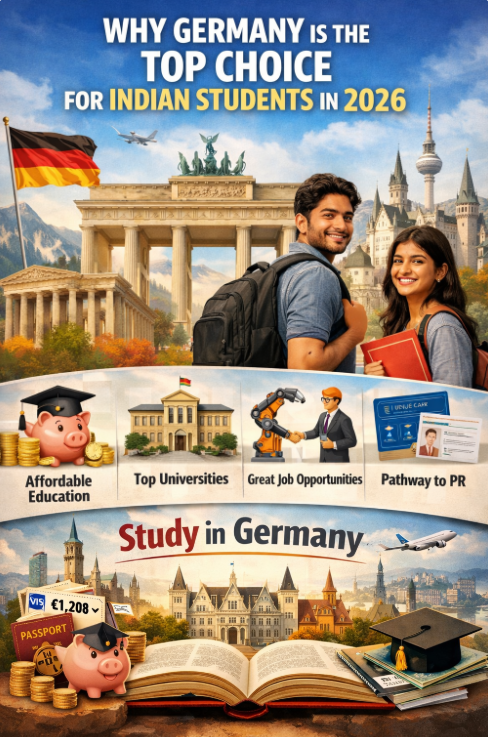
Germany has steadily moved from being an “alternative” study destination in the 2010s to becoming the first choice country for Indian students planning higher education. The reason is simple: high-quality education, minimal tuition fees, strong job outcomes, and a clear pathway to long-term settlement. In the last five years, the number of Indian students in Germany has grown by 138%, compared to traditional favourites like the USA and UK, where the influx of Indian students has stagnated or declined. This rapid shift means admissions to top German universities are becoming much more competitive for Indian students. There’s a need to understand the system in depth, and it is essential to stay informed, plan early, and maintain a clear competitive edge. But why are more and more Indian students choosing Germany? Affordable education: Public universities offer no or minimal tuition fees for international students. Top-ranked universities: Germany has 13 universities in the top-100 ranked in the world, the most after the USA and the UK. Strong job prospects – Germany continues to offer jobs abundantly in a stable economy, along with access to the entire Europe through the Schengen Visa, in a time when countries like the US have started limiting work visas by charging USD 100K for the H1B. Strong focus on engineering – Germany has built a global reputation for excellence in engineering, automotive technology, artificial intelligence, robotics, data science, and applied research. English-friendly environment – Unlike the reputation, most programs in Germany and daily life function well without mandatory German proficiency. Germany Student Visa Process for Indians Tuition Fees Public universities: €0 – €1,500 per year (most charge €0) Private universities: €10,000 – €20,000 per year (generally avoidable) Blocked Account Indian students must show proof of funds through a blocked account to cover living expenses. Estimated amount for 2026: €11,208 per year Accomodation(Share) Average monthly expenses range between €850 and €1,000, covering: Accommodation Food Health insurance Transportation Utilities and internet Germany offers one of the best balances between affordability and quality of life, making it a smart long-term investment rather than just a low-cost option. Studying Master’s (MS) in Germany: Key Points Indian Students Must Know Strong Profile matters– Projects, internships, research, and experience must be clearly structured and aligned with the chosen program. Relevant bachelor’s degree required – Course content alignment is more important than university brand or reputation. Marks are flexible – Many public universities accept 60–75%, evaluating the complete academic and professional profile. English-taught programs available – IELTS 6.0–6.5 is common; German is not mandatory for admission. Public universities are tuition-free. Most MS programs charge €0 tuition, with only a small semester contribution. Amazing post-study opportunities– 18-month job search visa, EU Blue Card, and clear permanent residency pathways. Studying Bachelor’s/ Undergraduate (UG) in Germany: Key Points Indian Students Must Know 13th-year requirement – Germany follows a thirteen-year education system; Indian 12th grade alone is usually insufficient. One simply won’t be eligible after completing 12th in India. Studienkolleg pathway – Most students must complete a one-year foundation program before starting a bachelor’s degree. Alternative routes to the Studienkolleg pathway – One year of bachelor’s study in India or clearing JEE Advanced can help bypass the Studienkolleg (engineering). German language is critical for UG – Unlike the case with MS, Studienkolleg, and most UG programs require B1–B2 level German proficiency. Public universities are affordable – Bachelor’s degrees at public universities usually have no tuition fees. Early planning is essential Germany Student Visa Process for Indians The German student visa process is structured but requires careful documentation. Key steps include: University admission letter Blocked account confirmation Health insurance proof APS Certificate – The APS certificate verifies Indian academic documents for use in Germany. Apply online, submit your transcripts, pay the fee, send the required documents, and attend the verification as instructed by APS India. Visa appointment at the German Consulate Accuracy and document quality are critical. Even strong applicants may face rejection if paperwork is incomplete or inconsistent, which is why proper guidance matters. Jobs and PR Opportunities After Study Germany offers excellent long-term settlement opportunities for international graduates. After completing studies, students can benefit from: An 18-month job search visa EU Blue Card for skilled professionals Permanent Residency in 21–33 months Citizenship eligibility after long-term stay Graduates in IT, engineering, and science-related fields often secure stable, well-paying jobs with strong career growth, making Germany a reliable destination for long-term professional security. Studying in Germany is not just about saving money—it is about making a strategic career decision. Success depends on choosing the right program, the right university, and the right pathway. This is where Study Ark’s approach stands out. Instead of commission-driven advice, it focuses on: Data-backed university shortlisting Career and ROI alignment Honest and transparent guidance Affordable public university pathways The goal is not just studying abroad, but building a sustainable global career. Book a Free Germany Study Planning Session Get personalised guidance to plan your education in Germany the right way, strategically, affordably, and with your long-term career in focus.
Cost of Living in the UK for Indian Students in 2025

Thinking about studying in the UK but feeling anxious about the living costs? You’re not alone. For most Indian students, the biggest question after getting an offer letter is: “How much will it actually cost me to live in the UK?” Well, here’s the good news: it’s not as scary as it seems—if you plan smartly. Let’s break it down step by step so you know what to expect. What’s the Average Cost of Living in the UK? On average, Indian students in the UK spend approximately £950–1,250 per month (₹ 1 lakh–1.2 lakh). Rent consumes almost half of this budget, while the rest is allocated to groceries, utilities, transportation, and a little fun (yes, you’ll want nights out and Netflix too). Here’s a quick snapshot: Expense London Other Cities Why it matters Rent £900–1,100 (₹1L–1.2L) £450–700 (₹52K–81K) The biggest chunk of expenses Utilities + Internet £70–90 (₹8K–10K) £70 (₹8K) Gas, water, electricity, WiFi Groceries £160 (₹18K) £140 (₹16K) Tesco, Aldi, and Asda student deals Transport £95 (₹11K) £55–70 (₹6K–8K) Student Oyster/Railcard discounts Leisure + Mobile £150–200 (₹17K–22K) £130–180 (₹15K–20K) Gym, Netflix, weekend plans Rule of thumb: Keep at least £1,000 (₹1.1L) a month aside to live comfortably as a student. The Visa & Proof of Funds Catch Here’s something students often overlook: the UK student visa funds requirement. From January 2025, you need to show proof that you can survive 9 months without starving London: £12,006 (₹13.8L) Outside London: £9,207 (₹10.6L) Visa fee: £490 (₹56K) NHS surcharge: £1,035/year (₹1.1L) Proof can be bank statements, an education loan, or an official sponsor. So, even if you know you’ll work part-time, the UK government wants proof you can handle life there on day one. Accommodation: The Real Budget Buster Let’s be real: accommodation will make or break your budget. London (a.k.a. the expensive dream) Central zones (1–2): £950–1,400 per month (₹1L–1.6L) Outer zones (3–4): £750–950 (₹86K–1L), 20 mins by train Extras: tenancy deposit (5 weeks’ rent), TV license (£169.50/yr), council tax (students usually exempt) Student-Friendly Cities (cheaper + vibrant) City Shared Flat Uni Halls Manchester £550–700 (₹63K–81K) £140/week (₹16K) Birmingham £500–630 (₹58K–73K) £135/week (₹15K) Glasgow £470–600 (₹54K–69K) £125/week (₹14K) If you’re on a tight budget, consider cities outside London. You’ll save 20–30% on rent, and the lifestyle is just as exciting. Scholarships: Your Best Friend If you don’t want to stress about every coffee or bus ticket, scholarships are a lifesaver. Some of the big ones for 2025: GREAT Scholarships India – £10,000 (₹11.5L) each Chevening Scholarship – Covers full tuition + living expenses Commonwealth Master’s – Full tuition + stipend (STEM & development fields) University hardship funds – Emergency top-ups (£3,000 max) Pro tip: Apply early. Deadlines close 8–12 months before intake, and most students miss them because they apply too late. Can You Survive on Part-Time Jobs? Short answer: yes, but don’t depend on it for everything. Work limit: 20 hours/week during term, full-time in vacations Minimum wage (2025): £11.44/hr (₹1.3K) What you’ll earn: around £450–500/month (₹52K–58K) Typical student jobs: Barista at a campus café Library assistant Tutoring younger students (£15–20/hr if you’re good at it!) This income usually covers groceries and utilities, but rent still needs pre-planning. London vs Other Cities: The Big Decision London = amazing opportunities, world-class universities, but £1.3–1.6L/month living cost Other cities = 20–30% cheaper, friendlier student vibe, less financial stress If prestige matters, London is worth it. But if you want balance, Manchester, Birmingham, or Glasgow might be smarter choices. The Bottom Line So, what’s the real cost of living in the UK for Indian students in 2025? Budget £950–1,250/month Show £9,207–12,006 proof of funds for visa Apply for scholarships early to cut costs Use part-time work to ease the burden Ultimately, while the cost may seem high, remember you are not just spending money, you are investing in global opportunities, career growth, and unforgettable experiences. Start your smart planning today with StudyArk!
Top 10 Overseas Education Consultants in Bhubaneswar: Your Gateway to Global Education

Top 10 Overseas Education Consultants in Bhubaneswar: Dreaming of studying in the USA, UK, Canada, Australia, or Europe? You’re not alone. Each year, thousands of students from Bhubaneswar set their sights on world-class universities abroad. But while the dream is exciting, the process — entrance exams, applications, visas — can be overwhelming. That’s where overseas education consultants come in. These professionals help you navigate the entire process — from choosing the right country and course to assisting with applications, SOPs, financial documents, and visa interviews. If you’re in Bhubaneswar and planning your global academic journey, here’s a list of the top 10 overseas education consultants in Bhubaneswar that can help you every step of the way. 1. StudyArk Bhubaneswar Specialties: GMAT, GRE, TOEFL, SAT, IELTS coaching + complete study abroad guidanceStudyArk is known for its personalized approach, expert test prep faculty, and transparent counseling. They help with everything from college selection to visa support and scholarship applications. 2. IDP Education A globally trusted name in study-abroad services, IDP has a center in Bhubaneswar offering end-to-end assistance for studying in the UK, Australia, USA, and more. 3. AECC Global AECC is known for its wide network and free counseling services. With expert counselors and strong university tie-ups, they help students apply to top institutions abroad. 4. Global Reach One of India’s most established names in overseas education consulting. Global Reach offers career counseling, course selection, application processing, and visa guidance. 5. Manya Group (The Princeton Review) Ideal for students preparing for GRE, GMAT, SAT, or IELTS. Manya combines test prep with university application support for a holistic overseas education service. 6. KC Overseas Education With a growing presence in Odisha, KC Overseas provides expert counseling and university admissions support, especially for Canada and Australia. 7. iBook Consultancy iBook specializes in admissions and visa processing, especially for the UK, New Zealand, and Germany. They also provide SOP and LOR writing assistance. 8. EduSynch Bhubaneswar Known for its smart AI-based approach to test preparation and admission services. Great for students aiming at US colleges with TOEFL, GRE, and SAT. 9. Vinnova Education Focused on European and Asian universities, Vinnova provides tailored solutions for MBBS and Engineering aspirants looking to study abroad. 10. Global Edu Connect This growing Bhubaneswar-based consultant offers affordable packages for students aiming to pursue their bachelor’s or master’s degrees abroad. Why Choose a Consultant? Working with one of the top 10 overseas education consultants in Bhubaneswar saves you time, reduces stress, and boosts your chances of acceptance at your dream university. Consultants can: Suggest universities based on your profile Help with application timelines and documentation Train you for SOPs and interviews Guide you on scholarships and finances Assist with visa applications and pre-departure prep Final Words Your study-abroad journey is a life-changing decision — and with the right consultant by your side, it becomes a well-guided, confident path. Choose a consultant that understands your goals, listens to your preferences, and gives you honest, expert advice. If you’re in Bhubaneswar, these 10 names are a great place to begin your global academic journey. Visit our CenterLearn more at www.studyark.inCall now to schedule a free SAT counseling session
Best GMAT Coaching in Bhubaneswar: Your Launchpad to a Global MBA
Best GMAT Coaching in Bhubaneswar: Dreaming of an MBA from a top global B-school? The GMAT (Graduate Management Admission Test) is the key that unlocks doors to prestigious programs in the U.S., Europe, Singapore, and beyond. But cracking the GMAT isn’t just about being good at math or English — it’s about understanding the exam, managing your time, and applying smart strategies. And when it comes to finding the best GMAT coaching in Bhubaneswar, you need more than just a coaching center — you need a partner who understands your goals and helps you exceed them. Why GMAT Preparation Needs Expert Guidance The GMAT tests more than academic knowledge. With its focus on analytical writing, integrated reasoning, quantitative, and verbal reasoning, it challenges your critical thinking and decision-making under pressure. Self-preparation may work for some, but most successful test-takers credit a big part of their achievement to structured coaching. A good GMAT coaching center offers: Expert faculty who understand the exam pattern inside-out Customized study plans tailored to individual strengths and weaknesses Regular mock tests to simulate the real exam Feedback and progress tracking to keep you on course Bhubaneswar: An Emerging Hub for GMAT Aspirants Bhubaneswar is quietly making its mark as a reliable destination for MBA and study-abroad preparation. With more graduates from Odisha aiming for top B-schools, coaching institutes in the city have evolved to meet international exam standards. You no longer have to move to metros like Delhi or Bangalore for quality GMAT prep. Bhubaneswar’s top coaching centers now offer everything — from online classes and weekend batches to global mentorship and admissions guidance. StudyArk: A Trusted Name for the Best GMAT Coaching in Bhubaneswar When talking about the best GMAT coaching in Bhubaneswar, StudyArk deserves a special mention. Known for its student-first approach, StudyArk blends the best of technology and teaching to deliver results-driven GMAT preparation. What makes StudyArk stand out? Experienced Trainers with a track record of 700+ scores Customized Study Plans aligned with your target universities Doubt-Clearing Sessions, strategy workshops, and regular performance reviews Admissions Counseling to support your journey beyond the GMAT Their unique approach ensures that each student receives personalized attention, which is often lacking in large coaching chains. Final Thoughts: The GMAT is not just a test — it’s a stepping stone to your dream career in business and management. Choosing the right coaching is the first and most crucial decision in that journey. If you’re in Bhubaneswar and serious about your MBA abroad, don’t settle for average. Look for an institute that offers mentorship, structure, and results — like StudyArk, where your goals become theirs too. Start today. The path to your global MBA begins with one smart choice — finding the best GMAT coaching in Bhubaneswar. Visit our CenterLearn more at www.studyark.inCall now to schedule a free SAT counseling session
Top 10 Overseas Education Consultants in Noida [2025 List]

Are you dreaming of studying abroad but not sure where to begin? From choosing the right university to visa processing, overseas education consultants play a crucial role in shaping your global academic journey. If you’re in Noida, you’re in luck—this city hosts some of the best study-abroad consultants in India. In this guide, we bring you the top 10 overseas education consultants in Noida, handpicked based on experience, success rate, and student reviews. Why Consult a Study Abroad Expert? Choosing to study abroad involves several key steps: Selecting the right course & country Shortlisting universities based on your profile Preparing application documents like SOP, LORs, and a resume IELTS/TOEFL/GRE training Visa guidance and financial documentation Pre-departure orientation A professional consultant simplifies this entire process, making your dream a lot more achievable. Top 10 Overseas Education Consultants in Noida: 1. Manya – The Princeton Review Location: Sector 62, NoidaSpecialties: USA, Canada, UK, AustraliaWith its legacy of helping students crack the GRE, TOEFL, and SAT, Manya also offers comprehensive overseas education consulting, including SOP editing, university shortlist, and visa prep. ⮞ Why Choose: Association with Princeton Review Personalized application & admission counseling Excellent global network with universities 2. Edwise International Location: Sector 18, NoidaSpecialties: USA, UK, Australia, Singapore, CanadaA well-known name across India, Edwise offers end-to-end consulting services from course selection to post-arrival services. ⮞ Why Choose: Global university tie-ups IELTS & PTE training Over 25 years of experience 3. IDP Education Location: Sector 18, NoidaSpecialties: Australia, UK, USA, Canada, New ZealandIDP is a global leader in international education services, co-owner of IELTS, and official partner with 700+ universities worldwide. ⮞ Why Choose: Direct university application support Certified IELTS training 100% free counseling 4. StudyArk Location: Noida ExtensionSpecialties: USA, UK, Europe, Australia, Japan, South Korea, GermanyA growing consultancy with personalized support and a hands-on approach for undergraduates and postgraduates. ⮞ Why Choose: Affordable and flexible packages Tailored SOP writing support Mock visa interviews and post-admission help 5. Global Opportunities Pvt. Ltd. Location: Sector 2, NoidaSpecialties: UK, USA, Canada, Ireland, GermanyWith 20+ years in the domain, they have placed thousands of students in top universities globally. ⮞ Why Choose: Free profile evaluation 1-on-1 counseling with country experts Pre-departure briefings 6. KC Overseas Education Location: Sector 16, NoidaSpecialties: 29+ countries, including Germany, France, ItalyKnown for its tech-enabled platform, KC Overseas offers real-time application tracking and strong university networks. ⮞ Why Choose: Smart tools for course search Support for non-English speaking countries Scholarship assistance 7. Fateh Education Location: Sector 63, NoidaSpecialties: UK & IrelandSpecialized consultants for students targeting top universities in the UK and Ireland. ⮞ Why Choose: Official partners of 120+ UK universities Free application process IELTS and visa documentation support 8. SI-UK (Study in UK) Location: Sector 18, NoidaSpecialties: United KingdomIf you’re focused solely on the UK, SI-UK is one of the most trusted names for UCAS application support. ⮞ Why Choose: In-house British Council-certified counselors Oxbridge & Russell Group guidance UCAS Application Review 9. The Chopra Consultancy Location: Sector 15, NoidaSpecialties: USA, Canada, AustraliaA personalized consultant known for small batch, high success counseling, especially among master’s aspirants. ⮞ Why Choose: Visa guidance & SOP writing Low-cost packages Transparent pricing 10. iSchoolConnect Location: Online-based with office support in NoidaSpecialties: USA, Canada, UK, GermanyAn AI-powered overseas consultancy platform that automates the application process while still offering human expertise. ⮞ Why Choose: AI SOP & LOR tools Live dashboard for application progress Budget-friendly Bonus Tips Before You Choose a Consultant: Attend free seminars & webinars Check their university list and country options Read Google reviews and student testimonials Ask for a free profile evaluation Confirm fees, success rate, and refund policy Final Thoughts: Choosing one of the top 10 overseas education consultants in Noida can drastically improve your chances of getting into your dream university abroad. Each consultant has unique strengths—so pick the one that matches your academic goals, budget, and country preference. Studying abroad is a life-changing experience—start it right with expert guidance. Visit our CenterLearn more at www.studyark.inContact us to schedule a free counseling session