
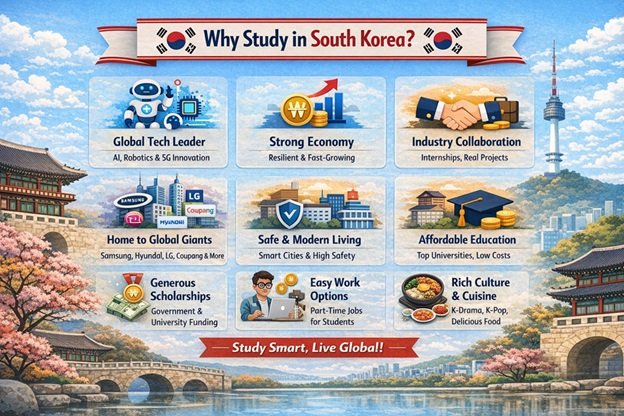
For many Indian students, going abroad for a Master’s is a big dream, but it can also feel expensive. This is where South Korea excels. It offers globally recognised universities, modern research facilities, and strong career opportunities, at a cost that is far more affordable than traditional destinations like the US or UK. With generous scholarships, industry exposure, and high-quality education, South Korea gives students the chance to build a global career without putting extreme financial pressure on themselves or their families.
Over the past decade, South Korea has actively invested in becoming a global education hub, increasing its international student population from around 85K to over 300K through government scholarships, research funding, and global recruitment initiatives. Alongside this, the Indian community has quietly grown to more than 17K people, creating a sense of familiarity, support, and belonging, so when Indian students arrive, they don’t feel alone; they feel part of something bigger.
Top Master’s Programs and Career Paths
| Fields | Specializations | Career Roles | Average Salary after Graduation |
| Computer Science & Artificial Intelligence | Artificial Intelligence, Data Science, Machine Learning, Cybersecurity, Software Engineering | AI Engineer, Data Scientist, ML Engineer, Software Developer | ₹28 – ₹47 lakhs |
| Engineering & Technology | Electrical, Mechanical, Semiconductor, Robotics, Automotive Engineering | Semiconductor Engineer, Robotics Engineer, Automotive Engineer, R&D Specialist | ₹25 – ₹44 lakhs |
| Business & Management | MBA, International Business, Finance, Marketing, Supply Chain | Business Analyst, Marketing Manager, Operations Manager, Consultant | ₹22 – ₹38 lakhs |
| Biotechnology & Life Sciences | Biotechnology, Biomedical Engineering, Pharmaceutical Sciences, Bioinformatics | Research Scientist, Clinical Research Associate, Biotech Analyst | ₹22 – ₹34 lakhs |
Where to Study: South Korea’s Top Universities
South Korea has quietly become one of Asia’s strongest education hubs and is home to around 2429 universities, offering students a wide mix of public and private institutions. What makes it special is the balance. You get a strong education, but also real industry exposure. Many universities work closely with companies like Samsung, Hyundai, and LG. So students don’t just study from books. They work on real projects. They learn skills that actually help in jobs. Some top universities include:
- Seoul National University – QS Rank: 31 globally
- KAIST – QS Rank: 53 globally
- Yonsei University – 56 globally
- Korea University – QS Rank: 67 globally
- POSTECH – 98 globally
- Sungkyunkwan University – 123 globally
Want to check if you’re eligible for these universities? Try our 100% accurate AI-powered CV Matcher and get instant clarity.
Tuition Fees and Living Costs
Tuition in South Korea depends on the type of university and the course you choose. On average, public universities cost around ₹3 to ₹7 lakhs per year, while private universities range between ₹6 to ₹11 lakhs per year, with technical courses like AI, Engineering, and Biotechnology usually on the higher side.
Average Living Costs per Year in South Korea
- Accommodation: ₹2 – 4lakhs/year (dorm or shared housing)
- Food: ₹1.2 – 2lakhs/year (student cafeterias are cheaper)
- Transportation: ₹30,000 – 60,000/year (metro, buses, student discounts)
- Health Insurance: ₹20,000 – 40,000/year (mandatory)
- Miscellaneous: ₹50,000 – 1lakh/year (mobile, personal, study expenses)
Total Living Cost: ₹4.0 – ₹7.0 lakhs per year, depending on lifestyle and city.
IELTS and TOPIK Requirements
The Language requirement mainly depends on whether your course is taught in English or Korean.
For English-taught programs: Most universities ask for an IELTS score of 6.0 to 6.5. Some universities may even waive IELTS if your bachelor’s degree was fully taught in English.
For Korean-taught programs: You’ll need TOPIK Level 3 or 4. This shows you can understand lectures and manage daily life in Korea.
Pro tip: Try learning basic Korean – it makes day-to-day life way easier, from ordering food and using transport to making friends and feeling comfortable faster.
Scholarships & Funding: Making Your Korea Dream Affordable
For many students, the dream of studying abroad often feels limited by financial worries – but South Korea is changing that reality. With generous support from the government, universities, and research foundations, students are given real opportunities to pursue world-class education without carrying the weight of financial stress, making the journey feel not just possible but truly within reach.
Government Scholarships:
- Global Korea Scholarship (GKS):
The Global Korea Scholarship (GKS-Graduate) is the primary scholarship offered by the Korean government for Master’s students.
Key Benefits:
- Full tuition fees (100% covered)
- Monthly Stipend (₹60,000+)
- Medical insurance coverage
- Thesis and research support
- Valid for top public and private universities
- KOICA Scholarship:
The Korea International Cooperation Agency offers KOICA grants. It is mainly designed for students who want to build careers in public policy, development, engineering, and leadership roles.
University & Research Institute Scholarships:
- KAIST Scholarships:
KAIST offers one of the best-funded scholarship programs for international Master’s students, especially in STEM fields. - UST Scholarship (University of Science and Technology):
University of Science and Technology (UST) is a unique government-funded research university that partners with national research institutes.
Research and Assistantships: Earn While You Learn
One of the biggest advantages of doing a Master’s in South Korea is the chance to be part of real research. You don’t just attend lectures and go home. You spend time in labs. You work on real projects. You learn directly from professors. This hands-on experience helps you understand your field better and prepares you for a real career after graduation.
- Research Assistant (RA):
- Work closely with professors on live research projects.
- Monthly stipend of ₹40,000 – 1,00,00
- Gain practical experience in your field
- Teaching Assistant (TA):
- Help professors in classes, labs, or assignments
- Receive stipend or financial support
To know more about student part-time jobs in South Korea, click here.
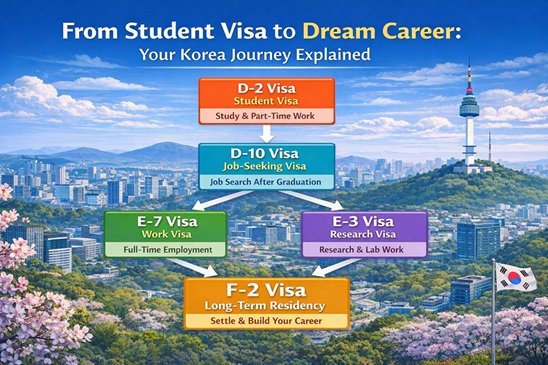
From Studying to Settling: Korea’s Visa Roadmap for Students
Graduating from a Korean university doesn’t mean you have to pack your bags and leave right away. After spending years studying, adjusting to a new culture, and building your skills, you get the chance to stay back and turn your student life into a real career.
Here is a simple roadmap to help you understand how your student journey can turn into a career in South Korea.
Smart Choice, Strong Future: Why Indian Students Are Choosing South Korea
Yes, South Korea might have first caught your eye because of K-pop, K-dramas, and all the cool things you see online. But there’s so much more waiting beyond the screen. It’s quickly becoming one of the best places for Indian students who want to do their Master’s without putting huge pressure on their families. Here, you don’t just attend classes – you learn real skills, discover new opportunities, and slowly build a future that once felt far away. This isn’t about following a trend. It’s about choosing a place that believes in your dreams and gives you the chance to grow.
And when it comes to that step, Study Ark is right there with you. We guide you like someone who truly cares, helping you find the right university, apply for scholarships, and move forward with confidence. Because our mentors have been there and done that. We understand the fear, confusion and hope you feel. We don’t just guide you – we support you, so you can stop worrying and start believing that this dream is actually possible.