
Germany has steadily moved from being an “alternative” study destination in the 2010s to becoming the first choice country for Indian students planning higher education. The reason is simple: high-quality education, minimal tuition fees, strong job outcomes, and a clear pathway to long-term settlement.
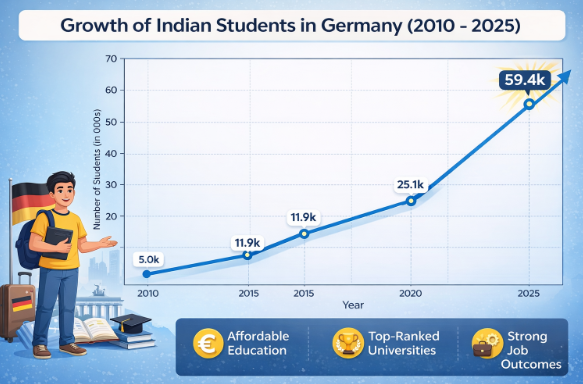
In the last five years, the number of Indian students in Germany has grown by 138%, compared to traditional favourites like the USA and UK, where the influx of Indian students has stagnated or declined.
This rapid shift means admissions to top German universities are becoming much more competitive for Indian students. There’s a need to understand the system in depth, and it is essential to stay informed, plan early, and maintain a clear competitive edge.
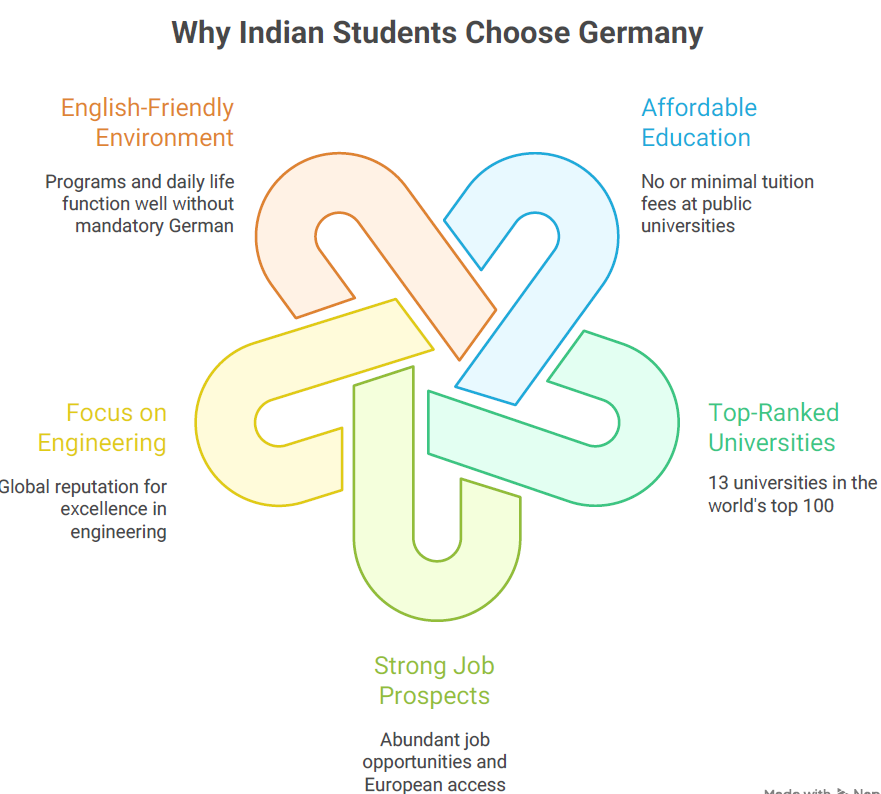
But why are more and more Indian students choosing Germany?
- Affordable education: Public universities offer no or minimal tuition fees for international students.
- Top-ranked universities: Germany has 13 universities in the top-100 ranked in the world, the most after the USA and the UK.
- Strong job prospects – Germany continues to offer jobs abundantly in a stable economy, along with access to the entire Europe through the Schengen Visa, in a time when countries like the US have started limiting work visas by charging USD 100K for the H1B.
- Strong focus on engineering – Germany has built a global reputation for excellence in engineering, automotive technology, artificial intelligence, robotics, data science, and applied research.
- English-friendly environment – Unlike the reputation, most programs in Germany and daily life function well without mandatory German proficiency.

Germany Student Visa Process for Indians
Tuition Fees
- Public universities: €0 – €1,500 per year (most charge €0)
- Private universities: €10,000 – €20,000 per year (generally avoidable)
Blocked Account
- Indian students must show proof of funds through a blocked account to cover living expenses.
- Estimated amount for 2026: €11,208 per year
Accomodation(Share)
Average monthly expenses range between €850 and €1,000, covering:
- Accommodation
- Food
- Health insurance
- Transportation
- Utilities and internet
Germany offers one of the best balances between affordability and quality of life, making it a smart long-term investment rather than just a low-cost option.
Studying Master’s (MS) in Germany: Key Points Indian Students Must Know
- Strong Profile matters– Projects, internships, research, and experience must be clearly structured and aligned with the chosen program.
- Relevant bachelor’s degree required – Course content alignment is more important than university brand or reputation.
- Marks are flexible – Many public universities accept 60–75%, evaluating the complete academic and professional profile.
- English-taught programs available – IELTS 6.0–6.5 is common; German is not mandatory for admission.
- Public universities are tuition-free. Most MS programs charge €0 tuition, with only a small semester contribution.
- Amazing post-study opportunities– 18-month job search visa, EU Blue Card, and clear permanent residency pathways.
Studying Bachelor’s/ Undergraduate (UG) in Germany: Key Points Indian Students Must Know
- 13th-year requirement – Germany follows a thirteen-year education system; Indian 12th grade alone is usually insufficient. One simply won’t be eligible after completing 12th in India.
- Studienkolleg pathway – Most students must complete a one-year foundation program before starting a bachelor’s degree.
- Alternative routes to the Studienkolleg pathway – One year of bachelor’s study in India or clearing JEE Advanced can help bypass the Studienkolleg (engineering).
- German language is critical for UG – Unlike the case with MS, Studienkolleg, and most UG programs require B1–B2 level German proficiency.
- Public universities are affordable – Bachelor’s degrees at public universities usually have no tuition fees.
- Early planning is essential
Germany Student Visa Process for Indians
The German student visa process is structured but requires careful documentation. Key steps include:
- University admission letter
- Blocked account confirmation
- Health insurance proof
- APS Certificate – The APS certificate verifies Indian academic documents for use in Germany. Apply online, submit your transcripts, pay the fee, send the required documents, and attend the verification as instructed by APS India.
- Visa appointment at the German Consulate
Accuracy and document quality are critical. Even strong applicants may face rejection if paperwork is incomplete or inconsistent, which is why proper guidance matters.
Jobs and PR Opportunities After Study
Germany offers excellent long-term settlement opportunities for international graduates. After completing studies, students can benefit from:
- An 18-month job search visa
- EU Blue Card for skilled professionals
- Permanent Residency in 21–33 months
- Citizenship eligibility after long-term stay
Graduates in IT, engineering, and science-related fields often secure stable, well-paying jobs with strong career growth, making Germany a reliable destination for long-term professional security.
Studying in Germany is not just about saving money—it is about making a strategic career decision. Success depends on choosing the right program, the right university, and the right pathway.
This is where Study Ark’s approach stands out. Instead of commission-driven advice, it focuses on:
- Data-backed university shortlisting
- Career and ROI alignment
- Honest and transparent guidance
- Affordable public university pathways
The goal is not just studying abroad, but building a sustainable global career.
Book a Free Germany Study Planning Session
Get personalised guidance to plan your education in Germany the right way, strategically, affordably, and with your long-term career in focus.